Hagi's Castle Town: Shokasonjuku, Iron and Ships, and Hagi Ware
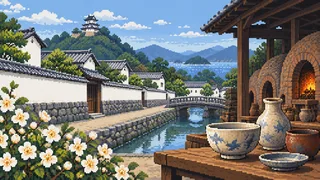
A town whose Edo-period map still works stands on a river delta facing the Sea of Japan, laid out by a lord who lost at Sekigahara.
At Sekigahara in 1600, Mori Terumoto was regarded as the commander of the western army, and his holdings of about 1.2 million koku, spread across Aki, Iwami, Izumo and other parts of the Chugoku region, were cut to just two provinces, Suo and Nagato, worth 369,000 koku. Together the two provinces are called Bocho. The site chosen to replace Hiroshima was a river delta on the Sea of Japan. In 1604 Terumoto moved into Hagi Castle, also known as Shizuki Castle, while it was still being built.
For about 260 years, until the domain office moved to Yamaguchi in 1863, Hagi was the political center of the Mori domain. In that time a domain school trained retainers, a private academy produced leaders of the Restoration, and in the last years of the shogunate the domain tried its hand at Western-style cannon and warships. The domain kiln left a pottery name that endures.
Five components of the World Heritage property "Sites of Japan's Meiji Industrial Revolution" lie inside the city, and Hagi Castle Town is made of three districts: the castle ruins, the former upper-samurai quarter and the former merchant district. Life in the town was continuous with the temples, roads and kilns around it.
A castle town drawn on a river delta: Hagi Castle and its districts
Hagi, founded by Mori Terumoto in 1604, was divided into castle, samurai and merchant districts, and right-angled lanes called kaimagari still survive.
Hagi Castle (Shizuki Castle)
Construction of Hagi Castle began in 1604 at the foot of Mt. Shizuki, which is why it is also called Shizuki Castle. It combined a lowland castle at the foot of the mountain with a mountain stronghold on the summit, and its five-story keep stood about 14.4 m tall. Every building, including the keep, was dismantled in 1874, and today only parts of the stone walls and moat remain as a national historic site. The stronghold on the 145 m summit was the last refuge in case of siege and served as a lookout over land and sea in peacetime.
Source:Hagi Castle Ruins and Shizuki ParkSite of the Castle KeepHagi Area: Hagi Castle Town
Mori Terumoto
In 1589 Terumoto began building a castle on the delta of the Ota River and named the place Hiroshima. After Sekigahara he shaved his head and retired in October 1600, passing the headship to his six-year-old son Hidenari. In November 1604 he moved into the still unfinished Hagi Castle, and from then on the Mori family was based in Hagi. Both Hiroshima and Hagi were castle towns founded on river deltas.
Kaimagari
A kaimagari is a lane between high earthen walls that turns abruptly at a right angle, so the view ahead is blocked and the road looks like a dead end. The Horiuchi district was the third compound of the castle in the feudal era, lined with government offices and the residences of Mori kin and senior retainers. The kaimagari on Oimawashi-suji, together with those in Hirako and Okodama Yokocho, keep the look of a castle-town street.
Kikuya Residence
The Kikuya family were samurai in the era of the Ouchi clan and came to Hagi as leading townspeople when Terumoto built the castle; they are said to have worked hard at building the town. As purveyors to the domain, they hosted shogunate inspectors in this house, which served as an official inn. The main house and four storehouses and sheds are Important Cultural Properties, and it is among the oldest large townhouses surviving from the early Edo period. The lot covers roughly 2,000 tsubo, and about a third of it is regularly open to visitors.
Source:Kikuya Residence
The Edoya, Iseya and Kikuya lanes
Edoya, Iseya and Kikuya were the shop names of wealthy merchants whose houses faced the road used by the lord. The names stuck to the side streets. Beyond the outer moat of the old castle, the town was divided into a grid of blocks where mid- and lower-ranking samurai lived. Edoya Yokocho has the former homes of Kido Takayoshi and Aoki Shusuke and the temple Enseiji, all along a line of black wooden fences. Enseiji is a Shingon temple with a Konpira shrine; it is remembered for two brothers who, in December 1815, made a hundred visits to pray for their mother's recovery after childbirth and died in a storm, the tale of the "Kagawa-zu Nikoshi" (two filial sons).
A town where Edo-period maps still work
The look of the castle town formed under the Mori domain survives as urban heritage, and Hagi is said to be the only place in Japan where an Edo-period map can still be used as is. A plan to treat the whole town as a museum without a roof is under way. The World Heritage site Hagi Castle Town has three parts: the castle ruins inside the middle moat, the former upper-samurai district, and the former merchant district. The castle stands for politics and administration, the merchant quarter for an economy built on commerce and small-scale industry.
Source:Overview of Hagi City: Geography and IndustryHagi Area: Hagi Castle Town
A lineage of learning: from Meirinkan to Shokasonjuku
The domain school Meirinkan opened in 1719. The name Shokasonjuku was first used by Shoin's uncle Tamaki Bunnoshin, and Shoin opened his own class in a shed at the Sugi house in 1857.
Meirinkan
Meirinkan was founded in 1719 by the fifth lord, Mori Yoshimoto, on the south side of the castle's third compound. It is said to have been the twelfth domain school established in Japan out of nearly 300. Its curriculum and ceremonies were modeled on the Yushima Seido in Edo, and the name was taken by the school's second head, Yamagata Shunan, from a passage of Mencius about making human relations clear. In 1849 the school moved to Emukai, and the old Meirin Elementary School building on the new grounds is now used as Hagi Meirin Gakusha.
Murata Seifu
Seifu was born in 1783 in the village of Misumi (now part of Nagato) as the eldest son of Murata Mitsukata. He entered Meirinkan at fifteen, became a page to the lord, and went on to serve five successive lords. The products he stressed in the Tenpo reforms were rice, wax, salt and paper. He retired to Misumi in 1845, at sixty-three, and devoted himself to training people; many, including Yoshida Shoin, visited his mountain villa to ask for his teaching.
Source:Site of Murata Seifu's VillaWalking Misumi with an Old MapMurata Seifu (Guide to Meiji Restoration Figures No. 10)
Yoshida Shoin
Shoin was born in 1830 as the second son of Sugi Yurinosuke, a Hagi samurai with a stipend of 26 koku. His birthplace is on a hill called Dangoiwa with a view over the whole town. Adopted at six into the Yoshida family of military-science instructors, he was drilled hard by his uncle Tamaki Bunnoshin and began serving at Meirinkan at ten (both ages by Japanese count). His travels for study are said to total about 13,000 km. In 1854 he and his pupil Kaneko Shigenosuke boarded Perry's ships off Shimoda to ask for passage to America; refused, he was jailed at Noyama Prison in Hagi. There he lectured prisoners on Mencius, and after he was moved to house arrest at the Sugi home, neighborhood youths began to gather for his family lectures. He was sent to Edo in the Ansei Purge and executed in 1859, at thirty by Japanese count.
Source:Shokasonjuku (World Heritage) | History of Shoin ShrineBirthplace of Yoshida ShoinYoshida Shoin (Guide to Meiji Restoration Figures No. 3)
Shokasonjuku
The private school first called Shokasonjuku was opened not by Shoin but by his uncle Tamaki Bunnoshin, in 1842. The name then passed to the school of Shoin's maternal uncle Kubo Gorozaemon, and only then to Shoin. He repaired a shed on the Sugi property into an eight-mat classroom in November 1857 and later built onto it. After his execution the school changed hands from a study group led by Kusaka Genzui to Majima Hosen and then Tamaki Bunnoshin again, and finally to Shoin's elder brother Sugi Minji, under whom it closed in 1892 after about fifty years. The surviving one-story building has two rooms, of eight and ten and a half mats, and is a national historic site.
Source:Shokasonjuku AcademyShokasonjuku (World Heritage) | History of Shoin ShrineShokasonjuku (National Database of Designated Cultural Properties)
Ages at death: Shoin, Sufu, Seifu and Minji
Yoshida Shoin was executed in the Ansei Purge in 1859, at thirty by Japanese count. Sufu Masanosuke took his own life in 1864, feeling responsible after the Kinmon Incident and the defeat at Shimonoseki let the pro-shogunate faction regain ground in the domain; he was forty-two. Murata Seifu, who led the Tenpo reforms, died in 1855 at seventy-three, and Shoin's elder brother Sugi Minji lived to eighty-three, dying in 1910. All ages follow the Japanese count, which runs about a year higher than age in full years.
Source:Yoshida Shoin (Guide to Meiji Restoration Figures No. 3)Sufu Masanosuke (Guide to Meiji Restoration Figures No. 22)Murata Seifu (Guide to Meiji Restoration Figures No. 10)Sugi Minji (Guide to Meiji Restoration Figures No. 26)
People who came out of the academy: Ito, Takasugi, Kido and Maebara
Pupils and students of Shokasonjuku and Meirinkan scattered across Bakumatsu and Meiji life, from first prime minister Ito Hirobumi to Takasugi Shinsaku of the Kiheitai and Kido Takayoshi of the Satsuma-Choshu alliance.
Ito Hirobumi
Ito Hirobumi was not born in Hagi. He was born in 1841 to a farming family in Tsukari village, Kumage District (now Hikari City). His father became the adopted son of Ito Naoemon, a low-ranking Hagi retainer, and the family moved to Hagi; their old house, a small thatched one-story building of about 29 tsubo, is a national historic site. He entered Shokasonjuku in 1857, and Shoin remarked that he seemed likely to become a fixer. In 1863 he went to Britain as one of the "Choshu Five," and in 1885 he became the first prime minister, forming four cabinets in his lifetime.
Takasugi Shinsaku and the Kiheitai
Takasugi Shinsaku attended the domain school Meirinkan while also studying at Shokasonjuku, where he stood out. After visiting Shanghai in 1862 he came home alarmed, and in 1863 he formed the Kiheitai, a military unit that recruited members regardless of social rank. It is described as Japan's first military organization open to all classes. In the Second Choshu Expedition of 1866 he commanded the domain's navy against shogunate forces, but his tuberculosis worsened; he convalesced in Shimonoseki and died in 1867 at twenty-seven years and eight months.
Source:Birthplace of Takasugi ShinsakuTakasugi Shinsaku (Guide to Meiji Restoration Figures No. 14)
Kido Takayoshi
Kido Takayoshi was born in 1833 as the eldest son of a domain physician, Wada Masakage, and was later adopted into the Katsura samurai family. Known as Katsura Kogoro, he changed his surname to Kido by domain order in 1865. He attended Meirinkan and studied military science under Shoin, and in 1866, with Sakamoto Ryoma as go-between, he sealed the alliance with Saigo Takamori and Okubo Toshimichi of Satsuma. After the Restoration he helped draft the Charter Oath and carried out the return of domain registers and the abolition of the domains. He died of illness in 1877 during the Satsuma Rebellion, aged forty-five by Japanese count.
Maebara Issei
Maebara Issei was born in 1834, the eldest son of a Hagi samurai, and entered Shokasonjuku at twenty-four by Japanese count. In the Boshin War he served as a staff officer of the imperial army in Hokuetsu; as a magistrate in Echigo he carried out flood control on the Shinano River and halved the land tax of struggling farmers. He rose to councilor and vice minister of military affairs, but disagreed with Kido Takayoshi and others and resigned in 1870 to return home. In 1876 he rose in arms with Meirinkan as his headquarters and failed. This is the Hagi Rebellion, sometimes written "Hagi no hen."
Smelting iron, casting cannon, building ships: late-Edo Hagi and the World Heritage sites
Hagi has five World Heritage components: the Oitayama Tatara Iron Works, the Hagi Reverberatory Furnace, the Ebisugahana Shipyard, Shokasonjuku and Hagi Castle Town, which together show the domain's bid to arm itself in Western style.
Oitayama Tatara Iron Works
One of the largest tatara ironworks sites in the prefecture, it operated three times, in the Horeki era, the Bunka-Bunsei era and the last years of the shogunate. Production remains such as the furnace facility called the takadono survive, and it became a national historic site in 2012. It is a World Heritage component because old documents confirm that iron made here was used for the nails of Heishin Maru, the first Western-style sailing ship built at Ebisugahana. Iron sand came from Ino village in Hamada, Shimane, by Kitamae-bune cargo ship to Nako port in Abu, and from there by horse into the hills; the finished iron is thought to have gone back along the same road by horse to Nako port, and from there by ship to Ebisugahana. The site was chosen because forests around it supplied charcoal.
Hagi Reverberatory Furnace
A reverberatory furnace reflects flame and heat off a domed ceiling onto the iron, reducing its carbon so that it becomes tough enough for cannon. Hagi sent retainers to Saga, where such a furnace was already working, to ask for casting techniques; it was refused at first and later allowed to sketch the furnace. The chimney of the furnace built in 1856 still stands and became a national historic site in 1924. The only surviving furnace built exactly to a Dutch book's plans is Nirayama in Izunokuni, Shizuoka, and Hagi's is valued as a trial furnace that records trial and error. It is believed to have been built with local masons' andesite stonework topped with brick, applying know-how from Obata-ware climbing kilns.
Source:Hagi Area: Hagi Reverberatory FurnaceHagi Area: Oitayama Tatara Iron Works Site
Ebisugahana Shipyard Site
The shogunate lifted its ban on large ships in 1853, the year Perry arrived, and the next year Hagi was ordered to build warships. A shipyard was built at Ebisugahana in 1856, and the 25 m Heishin Maru was launched that year and the 44 m Koshin Maru in 1860. Heishin Maru used techniques Russians taught at Heda in Izu, and Koshin Maru used those taught by Dutch instructors at the Nagasaki naval training school; no other yard is known to have used two different traditions at once. It is also the only late-Edo sailing-ship yard whose remains can be confirmed, and became a national historic site in 2013. Koshin Maru fired on an American merchant ship in the Kanmon Strait in 1863 and was sunk the next month in reprisal by a US warship.
Sites of Japan's Meiji Industrial Revolution
The World Heritage property "Sites of Japan's Meiji Industrial Revolution" has 23 components in eight prefectures and eleven cities, and was inscribed at the UNESCO World Heritage Committee in July 2015. Hagi holds five: the Oitayama Tatara Iron Works, the Hagi Reverberatory Furnace, the Ebisugahana Shipyard Site, Shokasonjuku and Hagi Castle Town. The castle ruins are not a separate component but one of the three districts of Hagi Castle Town. The domain school Meirinkan, Tokoji Temple and the Mori family graves are not included.
Source:Registration of "Sites of Japan's Meiji Industrial Revolution"Hagi Area: Hagi Castle Town
Hagi ware: a domain kiln and a vessel that changes with use
Hagi ware goes back to the 1592 invasion of Korea; potters Ri Shakko and his brother Ri Kei, invited by Mori Terumoto, opened a domain kiln in Matsumoto village. Its color changes with use.
Hagi ware
The story goes back to 1592 and Toyotomi Hideyoshi's invasion of Korea. Mori Terumoto invited the Korean potter Ri Shakko and, later, his younger brother Ri Kei. After Sekigahara the brothers followed Terumoto from Hiroshima to Hagi, where they opened a domain kiln in Matsumoto village, and this is regarded as the beginning of Hagi ware. Because the invasion brought potters to many regions and started the porcelains of western Japan such as Arita ware, it is sometimes called the "pottery war." Hagi ware is known in the saying "first Raku, second Hagi, third Karatsu" and counted among Japan's leading ceramics.
Source:About Hagi WareOverview of Hagi City: Geography and Industry
Hagi no nanabake
Hagi ware uses a coarse, loosely fired clay that absorbs water and holds moisture and heat well. On the surface, fine cracks called kannyu form because the clay and the glaze shrink at different rates. Water seeps into them, so the color shifts with use and the vessel gains a subdued, wabi character. This change is called "Hagi no nanabake," the seven changes.
Source:About Hagi Ware
Daido, Mishima and Kinpo clays
The main clay is Daido clay, a gravelly white clay dug from Daido in Hofu to Yotsuji in Suzenji, Yamaguchi, which gives Hagi ware its basic feel. Mishima clay, a reddish-black clay rich in iron from Mishima island off Hagi, is mixed into the body to vary its texture and color. Kinpo clay, a sandy white soil from Kinpo in Fukue, lowers the body's stickiness and raises its heat resistance. Colors are fairly limited, from flesh-tone and loquat yellow to brown and gray-blue and the white of rice-straw-ash glaze, and painted decoration is rarely used.
Source:About Hagi Ware
The notched foot ring (kiri-koudai)
Cutting a notch in the foot ring is not a technique limited to Hagi ware, and not every Hagi tea bowl has one. Because Hagi ware developed as tea ceramics, its makers pursued the shape of the foot, and the notch came to be seen as a trait. The tale of a notch cut on purpose so commoners could use domain-kiln ware may have strengthened the impression that it is a Hagi signature.
Source:About Hagi Ware
Miwa Kyusetsu and Oni-Hagi
Miwa Jusetsu was born in Hagi in 1910. He helped his elder brother, the tenth Kyusetsu (later Kyuwa), make tea utensils, took the name Miwa Kyusetsu XI in 1967, and in 1983 was recognized as a holder of the Important Intangible Cultural Property "Hagi ware," a Living National Treasure. His career as a potter spanned about eighty years. His signature style, "Oni-Hagi," has a rough texture from coarse sand in the clay, paired with a white glaze called Kyusetsu-jiro.
Source:Jusetsu Miwa exhibition (National Crafts Museum)Hagi Ware: Miwa Kyusetsu XI and His Oni-Hagi
The Mori family temples and the road out of town: Tokoji, Daishoin and Hagi Okan
Tokoji holds the odd-numbered lords from the third to the eleventh, and Daishoin the first lord and the even-numbered ones. Lanterns are lit at Obon, and the Okan road starts from the Karahi notice-board site.
Tokoji Temple
Tokoji is an Obaku Zen temple founded in 1691 by the third lord, Mori Yoshinari, with a monk born in Hagi as its founding abbot. It is regarded as one of the leading Obaku temples in Japan and, with Daishoin, is a Mori family temple. In the graveyard behind the main hall lie the third to eleventh lords, the odd-numbered ones, with their wives and kin, and over 500 stone lanterns donated by retainers line the graves. The main gate, the Sanmon gate, the bell tower and the main hall are Important Cultural Properties, and the graveyard is a national historic site.
Source:Tokoji Temple
Daishoin Temple
Daishoin belongs to the Nanzenji branch of Rinzai Zen. The second lord, Tsunahiro, rebuilt the decayed temple from 1654 to 1656 as the memorial temple of his late father, the first lord Hidenari. After a fire in 1747 the sixth lord, Munehiro, rebuilt it in 1750. The adjoining graveyard holds Hidenari and the even-numbered lords from the second to the twelfth, with their wives and kin, and over 600 stone lanterns stand before the graves. The main hall, kitchen, study, bell gate and sutra hall are Important Cultural Properties, and wisteria blooms in early May.
Source:Daishoin Temple
Hagi Mando-e
This Obon event at the Mori family temples welcomes the spirits on August 13 at Daishoin and sends them off on August 15 at Tokoji. Candles are lit in the stone lanterns of the graveyards, about 600 at Daishoin and about 500 at Tokoji. Welcoming and farewell fires are held at separate temples, a feature unique to the Mori family's memorial temples.
Source:Hagi Mando-e (Welcoming Fires)Hagi Mando-e (Farewell Fires)
Hagi Okan
Opened as the road for the Mori lords' processions to Edo, it links Hagi with Mitajiri in Hofu on a nearly straight line of about 53 km. Taking the shortest route, it cuts straight across the Chugoku Mountains, so there are many passes and steep slopes. It starts at the site of the Karahi notice board in the middle of the Hagi delta, the origin of the roads of Suo and Nagato and the base point for their milestones. A boundary stone at Itado Pass is inscribed with the provinces on either side and marks the border of Nagato and Suo. The last place from which travelers could look back at the town is remembered as Namida-matsu, the tear pine. The road is a national historic site and one of the "Hundred Historic Roads of Japan."
Source:Hagi Okan RoadHagi Okan Road (Cultural Properties of Yamaguchi)
Temples and a festival song that keep the Mori domain alive: Jonenji, Kaichoji and Ofuna-uta
The front gate of Jonenji is said to be the rear gate of Jurakudai and is a national Important Cultural Property. Kaichoji's main hall was Meirinkan's Confucian shrine, and the Ofuna-uta of Sumiyoshi Shrine is a Mori domain boat song.
Jonenji Front Gate
In the grounds of Jonenji in Shimogoken-machi stands a four-pillared gate, 3.66 m long and 3.12 m deep, with a gabled roof of heavy hongawara tiles. A ridge tablet dated 1633 (Kan'ei 10), probably from the time the gate was moved, survives. Temple tradition says it was the rear gate of Jurakudai in Kyoto, given by Toyotomi Hideyoshi to Mori Terumoto, who moved it to his own residence at Fushimi, then into Hagi Castle, and finally to Jonenji. That it came from Jurakudai cannot be confirmed in formal documents. Small but sturdily proportioned, it is a valuable survivor in Yamaguchi, where few early Edo buildings remain.
Source:Jonenji Front Gate (Cultural Properties of Yamaguchi)
Kaichoji Temple
Kaichoji, a Soto Zen temple in Kita-Furuhagi-machi, began in 1408 at Yunotsu in Iwami. When the Mori family was moved to Suo and Nagato, it came to Hagi in 1607 and took its present mountain and temple names. A fire in 1874 burned everything except the gate and a storehouse. The temple then moved the Confucian shrine of the domain school Meirinkan onto its grounds and made it the main hall, and by 1883 it had regained its old look. The shrine is a designated tangible cultural property of Hagi City.
Source:Meirinkan Confucian Shrine at Kaichoji | SightseeingSogenzan Kaichoji (Hagi Buddhist Association)
Ofuna-uta of Sumiyoshi Shrine
Ofuna-uta is a song of the lord's state barge, performed at the opening rites of Sumiyoshi Shrine's summer festival in late July and at the procession on August 3. It began as a Mori domain boat song sung to celebrate the lord boarding a ship or the launch of a new vessel. When the shrine was enshrined in 1659 (Manji 2), the domain gave a float modeled on the lord's barge, and singing on it became custom. Under the domain only men of the hereditary "Ofuna-uta kakogumi" families were allowed to perform it; from the Meiji era the festival was run by the fish wholesalers of Hamasaki. It was designated an intangible folk cultural property of Yamaguchi Prefecture in 1976.
Source:Sumiyoshi Shrine "Ofuna-uta" (Cultural Properties of Yamaguchi)
FAQ
Did Yoshida Shoin found Shokasonjuku?
No. The private school first named Shokasonjuku was opened by Shoin's uncle, Tamaki Bunnoshin, in 1842. His former home still stands as a historic site, and Shoin studied there as a boy. The name later passed to their relative Kubo Gorozaemon and then to Shoin, whose own classes began in a shed at the Sugi house only in 1857.
Why is Hagi said to be a town you can walk with an Edo-period map?
Because the street plan formed under the Mori domain survives as urban heritage. The kaimagari of the Horiuchi district are lanes bent at a right angle to block the view, a street form found in castle towns. Side streets named after the shop names of wealthy merchants, such as Kikuya, Edoya and Iseya, also line the old townsman district, so the Edo-period layout can still be walked and checked. The city presents the town as the only place in Japan where an Edo-period map can be used as is.
What is the "seven changes" of Hagi ware?
It is a name for the way a vessel's color shifts as it is used. Hagi ware is made from coarse clay that takes in water, and water seeps into the fine cracks that appear because clay and glaze shrink at different rates. The stains spread gradually, and a subdued look that a new piece lacks builds up over time.
How many World Heritage components does Hagi have, and where are they?
Five lie in the city: the iron-making Oitayama Tatara site, the Hagi Reverberatory Furnace where cannon were attempted, the Ebisugahana Shipyard that built ships, Shokasonjuku for education, and Hagi Castle Town that produced all of these. People often assume the castle alone is listed, but the castle ruins count as one of the three districts of the castle town.
Sources & references
- Hagi Castle Ruins and Shizuki Park
- Site of the Castle Keep
- Hagi Area: Hagi Castle Town
- Tenju-in Mausoleum
- Horiuchi Kaimagari (Right-Angle Lanes)
- Kikuya Residence
- Edoya Yokocho Lane
- Konpira Shrine and Enseiji Temple
- Overview of Hagi City: Geography and Industry
- Site of the Old Meirinkan
- Hagi Meirin Gakusha
- Site of Murata Seifu's Villa
- Walking Misumi with an Old Map
- Murata Seifu (Guide to Meiji Restoration Figures No. 10)
- Shokasonjuku (World Heritage) | History of Shoin Shrine
- Birthplace of Yoshida Shoin
- Yoshida Shoin (Guide to Meiji Restoration Figures No. 3)
- Shokasonjuku Academy
- Shokasonjuku (National Database of Designated Cultural Properties)
- Sufu Masanosuke (Guide to Meiji Restoration Figures No. 22)
- Sugi Minji (Guide to Meiji Restoration Figures No. 26)
- Former Residence of Ito Hirobumi
- Birthplace of Takasugi Shinsaku
- Takasugi Shinsaku (Guide to Meiji Restoration Figures No. 14)
- Former Residence of Kido Takayoshi
- Former Residence of Maebara Issei
- Hagi Area: Oitayama Tatara Iron Works Site
- Hagi Area: Hagi Reverberatory Furnace
- Hagi Area: Ebisugahana Shipyard Site
- Registration of "Sites of Japan's Meiji Industrial Revolution"
- About Hagi Ware
- Jusetsu Miwa exhibition (National Crafts Museum)
- Hagi Ware: Miwa Kyusetsu XI and His Oni-Hagi
- Tokoji Temple
- Daishoin Temple
- Hagi Mando-e (Welcoming Fires)
- Hagi Mando-e (Farewell Fires)
- Hagi Okan Road
- Hagi Okan Road (Cultural Properties of Yamaguchi)
- Jonenji Front Gate (Cultural Properties of Yamaguchi)
- Meirinkan Confucian Shrine at Kaichoji | Sightseeing
- Sogenzan Kaichoji (Hagi Buddhist Association)
- Sumiyoshi Shrine "Ofuna-uta" (Cultural Properties of Yamaguchi)