Natsumikan, Kamaboko and Hot Springs: Food and Life in Hagi-Nagato
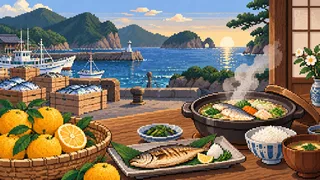
Over the earthen walls of Hagi's castle town, yellow natsumikan fruit peeks out. Before it was a specialty, it was how jobless samurai rebuilt their lives.
Hagi and Nagato share the Sea of Japan coast called Kitaura, but their food developed a little differently. Kitaura includes Nagato with its whaling culture, Shimonoseki with its pufferfish, and Hagi, where samurai culture survives and has given it a food culture of its own. Hagi grew its flavors from castle-town life, Nagato from the life of a port for fish and whales.
Why is this grown here, how is it made, and how does it reach the table? Samurai relief work, fields of volcanic ash soil and fish paste that depends on freshness each come from local circumstances.
Beyond the food come the places to buy it and the roads that lead there. Roadside stations and direct-sales markets, the way to Hagi, and the hot spring towns of Nagato Yumoto and Tawarayama are all part of everyday life here.
Natsumikan: from relief for samurai to the look of a castle town
Hagi's natsumikan spread in the early Meiji era as relief work for jobless samurai, and by 1889 its earnings had overtaken the town's finances.
Hagi's natsumikan
Natsumikan reached Hagi in the early Bunka era, around 1804, when Narasaki Jurobei of Emukai planted seeds from fruit a friend at Ohibi had given him. The original tree stands in Ohibi, Senzaki, in Nagato. Until people found late in the shogunate that it could be eaten in summer too, it was used as a substitute for yuzu. Its other name, natsu-daidai, is "summer" added to daidai, a citrus name said to be written with the characters for "generation after generation" because last year's and this year's fruit hang on the tree together. In 2006 Hagi named the natsumikan its city fruit, and its small white flowers in early summer decorate the castle town.
Source:Earthen Walls and Natsumikan (Natsu-daidai)Hagi's Natsumikan CitrusOverview of Hagi City: Emblem, Charter and City Symbols
Obata Takamasa and relief for samurai
When the domain office moved from Hagi to Yamaguchi, and then the Meiji government had samurai return their stipends, the warriors left in Hagi fell on hard times. As a remedy, Obata Takamasa, who had held senior posts in the new government and returned to Hagi, sowed natsumikan seeds in abandoned samurai houses and handed out saplings to former samurai to spread cultivation. Growing began in Hagi in 1876. By 1889 earnings from fruit and saplings had overtaken the town's finances, and natsumikan orchards spread across the whole town.
Source:Hagi's Natsumikan CitrusOverview of Hagi City: Emblem, Charter and City SymbolsYamaguchi Prefecture | Our Local Dishes
Marugoke, candied peel and marmalade
Natsumikan are harvested in early May. The marugoke, a hollowed-out fruit filled with sweet bean jelly, is a popular gift along with jelly, juice and marmalade. Candied natsumikan sweets carry the history of trees planted to save impoverished samurai. Fukuzawa Yukichi is said to have made Japan's first natsumikan marmalade, using peel sent to him in 1893, according to his thank-you letter to Matsuoka, a friend from a Hagi domain doctor's family.
Source:Natsumikan | Hagi GoChiYamaguchi Prefecture | Our Local DishesHagi's Natsumikan Citrus
Hagi Natsumikan Festival and the City Symbols
According to the city's introduction, posted in 2014, the Hagi Natsumikan Festival is held every year in mid-May at the citrus park of the former Tanaka Villa. Natsumikan growing in Hagi began in 1876 (Meiji 9) as relief for samurai who lost their posts in the Meiji Restoration, and many trees from that time still stand in the city. In November 2006 the city chose its symbols: hinoki cypress and pine as trees, camellia and hagi (bush clover) as flowers, natsumikan as the fruit, and the firefly as the creature. Genji and Heike fireflies are the well-known ones, and the same page says firefly festivals are held at several places in the city in June.
Source:Overview of Hagi City: Emblem, Charter and City Symbols
Yakinuki kamaboko and Choshu kurokashiwa: freshness behind Nagato's food
Yamaguchi's kamaboko is yakinuki, fish paste on a cedar board grilled through rather than steamed. Choshu kurokashiwa is the prefecture's first regional chicken, raised where fish meal made feed cheap.
Yakinuki
In Yamaguchi, kamaboko means yakinuki. The fish paste is spread on a cedar board and grilled all the way through over charcoal (today with far-infrared heat) instead of being steamed, hence the name, and it has become synonymous with Senzaki kamaboko. The grilling temperature is low, so unless the fish is very fresh the chewy texture that decides quality will not develop; freshness is everything, and the method is said to have grown up at Senzaki in Nagato, next to rich fishing grounds. The traditional fish are local eso (lizardfish) and guchi (croaker). In the 1950s and 60s frozen pollock paste arrived and made mass production possible.
Source:Senzaki Kamaboko
Hagi's yakinuki kamaboko
Hagi's yakinuki kamaboko uses fresh lizardfish caught in the Sea of Japan as its main ingredient. Eso has a rich flavor and is counted among the better fish for kamaboko. The paste is grilled slowly over low heat from below the board, so it never touches direct flame and does not brown. The surface turns glossy white and, as it cools and shrinks, develops fine crinkled wrinkles. Kamaboko appeared on the menu of a tea gathering in November 1640 held for Mori Hidenari, and in the Edo period it was known in other domains as a Choshu specialty.
Choshu kurokashiwa
Choshu kurokashiwa is Yamaguchi's original regional chicken, developed over thirteen years from the local natural monument Kurokashiwa fowl, and the prefecture's first jidori meat. It is produced in Nagato and Mine and was registered under the geographical indication system on March 27, 2024. It stays tender with a moderate bite and is rich in the umami compound inosinic acid and the fatigue-fighting imidazole dipeptides. The registered producers' group is the Fukawa Poultry Farming Cooperative in Nagato.
Source:GI No. 152: Choshu Kurokashiwa (Geographical Indication)
Nagato, the yakitori town
Nagato is also known as a "yakitori town" for tourism, and Choshu kurokashiwa is a specialty that has taken root there. Poultry farming thrives near Nagato because, with fishing long flourishing here, fish meal and other costly feed could be had cheaply. Chicken is part of local food culture not only at restaurants but in home cooking.
Source:GI No. 152: Choshu Kurokashiwa (Geographical Indication)
The sea's bounty: sea urchin, kensaki squid and mafugu
Sea urchin processed on islands off Hagi, kensaki squid eaten live-fresh, and mafugu, which Hagi lands in most of Yamaguchi's wild pufferfish catch, are the stars of the Kitaura sea.
Uni-meshi
Hagi's signature local dish uni-meshi is not a bowl topped with raw sea urchin but rice cooked together with the urchin. Turban shells or abalone go in as well for the smell of the shore and body. Sea urchin was costly and rarely on the table, and was served to honor important guests.
Bottled uni from Oshima
Oshima, one of the Hagi Six Islands, lies about 8 km off Hagi and is the city's busiest fishing island. Its specialty is bottled tsubu-uni, bafun and aka urchin preserved in salt and alcohol; urchin pickled in salt alone is called shio-uni. In season, sorting the urchin and making boards of it goes on at entrances and yards of houses near the harbor. The star species changes through the year: murasaki in March and April, bafun in June and July, aka in July and August.
Source:Kitaura Sea Urchin | Hagi GoChiOverview of Hagi (Geography and Industry)
Kensaki squid
Hagi's live kensaki squid makes sashimi that turns translucent white, snaps lightly between the teeth and releases a slow sweetness, which is why it is so popular. The squid loses freshness at the slightest stress and is hard to ship far, so eating it live-fresh as sashimi is a privilege of the producing area. The peak season runs from the end of the rainy season into autumn, when fishers catch each squid by hand line and keep it alive in the boat's tank until reaching port. The legs are also fried as tempura.
Hagi's mafugu
Mafugu caught at Hagi are all wild, whereas tiger pufferfish is mostly farmed. Hagi lands most of Yamaguchi's wild pufferfish, and the peak is February to April. Even at Shimonoseki's Haedomari market, regarded as Japan's greatest collection point for pufferfish, most of the mafugu landed are caught by the longline fleet of Koshigahama in Hagi.
Hagi Uomatsuri
The Hagi Uomatsuri is a regular event held at the Hagi wholesale market of the Yamaguchi Prefectural Fisheries Cooperative and at the roadside station Hagi Seamart. Besides sales of live and fresh fish, the women's section of the cooperative and fishers' wives make and sell jumbo fugu hot pot and turban-shell rice, and there are corners such as grabbing fish by hand where visitors can get close to fish.
Source:Hagi Uomatsuri
Fields, ranches and breweries: from volcanic-island watermelon to yuzukichi and GI Hagi
Aishima watermelon and Sengokudai daikon are raised by volcanic islands and basalt plateaus, and Oi onions by the Tsushima Current and sandy loam. Nagato yuzukichi is native to Tamagawa in Hagi, and sake of Hagi and Abu holds a national GI.
Aishima watermelon
Aishima, one of the Hagi Six Islands about 14 km off Hagi, was raised by volcanic activity and is Yamaguchi's biggest watermelon producer. With no mountain on the island, nothing blocks the sun, and the melons grow on terraced fields of well-drained volcanic ash soil. Only one fruit is left on each vine to give high sugar and a crisp texture. Shipping runs from late May to early August.
Sengokudai daikon
Sengokudai in the Mutsumi area is a basalt plateau and Yamaguchi's biggest radish-growing area. Radishes grown in fields at 400 to 500 m are harvested at night, when it is cold, to keep them fresh, and are shipped to Yamaguchi, Hiroshima, Fukuoka and elsewhere. The soil is soft black andosol from volcanic ash, and the name Sengokudai is said to come from a tale of harvesting a thousand koku of grain.
Oi onions
Onions from the Oi district in Hagi are known as "polished onions," each carefully peeled after harvest for a distinctive gloss, and were certified as a Yamaguchi Brand agricultural product in 2015. The Tsushima Current keeps winters relatively mild, and the well-drained sandy loam fields yield large, thick, sweet onions, mostly shipped to markets in Shimonoseki and Kitakyushu.
Source:Oi Onions | Hagi GoChi
Nagato yuzukichi
Nagato yuzukichi is a citrus related to kabosu and sudachi and is original to Yamaguchi. Nagato is the largest grower in the prefecture, and the fruit is also grown in Hagi and Shimonoseki, harvested from early August to late October. Though named for Nagato, it originated in the Tamagawa area of Hagi, where it was grown as a garden fruit; it was named in 1967 on the proposal of Dr. Tanaka Ronichiro, former head of the Shizuoka citrus experiment station. In the 1960s and 70s natsumikan dominated Tamagawa, but repeated cold damage and falling prices turned attention to yuzukichi, and plantings grew. It lacks the strong aroma and sharp acidity of yuzu or kabosu, so it does not overpower the food; the standard use is squeezing the juice into soy sauce for sashimi or over fried fish and chicken in place of lemon. It was registered as a regional collective trademark on November 2, 2007.
Kenran beef and Hagi Mutsumi pork
Kenran beef comes from crossing native Mishima cattle, untouched by Western breeds, with Dutch Holsteins. The aim was to preserve and use the Mishima breed; the first privately bred calf was born in 1979, and sales began the next year. Hagi Mutsumi pork is raised with 60 percent of its feed made from local eco-feed, food leftovers such as bread crumbs and rice bran, on sawdust bedding from nearby sawmills. The sawdust is later composted and returned to local farmland.
Source:Kenran Beef | Hagi GoChiHagi Mutsumi Pork | Hagi GoChi
Yamaguchi Abu Tomato
Yamaguchi Abu Tomato is grown to take advantage of a climate with an average annual temperature of 13 degrees Celsius, relatively cool even in summer. It is rated highly on the market for its high sugar content and low acidity, and its season runs from early July to late November. Its citric acid is said to cut greasiness, so it pairs well with meat dishes.
Ogawa peaches
The Hirayamadai district of Ogawa in Hagi is the largest peach-growing area in Yamaguchi. The peaches are grown unbagged, so they take the sun directly, gain sugar and turn red all over. The main variety is Akatsuki, and the fruit is shipped as "Ogawa Sunpeach" from mid to late July to supermarkets in the prefecture and roadside stations in Hagi.
Source:Ogawa Peaches | Hagi GoChi
Itokoni
Itokoni, found throughout the prefecture, always has dumplings of sweetened azuki beans and shiratama rice flour, but seasoning, ingredients and the amount of broth differ by area. In Hagi it is a cold soup of clear dashi from kelp seasoned with soy sauce and salt, with azuki, shiratama, shiitake and kamaboko, a clear soup said to suit a castle town.
Geographical Indication "Hagi"
On March 30, 2021, sake brewed by six breweries in Hagi and Abu was designated the national geographical indication (GI) "Hagi." It was the first alcohol GI in the Chugoku and Shikoku regions. Granite land formed by magma about 100 million years ago yields fine, soft water, and the soil and terrain of the lava plateaus of the Abu Volcano Group and the influence of the Tsushima Current suit rice growing. The taste is said to rest on the rice's full umami and a fresh acidity, and the standard requires that only rice harvested and water drawn within the designated area be used.
Source:Sake of the Hagi area designated as GI "Hagi"Production standard for GI "Hagi" (sake)
Roadside stations and getting to Hagi
Hagi has no Shinkansen station; the closest is JR Shin-Yamaguchi. The Maaru Bus circles the city for 100 yen a ride, roadside stations are stocked with local produce, and Hagi Seamart was certified as a national model station in 2015.
Hagi Seamart
It sits beside the Hagi fishing port and the prefectural fisheries cooperative's fish market, so fresh landings go straight to the shelves. Rather than a souvenir market for tourists, it aims to be a "citizens' kitchen" that local people rely on. It opened in 2001, and in February 2015 the Minister of Land, Infrastructure, Transport and Tourism named it a national "model roadside station," one of only six at the time. It also runs a project that turns cheap local fish into processed goods.
Source:Roadside Stations of Hagi
Roadside stations of Mitsu, Fukue, Katamata, Asahi and Hagi Okan
Sansan Mitsu in Mitsu, western Hagi, is known for its loquat harvest festival and a Sea of Japan set meal of fish killed that morning. Fukue's Happiness Fukue shows seasonal vegetables from about 120 farm households from early morning. Uribo no Sato Katamata in Okuabu stands at a three-way junction of National Route 315 and Prefectural Route 13, halfway between Hagi and Tsuwano, with a wild boar set meal as its specialty. Asahi, halfway between Yamaguchi and central Hagi, calls itself a "rest stop on the Hagi Okan road," and its specialty is Sasanami tofu, said to have been eaten by Ito Hirobumi. Hagi Okan, at the gateway to town, has the Shoin Memorial Hall attached.
Senzakitchen
Senzakitchen, a community hub in Senzaki, Nagato, opened its direct-sales market and restaurant building on October 7, 2017. Nagato built it as part of its growth strategy plan to gather Senzaki's foods in one place.
Getting to Hagi
There is no Shinkansen station in Hagi. Travelers by Shinkansen get off at JR Shin-Yamaguchi and continue by direct bus, the Super Hagi-go, which the city says takes about 60 minutes. By car it is about 20 minutes from the Edo interchange of the free Ogori-Hagi Road, reached through the Mine-Higashi junction of the Chugoku Expressway. By air one can use Hagi-Iwami Airport, but despite the name it is in Masuda, Shimane; its official name is Iwami Airport. The nickname was chosen by public call for names in March 2002, as befits an air gateway to western Shimane and northeastern Yamaguchi, including Hagi.
Hagi Maaru Bus
The loop bus starts and ends at Hagi City Hall and circles the city. The west route, through Horiuchi, Dobara, Yamada, Tsubaki and Kawashima, is nicknamed "Shinsaku-kun," and the east route, through Heian-furu, Tsubaki, Hashimoto, Hamasaki, Shinkawa and Ueno, is "Shoin-sensei"; a full loop takes about 80 minutes on either. The fare is 100 yen for junior high school students and older and 50 yen for elementary school children and younger, and nationwide transit IC cards such as ICOCA are accepted.
Onsen towns: Nagato Yumoto and Tawarayama
Nagato Yumoto is said to have been found by a Taineiji priest after a message from the god Sumiyoshi, and is regarded as the oldest hot spring in Yamaguchi. Tawarayama has few private baths and relies on shared outdoor baths.
Taineiji
Taineiji, at Yumoto in Nagato Yumoto Onsen, was so prosperous when founded that it was called the "Koya of the west." It is also known as the last place of the Ouchi clan, which brought Kyoto-style culture to Yamaguchi. In 1551 Ouchi Yoshitaka, betrayed by his retainer Sue Harukata, tried to escape to Kyushu by sea from Senzaki, failed, and is said to have taken his own life at Taineiji. The grounds hold Sugatami Pond, where Yoshitaka is said to have seen his face in the water and known his end, the early Edo Banjaku Bridge, one of three unusual bridges of Yamaguchi, and the graves of Yoshitaka, his eldest son and his retainers. The gravestones are hokyoin pagodas made of Hagi stone, and the graves of Yoshitaka and his followers were designated a prefectural historic site in 1967. The temple's formal name is Zuiun Banzaisan Taineigokoku Zenji.
Source:Taineiji TempleTaineiji Temple | SightseeingGraves of Ouchi Yoshitaka and His Retainers
Onto
Onto, the original bath of Nagato Yumoto Onsen, is said to be a "divinely given spring" found about 600 years ago by the third abbot of Taineiji, Teian Shuzen, after a message from the god Sumiyoshi Daimyojin, and is regarded as the oldest hot spring in Yamaguchi. In the legend the god, taught the deepest teachings of Buddhism by the abbot, made the spring flow at this spot in gratitude and rose to heaven as a dragon. The main spring is still owned by Taineiji, and Sumiyoshi Shrine stands on the hill above. Onto ended public operation in 2017 and was taken over by a company set up by young locals, reopening renewed in 2020.
Source:Feature: Taineiji Temple and OntoTaineiji Temple | SightseeingOnto and Nagato Yumori
Yunovation
To revive Nagato Yumoto Onsen, Nagato worked with Hoshino Resorts on a tourism town plan announced in 2016. Its subtitle, "Yunovation with local treasures and local strengths," is a coined word for renovating and innovating around the hot spring. The river running through the center of the town is the Otozure River. From 2017 social experiments such as the Otozure River Festa took place along it, and in 2018 the area of the Otozure and Taineiji rivers was designated the prefecture's first urban and regional revitalization use zone.
Source:Nagato Yumoto Onsen Tourism Town Development PlanOnto and Nagato Yumori
Tawarayama Onsen
Tawarayama Onsen in Nagato, protecting springs with small flows but high quality, has almost no baths inside its inns. Guests traditionally walk in yukata to the shared outdoor baths, Machi-no-yu and Hakuen-no-yu. It has five springs, and Machi-no-yu uses the undiluted, freely flowing water of its original spring. Hakuen-no-yu draws on the biggest-flowing spring, Kawa-no-yu. According to a legend of the spring's discovery, a white monkey, an incarnation of the healing Buddha, found it. The water is a simple alkaline spring of pH 9.8, and records show past lords bathed there, earning it the name of a healing town loved by lords. Sanzaru manju, sweets themed on that legend, are also a specialty.
Nagato's five onsen areas
Nagato has five hot spring areas: Yumoto, Tawarayama, Yumen, Kiwado and Yuyawan. Yumoto is described as a spring where fireflies dance over a clear stream and river frogs call, Tawarayama as a mountain healing spa, Kiwado and Yuyawan as springs facing the sea, and Yumen as a place to enjoy the water's benefits in peace.
Source:Overview of Nagato City
FAQ
How is yakinuki kamaboko different from ordinary kamaboko?
The main difference is that it is not steamed. Ordinary kamaboko is cooked with steam, but for yakinuki the paste is put on a cedar board and heated from underneath until it is grilled through. The low temperature means poor fish gives no bite. It is a method that grew up in a port where just-caught fish was at hand.
Why did natsumikan become a specialty of Hagi?
Because it was planted to help rebuild the lives of jobless samurai. After the domain office moved to Yamaguchi and Meiji reforms took away samurai stipends, Obata Takamasa handed out saplings. Earnings grew until they surpassed the town's finances, and the insides of the castle-town walls turned into orchards.
Which station do I get off at to reach Hagi by Shinkansen?
Shin-Yamaguchi. There is no Shinkansen station in Hagi. The city says it takes about 60 minutes by direct bus from Shin-Yamaguchi, or about 20 minutes from the Edo interchange of the free Ogori-Hagi Road by car. Hagi-Iwami Airport is in Masuda, Shimane, not in Hagi itself.
Why do so few inns at Tawarayama Onsen have private baths?
Because the town protects its high-quality but low-volume springs: inns have almost no private baths, and guests walk to the shared outdoor baths instead. There are two, Machi-no-yu and Hakuen-no-yu, and even overnight guests go in yukata. The water is alkaline simple spring at pH 9.8, and Machi-no-yu keeps its undiluted, freely flowing source.
Sources & references
- Earthen Walls and Natsumikan (Natsu-daidai)
- Hagi's Natsumikan Citrus
- Overview of Hagi City: Emblem, Charter and City Symbols
- Yamaguchi Prefecture | Our Local Dishes
- Natsumikan | Hagi GoChi
- Senzaki Kamaboko
- Yakinuki Kamaboko | Hagi GoChi
- GI No. 152: Choshu Kurokashiwa (Geographical Indication)
- Kitaura Sea Urchin | Hagi GoChi
- Overview of Hagi (Geography and Industry)
- Hagi's Kensaki Squid | Hagi GoChi
- Hagi's Mafugu Pufferfish | Hagi GoChi
- Hagi Uomatsuri
- Hagi Aishima Watermelon | Hagi GoChi
- Sengokudai Daikon Radish | Hagi GoChi
- Oi Onions | Hagi GoChi
- Nagato Yuzukichi | Hagi GoChi
- Nagato Yuzukichi
- Kenran Beef | Hagi GoChi
- Hagi Mutsumi Pork | Hagi GoChi
- Yamaguchi Abu Tomato | Hagi GoChi
- Ogawa Peaches | Hagi GoChi
- Sake of the Hagi area designated as GI "Hagi"
- Production standard for GI "Hagi" (sake)
- Roadside Stations of Hagi
- Overview of Hagi (History)
- Opening of Senzakitchen in the Senzaki District
- Access to Hagi City
- Hagi-Iwami Airport
- Guide to the Hagi Maaru Bus
- Getting Around the City
- Taineiji Temple
- Taineiji Temple | Sightseeing
- Graves of Ouchi Yoshitaka and His Retainers
- Feature: Taineiji Temple and Onto
- Onto and Nagato Yumori
- Nagato Yumoto Onsen Tourism Town Development Plan
- Tawarayama Onsen: A Hidden Hot Spring Town
- Overview of Nagato City