Bakan, Akamagaseki, Shimonoseki, “Kanmon”: Tracing the City’s Names
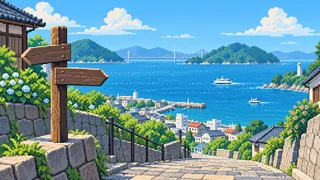
When the Sanyo Railway reached Shimonoseki in 1901, its terminus was not called Shimonoseki Station but Bakan Station. The story starts before the city’s name settled into one.
Shimonoseki carries several layers of names: administrative names, short forms, names for the strait, nicknames, informal names and dialect. Even off the map, station names, treaty names, festival titles and shopfront signs keep the names of each era alive.
Names move with the times. The city’s name changed once in the Meiji era, the strait’s name was formed by borrowing from its neighbor, Moji, and the name of a fish was swapped for a luckier one.
From Akamagaseki to Shimonoseki: how the city’s name changed
In 1889 the city was founded as Akamagaseki, the only city in Yamaguchi Prefecture at the time, and it was renamed Shimonoseki in June 1902.
Akamagaseki
When city status was introduced on 1 April 1889, Akamagaseki was the only city founded in Yamaguchi Prefecture at the time. The Japan Center for Asian Historical Records describes Shimonoseki at the time of the Sino-Japanese peace talks as “Akamagaseki City, Yamaguchi Prefecture”, and says the place was also called Akamagaseki, Akabakan and Bakan.
Source:Outline of city administration (chronology)Opening of the Sino-Japanese peace conference (20 March 1895)The First Sino-Japanese War and the peace talks
Shimonoseki
Akamagaseki City became Shimonoseki City in June 1902. The name is said to set this “lower barrier” (shimo-no-seki) on the Kanmon Strait against Kaminoseki, the “upper barrier” in eastern Yamaguchi. The city’s chronology puts the completion of the Sanyo Line in 1901 and the start of the Kanpu ferry in 1905 side by side with it.
Source:Outline of city administration (chronology)Akamagaseki (encyclopedia entry)
Where “Bakan” still lives
Bakan is a short form of Akamagaseki. It survives in the name of a railway terminus, as another name for the Treaty of Shimonoseki, and in the Shimonoseki Bakan Festival, a Busan exchange.
Bakan
The Sanyo Railway from Kobe to Bakan opened through on 27 May 1901, with its terminus at Bakan Station in Hosoe-cho. “Bakan” was an old name for Shimonoseki, and the station became Shimonoseki Station in 1902, the same year as the city’s renaming.
Source:Japan Heritage “Kanmon Nostalgic Strait”: Shimonoseki Station’s signal bellCompletion of the Sanyo Railway
The Bakan Treaty
The 1895 peace treaty of the Sino-Japanese War is formally the Treaty of Shimonoseki, but it is also called the Bakan Treaty. Bakan is an old name for Shimonoseki, and dictionaries also carry a “Bakan Treaty” entry and treat it as another name for the Treaty of Shimonoseki.
Source:Bakan Treaty, see Treaty of Shimonoseki (encyclopedia entry)
Shimonoseki Bakan Festival
Bakan is alive in modern event names too. The Shimonoseki Bakan Festival re-enacts a Korean embassy procession, and the city’s Busan exchange page records visits as chief envoy by Busan’s deputy mayor or the chair of its city council year by year from 2012 to 2018. In 2016 Busan’s mayor also took part and received the Shimonoseki International Friendship Honorary Citizen medal. The two cities are also linked by sea: the Kanpu Ferry, opened in 1970, was Japan’s first international scheduled ferry route.
What two words make “Kanmon”?
“Kanmon” joins the “kan” of Bakan, Shimonoseki’s old name, with the “mon” of Moji on the opposite shore. The strait also had other names, such as Bakan Strait and Anato Strait.
Kanmon
“Kanmon” joins the “kan” of Bakan, the former name of Shimonoseki, and the “mon” of Moji, as the Yamaguchi Tourism Federation explains. It stitches together the names of the two towns on either side of the strait and refers to both shores together.
Source:Kanmon Strait
Other names for the strait
Reference works list Bakan Strait, Shimonoseki Strait and Anato Strait as other names for the strait. “Bakan Strait” is the name from when Bakan was current as an old name for Shimonoseki.
Anato
The Kojiki and Nihon Shoki record the palace where Emperor Chuai and Empress Jingu stayed during the campaign against Kyushu’s Kumaso as the Toyura Palace in Anato. Iminomiya Shrine in Chofu is said to have begun as a shrine built at the place where they stayed, and the Nihon Shoki says a palace was raised in Anato and named the Anato Toyura Palace (as quoted in a historical place-name dictionary). Long before the name “Kanmon” appeared, this area was called Anato.
Source:Iminomiya Shrine: precinct guideChofu (encyclopedia entry)
Names that carry “Kanmon”
The strait’s name still turns up in everyday life. Kanmon Bridge, which opened in 1973, is a 1,068-meter suspension bridge that was the longest in the Orient at the time. The Kanmon tunnels and Kanmon Kisen, the operator of the Kanmon ferry, use the name too.
Fuku, the whale city, and the Naniwa of the west: nicknames and their sources
Shimonoseki calls fugu “fuku”, was once called a whale city, and in the domain era was known as “the Naniwa of the west”, a busy port.
Fuku
The Shimonoseki Fuku Federation explains that the unvoiced form is used because “fugu” sounds like a word for misfortune, while “fuku” echoes fortune and happiness. Other proposed origins include an entry for “fuku” in the Heian-period dictionary Wamyo Ruijusho and ideas linked to swelling, to the gourd (fukube), and to blowing at food on the seabed. Yamaguchi’s tourism slogan is “Welcome to Fuku no Kuni, Yamaguchi”, and its symbol is the Fuku Daruma.
Source:About the Shimonoseki Fuku FederationShimonoseki Fuku (blowfish)Yamaguchi dialect
The whale city
Regarded as the birthplace of modern whaling, Shimonoseki was called a “city of whales” from the days when it was the base for Antarctic whaling. In the postwar years the Taiyo Whales baseball club, forerunner of the Yokohama DeNA BayStars, and the women’s brass band Penguin Sisters were born there.
Nishi no Naniwa
In the domain era Shimonoseki (Akamagaseki) was called “Naniwa of the west” because of its busy shipping: goods from the northeast, Hokuriku, Kyushu and Shikoku arrived, and a thousand ships were said to come and a thousand to leave. The inn Shunpanro’s own history also describes it as “Naniwa of the west” in its days as a key Kitamae-sen port. “Naniwa” is an old poetic name for Osaka, so the town was spoken of alongside Osaka’s harbor. The Choshu domain tied that bustle to its finances in the Tenpo reforms: it set up the Koshinikata, an office for finance and warehousing aimed at passing trading ships, and turned toward earning income from outside the domain.
Source:Outline of city administration (chronology)Shunpanro: HistoryThe life of Murata Seifu (the Shimonoseki Koshinikata)
“Sekino Sentei, Kokura no Gion”
A traditional ditty runs, roughly, “Sekino Sentei, Kokura no Gion, if it doesn’t rain, money will”. It means that if it does not rain, Shimonoseki’s Senteisai and Kokura’s Gion festival bring crowds and business. Hundreds of thousands are said to have packed the festival days. It shows the two shores being named together through their festivals.
Source:Akama Shrine: Senteisai FestivalSenteisai (supplementary)
Nicknames and formal names: an island, a shrine, a hot spring, a shopping street
Ganryujima’s old name is Funashima, Kameyama Hachimangu is “the guardian shrine of the barrier”, Kawatana Onsen is the “back parlor”, and the station-front shopping street is “Little Busan”.
Funashima
Ganryujima was long called Funashima and was common land of Hikoshima village in the early Meiji era. The duel of Miyamoto Musashi and Sasaki Kojiro is placed in 1612, and the island came to be called Ganryujima after Kojiro’s sobriquet, Ganryu. The records are thin, though: Musashi’s Book of Five Rings does not mention the duel, and Niten-ki, the source of the detailed account, dates from 1755.
Source:Ganryujima Island
Kameyama Hachimangu
Located in central Shimonoseki, it is affectionately called “the guardian shrine of the barrier” and “Kameyama-sama”. In 859 a party carrying the Hachiman deity from Usa to Iwashimizu stopped for the night at the foot of this hill, then an island. An oracle told them the mountain was pure and the deity loved it, and asked them to enshrine the deity there for a while before going on, so they built a temporary shrine. That is the shrine’s origin according to the chronicle Bocho Shajiyurai.
Okuzashiki
Kawatana Onsen, in Toyoura about 25 kilometers north of Shimonoseki Port, is called the city’s “okuzashiki”, its back parlor. It is described under that name as a hot-spring town set a little apart from the urban center, and it is the birthplace of kawara soba.
Little Busan
The Green Mall Shopping Street north of JR Shimonoseki Station has grilled-meat restaurants, Korean groceries and chima-jeogori clothing shops, and the downtown Busan atmosphere has earned it the name Little Busan. It is introduced as Yamaguchi Prefecture’s Koreatown and lies about two minutes on foot from the station.
Source:Green Mall shopping street
Yamaguchi dialect: words of the whole prefecture, not only Shimonoseki
“Oidemase”, “buchi”, “-choru” and “habuteru” are Yamaguchi dialect. They are presented as words used across the whole prefecture, not only Shimonoseki.
Yamaguchi dialect
“Oidemase”, seen at stations, the airport, on signs and even on manhole covers across Yamaguchi, is a welcome that corresponds to standard “irasshai”. “Buchi” means “very”, as in “buchi atsui cha”, and is common in daily speech; some residents do not realize it is dialect. It is a relatively new word, said to derive from rough-action words like “buchi-kowasu”.
Source:Yamaguchi dialect
-choru and habuteru
“-choru” is a changed form of “-te oru” and mostly expresses a resulting state, while progress is expressed with “-yoru”. “Hana ga chitchoru” means the petals have fallen; “hana ga chiriyoru” means they are falling now. The prefecture’s PR chief “Choruru” takes its name from this ending. “Habuteru” means to sulk, as children hear in “Habuten sotcha!”.
Source:Yamaguchi dialect
Shimonoseki accent
The Shimonoseki-born actress Tanaka Kinuyo appeared in 1931 in Madame and Wife, the first all-talkie from the Shochiku studio. Her Shimonoseki accent, which had worried people, is said to have become a charm that brought acclaim. It shows a local way of speaking becoming her trademark.
Source:About Tanaka Kinuyo
FAQ
How do “Kanmon”, “the Kanmon Strait” and “Hayatomo Strait” differ?
Mostly it is a matter of scope. “Kanmon” is a regional name that joins the two towns on either shore; “the Kanmon Strait” is the waterway between Honshu and Kyushu itself; and Hayatomo Strait is the point where that waterway narrows most, between Shimonoseki and Moji. The whole channel has also been called Bakan Strait and Anato Strait.
How do you read “馬関”?
It is read “Bakan”. It is an old name for Shimonoseki shortened from Akamagaseki, and it was sometimes written “Akabakan”.
Who is the “Sentei” in Senteisai?
The emperor Antoku, who drowned at Dannoura. He is enshrined at Akama Shrine, and the festival begins on 2 May, the date the Meiji calendar reform set for the anniversary of his death (24th of the third lunar month).
Is it “fuku” or “fugu”?
“Fugu” is the common word nationwide, but Shimonoseki City and the Shimonoseki Fuku Federation both use “fuku”, and the GI name is “Shimonoseki Fuku”. Neither is wrong; in Shimonoseki the lucky-sounding word is the official name.
Sources & references
- Outline of city administration (chronology)
- Opening of the Sino-Japanese peace conference (20 March 1895)
- The First Sino-Japanese War and the peace talks
- Akamagaseki (encyclopedia entry)
- Japan Heritage “Kanmon Nostalgic Strait”: Shimonoseki Station’s signal bell
- Completion of the Sanyo Railway
- Bakan Treaty, see Treaty of Shimonoseki (encyclopedia entry)
- Exchange with Busan Metropolitan City
- Kanpu Ferry
- Kanmon Strait
- Kanmon Strait (encyclopedia entry)
- Iminomiya Shrine: precinct guide
- Chofu (encyclopedia entry)
- Kanmon Bridge
- Kanmon Kaikyo Navi: access
- About the Shimonoseki Fuku Federation
- Shimonoseki Fuku (blowfish)
- Yamaguchi dialect
- Shimonoseki, city of whales
- Yamaguchi whaling history
- Shunpanro: History
- The life of Murata Seifu (the Shimonoseki Koshinikata)
- Akama Shrine: Senteisai Festival
- Senteisai (supplementary)
- Ganryujima Island
- Kameyama Hachimangu: history
- Kameyama Hachimangu
- About Kawatana Onsen
- Kawara soba (aff magazine)
- Green Mall shopping street
- About Tanaka Kinuyo