Fuku, Whale and Kawara Soba: Shimonoseki’s Markets and Food
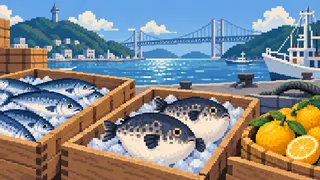
Shimonoseki’s day starts in its markets before dawn. Karato Market opens at 3 a.m., and at Haedomari Market on Hikoshima an auction where buyers squeeze fingers inside a cloth bag begins at about the same hour.
This city says “fuku” instead of “fugu”, and it names five seafood brands: fuku, sea urchin, whale, squid and monkfish. There are plenty of specialties, but why they took root here is seldom explained.
Behind the food lie a history of bans and their lifting, an era as a whaling base, and a port where people and goods gathered. Even the word “fuku” carries that layering.
Karato Market on weekends: a look at Iki-iki Bakangai
Karato Market opened in 2001. On Fridays, Saturdays, Sundays and holidays its shops set out sushi and rice bowls at the event called Iki-iki Bakangai.
Karato Market
Shimonoseki Regional Wholesale Market Karato Market opened in April 2001 and handles fresh seafood and processed goods. It opens at 3 a.m. It has two faces: a wholesale market in the early morning and a weekend destination for visitors.
Iki-iki Bakangai
Market shops lay out sushi and bowls made from the day’s catch, and visitors walk around choosing what they like, an event also called the “sushi battle”. Fugu nigiri appears among them. “Bakan” is an old name for Shimonoseki.
Source:Ikiiki Bakan-gaiKarato Market (Market Distribution Division)
Kamon Wharf
Between Karato Market and the Kaikyokan aquarium in Karato-cho, this mall gathers restaurants serving Kanmon seafood and souvenir shops, You can buy at the market, eat at the mall and look in on the aquarium next door in a single stroll.
Source:Kamon Wharf: company profile
Fuku, not fugu: the ban, the lifting, and the market
Shimonoseki calls fugu “fuku”, a lucky word. After a long ban it was lifted in 1888, and Hikoshima’s Haedomari Market became Japan’s only fuku-only producer market.
Fuku
Shimonoseki calls fugu “fuku”, a word linked to good fortune. In October 2016 “Shimonoseki Fuku” was registered as a Geographical Indication (GI), and on 9 December of that year the first shipment with the GI mark went out to supermarket seafood counters.
Source:Shimonoseki Fuku (blowfish)
The fugu ban
Toyotomi Hideyoshi is said to have banned eating fugu because soldiers gathered at Nagoya in Hizen, Kyushu (not the city in Aichi) for the Korean campaign kept dying of poisoning. The shogunate and the domains kept banning it in the Edo period, and in Choshu a death meant the family lost its stipend and its name. Even so, ordinary people seem to have eaten fugu soup.
Source:History of fugu
Shunpanro’s fugu license
In the winter of 1887 Ito Hirobumi, Japan’s first prime minister, is said to have eaten fugu at Shunpanro in Shimonoseki, and the following year, 1888, the ban in Yamaguchi Prefecture was lifted. Shunpanro is known as the first licensed fugu restaurant. Seven years later it hosted the peace conference that ended the Sino-Japanese War.
Source:History of fuguShimonoseki Fuku (blowfish)Shunpanro: origins and history
Haedomari Market
Opened in 1974 at the western end of Hikoshima, it is the only producer wholesale market in Japan centered on fuku. The “hae” in Haedomari is the old reading of the character for south wind. By volume it is said to handle more fugu than anywhere else in Japan, and a seafood processing park was built behind it.
Bag auction
The fuku auction at Haedomari starts shortly after 3 a.m. The auctioneer and the buyer clasp hands inside a cloth bag, and the way the fingers grip sets the price, so no one else can tell what it is. Haedomari is said to be the only market that uses the bag auction.
Source:About the Shimonoseki Fuku FederationHaedomari MarketHaedomari Market (Shimonoseki guidebook)
The fuku calendar
On 4 January comes the New Year’s first auction at Haedomari, on 9 February a pun-based Fuku Day, and on 29 April the Fuku Memorial Service, at which fuku are released into the strait to mark the season’s end. Longline boats set out on 1 September, and on 29 September Kameyama Hachimangu holds the Autumn Fuku Festival to pray for good catches and safe voyages. On 23 November the chamber of commerce runs the Shimonoseki Sakana Matsuri at the fishing port, where seafood from nearby waters sells at bargain prices and the line for fuku sashimi is long every year. The shrine grounds also hold a bronze fuku billed as the world’s largest.
Source:Annual fuku eventsShimonoseki Fuku (blowfish)Kameyama Hachimangu (Shimonoseki guidebook)
How to eat fugu: chrysanthemum plates, “migaki” and licenses
Fuku sashimi is sliced thin enough to show the plate’s pattern and arranged as a chrysanthemum or crane. Only licensed people may remove the toxic parts.
Kikumori
Sashimi arranged like petals on a plate is the calling card of fugu cuisine. The slices are cut so thin the pattern shows through, and there is also a crane arrangement called tsurumori.
Source:About the Shimonoseki Fuku FederationShimonoseki Fuku (blowfish)
Migaki
Migaki is fugu with the toxic parts and fins taken off, leaving only edible flesh. Fugu bought at auction goes to a buyer and is processed at a workshop into migaki or sashimi. Only someone licensed to handle fugu may do this.
Tetrodotoxin
Fugu poison is called tetrodotoxin and is said to be close to a thousand times stronger than potassium cyanide. Its strength varies by species, body part and season, and the city says the toxicity is thought to come mainly through the food chain.
Fugu ordinances
Japan’s first fugu ordinance was enacted in Osaka Prefecture in 1948. Based on the Food Sanitation Act, it aims to prevent harm from the poison, and 25 prefectures now regulate fugu by ordinance. A fugu cook holds a license from the prefectural governor, not a national qualification, and it is generally valid only within that prefecture.
Source:Fuku cuisine
When Shimonoseki was a whale city, and now
Shimonoseki is regarded as the birthplace of modern whaling and was called a whale city as a base for Antarctic whaling. It remains a mothership whaling base since commercial whaling resumed in 2019.
The whale city
Shimonoseki is regarded as the birthplace of modern whaling and served as a base for Antarctic whaling before and after the war. The city describes it as a transit point for whale-meat trade and processing know-how, where many goods and people came and went in the heyday.
Source:Shimonoseki, city of whales
Taiyo Whaling and the Whales
In 1936 Nakabe Ikujiro founded Taiyo Whaling in Shimonoseki and sailed for the Antarctic aboard Nisshin Maru, Japan’s first domestically built whaling mothership. After the war, the first ship of the 1946 restart left from the Karato quay for the Ogasawara Islands. The Taiyo Whales pro baseball club, forerunner of today’s Yokohama DeNA BayStars, is said to have been born in this whaling prosperity. Taiyo Fishery grew out of Hayashikane Shoten of Shimonoseki, and the monument at the site of its former head office marks where Taiyo Fishery kept its headquarters until 1949.
Source:Shimonoseki and whaling (journal article)Yamaguchi whaling history
The moratorium and restart
The International Whaling Commission adopted a commercial whaling moratorium in 1982, and after a whaling ship returned to Shimonoseki in 1987, commercial whaling stopped. The port then served as a base for research whaling. Japan announced its withdrawal from the whaling convention in December 2018, and on 1 July 2019 commercial whaling resumed within its exclusive economic zone, with Shimonoseki as the base for the Nisshin Maru fleet’s offshore mothership whaling.
Source:Shimonoseki, city of whalesShimonoseki and whaling (journal article)
Kangei Maru
Nisshin Maru retired in November 2023, and its successor, Kangei Maru, built at a shipyard in Shimonoseki, was completed in March 2024. Shimonoseki is described as Japan’s only mothership whaling base.
Whale skeletons at Kaikyokan
The city aquarium Kaikyokan, which opened in 2001, displays the skeleton of a blue whale about 26 meters long. Its other star is the “Tsunoshima whale”, described as a new species of baleen whale found after 90 years. In September 1998 an animal that collided with a fishing boat and died in the waters between Tsunoshima and the mainland was identified by the National Museum of Nature and Science and others as an unknown species, and in 2003 it was announced as Balaenoptera omurai. The species name honors Dr. Omura Hideo, regarded as the founder of Japanese whale science, and the Japanese name comes from where the specimen was found. A replica of the full skeleton is shown at the Tsunoshima Nature Museum.
Source:Yamaguchi whaling historyツノシマクジラ Balaenoptera omurai ~日本で発見された新種のヒゲクジラ~
The five seafood brands, and a detour to kawara soba
Shimonoseki names fuku, sea urchin, whale, squid and monkfish as its five seafood brands. Kawara soba is a noodle dish born at Kawatana Onsen.
Five seafood brands
The city places fuku, sea urchin, whale, squid and monkfish among its five great seafood brands, each with a mascot: Fukuo, Unibo, Kujita, Ikasuke and Anko. A three-brand promotion of fuku, sea urchin and whale began in fiscal 1995.
Source:Five great seafood brandsShimonoseki and whaling (journal article)
Bottled sea urchin
Shimonoseki is regarded as the home of bottled, granular sea urchin. In the early Meiji era, the story goes, the priest Hozan of Saikyoji on Mutsurejima was chatting with a British pilot when gin spilled into a small dish of sea urchin. The result was mellow and delicious, and alcohol-cured urchin was born.
Kitaura Kottoi squid
Swordtip squid, called the “king of squid”, fish well in the Sea of Japan off Hohoku from spring to autumn. The top-grade squid, either live squid landed at Hohoku or fresh squid landed at Kottoi Market on the day of the catch, is sold as Shimonoseki Kitaura Kottoi squid. It is at its best in summer, and its flavor deepens when it is full of roe in May and June.
Kawara soba
Boiled green tea soba is laid on a heated roof tile and topped with shredded egg, beef, nori, lemon and grated daikon with chili, then dipped in a soy-based sauce. Its roots are said to lie in the 1877 Satsuma Rebellion, when Satsuma soldiers reportedly grilled vegetables and meat on tiles. Kawatana Onsen, its birthplace, is about 25 kilometers north of Shimonoseki Port.
Source:Kawara soba (aff magazine)
Ganryu-yaki
This souvenir tied to the Ganryujima duel comes as a dorayaki filled with white bean paste called Ganryu-yaki, and one with dark paste called Osoizo Musashi, “You’re late, Musashi”. The story that Musashi arrived late to the duel is turned into a joke on the label.
Source:Ganryujima Island
FAQ
When is Iki-iki Bakangai held?
On Fridays, Saturdays, Sundays and holidays, and not on Monday to Thursday. Hours run from 8 a.m. on Fridays and Saturdays and 7 a.m. on Sundays and holidays, closing at 3 p.m. Dates can change, so check Karato Market’s calendar.
Can visitors tour Haedomari Market?
No. It is a trade-only market, closed to general visitors, so the bag auction is a world you cannot watch from outside. To eat fuku, head to Karato Market or a restaurant in town.
How many kinds of fugu can be eaten?
The Fuku Federation says there are about 100 species worldwide and about 55 in Japanese waters, and only 22 are approved for eating. Tiger puffer is the best known, wild catches have dropped, and farmed fish now make up more of the supply.
Can you make kawara soba at home?
The agriculture ministry’s magazine says it is enjoyed as a finishing dish at banquets and also as home cooking on a hot plate. In its home town the noodles are served on a well-heated tile.
Sources & references
- Karato Market (Market Distribution Division)
- Ikiiki Bakan-gai
- Kamon Wharf: company profile
- Shimonoseki Fuku (blowfish)
- History of fugu
- Shunpanro: origins and history
- Haedomari Market
- About the Shimonoseki Fuku Federation
- Haedomari Market (Shimonoseki guidebook)
- Annual fuku events
- Kameyama Hachimangu (Shimonoseki guidebook)
- All about fuku
- Fuku cuisine
- Shimonoseki, city of whales
- Shimonoseki and whaling (journal article)
- Yamaguchi whaling history
- ツノシマクジラ Balaenoptera omurai ~日本で発見された新種のヒゲクジラ~
- Five great seafood brands
- Bottled sea urchin of Shimonoseki
- Shimonoseki Kitaura Kottoi squid
- Kawara soba (aff magazine)
- Ganryujima Island