Aizu Lacquerware and Aizu Cotton: Crafts Traced to Gamo Ujisato
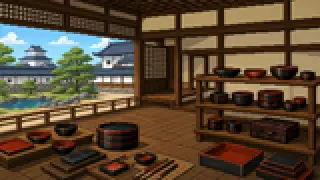
Aizu lacquerware and Aizu cotton are both said to trace back to Sengoku-era lord Gamo Ujisato's efforts to build up local industry in Aizu. This article covers the history and characteristics of each craft, lacquer and textile, along with the street where the lacquerware trade concentrated, with sources.
Aizu lacquerware is a nationally designated Traditional Craft, recognized by Japan's Minister of Economy, Trade and Industry. Aizu cotton, by contrast, carries only a Fukushima prefectural designation, not a national one, though both are said to trace back roughly 400 years to the same era in Aizu.
This article covers the techniques and history behind Aizu lacquerware, the characteristics and current production of Aizu cotton, and Nanukamachi-dori, the street once lined with lacquerware wholesalers, each with sources.
How did Aizu lacquerware develop?
Gamo Ujisato brought in artisans from Omi, and Kansei-era reforms added decorative techniques such as keshifun makie.
Gamo Ujisato and the start of Aizu lacquerware
Lacquerware took firm root as an industry in Aizu after Gamo Ujisato became lord of the domain in 1590 and promoted lacquer craft as a local industry. Ujisato brought woodworkers and lacquer artisans from his former domain of Hino, in present-day Shiga Prefecture, to pass on their techniques. Later domain lords built on this base, managing lacquer-tree forests and protecting artisans, drawing on Aizu's abundant timber resources.
Hananuri finishing and keshifun makie
Aizu lacquerware mainly uses a finish called hananuri, in which the top coat is left as applied rather than polished down, giving pieces a soft-looking surface. During the Kansei reforms of the mid-Edo period, new decorative techniques arrived, including keshifun makie, which uses coarser, duller metal powder than gold-leaf makie, and that technique is still used in Aizu lacquerware today. The craft received formal national recognition as a Traditional Craft in 1975.
Source:Fukushima, Aizu Lacquerware, Tohoku Traditional Crafts website
How did Aizu cotton spread?
It spread after an early Edo-period lord promoted cotton farming, and is known for its sturdy, indigo-striped weave.
Promotion by the domain lord, and its spread
Aizu cotton spread through domain-lord promotion of cotton farming and weaving. Hoshina Masayuki, who took over Aizu domain in 1643, encouraged samurai wives to weave cotton as a side occupation, and the resulting cloth became a household staple, used for work trousers and field clothing. Unlike Aizu lacquerware, Aizu cotton carries a Fukushima prefectural designation rather than a national one.
Source:How far back does Aizu cotton's history go? Its heritage and characteristics as a materialFukushima Prefecture, Fukushima's traditional crafts
Aizu cotton's character, and its surviving mills
Aizu cotton is a plain-woven cotton whose warp threads are stiffened with a wheat-starch paste before weaving, giving the finished cloth extra thickness while keeping it highly absorbent and warm. The original, and still most common, pattern is white stripes on an indigo ground. Around 30 mills operated during the Taisho era, but today only two remain within Aizuwakamatsu city, with one more in the neighboring town of Aizubange.
Nanukamachi-dori: where the lacquerware wholesalers stood
Nanukamachi-dori grew as a gateway on Aizu's five highways, and Meiji-era lacquerware wholesaler buildings still stand there.
A gateway on Aizu's five highways
Nanukamachi-dori carried roads toward Nikko, Echigo, and Yonezawa in the domain era, and wholesalers and inns lined the street as the castle town's western gateway. The street's name comes from a market once held there on every date ending in seven, and an Edo-period ranking of local businesses, the Wakamatsu Midori Komei Gofukutai, records numerous shops on this street, including lacquerware wholesalers and confectioners.
Lacquerware wholesalers and postwar recovery
The Boshin War dealt a heavy blow to Aizu's industries, but sake brewing, rooted in the region's abundant water, and lacquerware, which could be worked through the winter, became engines of recovery. Shiroki-ya Lacquerware, a long-established wholesaler on Nanukamachi-dori, played a major role in building Aizu lacquerware into a recognized brand, and one of its proprietors went on to serve as mayor of Aizuwakamatsu.
What other crafts and folk traditions does Aizu have?
Painted candles from the winter Aizu Candle Festival, and the spring lion dance Aizu Higan Jishi, are also Aizu traditions.
Aizu painted candles and the Aizu Painted Candle Festival
Aizu also has a tradition of Aizu e-rosoku, painted candles that developed alongside lacquerware and household Buddhist altars, decorated with flowers such as peonies and chrysanthemums. Every February, the Aizu Painted Candle Festival, held mainly at Tsuruga Castle and the Oyakuen garden, lights up the snow with countless numbers of these candles. Its nickname, Yukihotaru, meaning "snow fireflies," was chosen through a public naming contest when the festival was first held in 2000.
Source:Aizu Painted Candle Festival, Aizuwakamatsu Tourism Navi
Aizu Higan Jishi
Aizu Higan Jishi is carried on by two separate preservation societies, the Tennei Shishi Preservation Society and the Komatsu Shishi Preservation Society, who perform it during the spring equinox period at locations across the city, including the inner bailey of Tsuruga Castle, the grounds of Amida-ji temple, and several downtown streets. The performances are spread across two days, with each society covering different venues, and the tradition is designated an intangible folk cultural property by Aizuwakamatsu City.
FAQ
Which is older, Aizu lacquerware or Aizu cotton?
Both trace their roots to around Gamo Ujisato's time, near 1590, but as widely established industries, Aizu lacquerware's decorative refinement dates mainly to the Kansei era in the late eighteenth century, while Aizu cotton spread from 1643 onward under Hoshina Masayuki, meaning cotton took hold as a widespread craft earlier.
What exactly is the keshifun makie technique?
It is a makie technique using keshifun, a metal powder with coarser, duller particles than the gold powder used in showier makie work, producing a quieter, more subdued shine.
What colors and patterns does Aizu cotton typically use?
The classic combination was white stripes on indigo, but today's weavers also use red, green, yellow, and other colors in striped patterns, extending the fabric from traditional field clothing into modern clothing and accessories.
Can Aizu lacquerware be used for everyday meals?
Yes. The hananuri finish is durable enough for daily use, and Aizu lacquerware appears everywhere from the small tesarazara plates used to serve the local dish kozuyu to weddings, New Year celebrations, and ordinary family meals.
Sources & references
- Aizu Lacquerware Cooperative, official history
- Fukushima, Aizu Lacquerware, Tohoku Traditional Crafts website
- How far back does Aizu cotton's history go? Its heritage and characteristics as a material
- Fukushima Prefecture, Fukushima's traditional crafts
- Yamada Cotton Mill, company profile
- The history of Nanukamachi-dori
- Aizu Painted Candle Festival, Aizuwakamatsu Tourism Navi
- Aizu Higan Jishi, Aizu Matsuri Association