Sazaedo: The Double-Helix Wooden Hall, With Sources
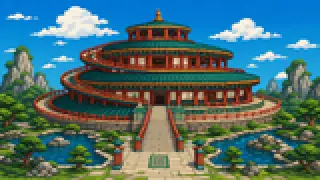
Sazaedo, formally Entsu-sansodo, on Iimoriyama, is a rare piece of wooden architecture built around a double-helix ramp where the way up and the way down never cross. Here is how the design came about, and how the building survived the upheaval of the Meiji Restoration, with sources.
Sazaedo is a hexagonal, three-story hall built in 1796 by Ikudo, the head priest of Shosoji temple, which once stood on Iimoriyama. Inside its 16.5-meter structure, a double-helix ramp lets visitors move through the hall in a single, one-way loop.
This article explains how that unusual structure actually works, and what happened to the Kannon statues once housed inside it after the anti-Buddhist campaign of the early Meiji era.
Why a spiral? The pilgrimage route Ikudo designed
A double-helix structure keeps the way up and the way down on separate paths, so visitors never have to pass one another.
Entsu-sansodo, the hall's formal nameEntsu-sansodo
Sazaedo's formal name is Entsu-sansodo. Sanso means to circle three times, and walking the hall's spiral ramp does trace out roughly three loops from the outside as it rises and descends. It was designed by Ikudo, head priest of Shosoji temple, which once stood on Iimoriyama, and built in 1796.
Source:Sazaedo (nationally designated Important Cultural Property), Aizuwakamatsu Tourism Bureau
The double-helix design
The ramp inside the hall forms a true double helix, with the upward and downward paths stacked as separate routes rather than sharing one. Visitors climb the upward ramp to the top, then follow the downward ramp straight back out, so even on a crowded day no one ever has to pass someone coming the other way. The structure is sometimes introduced as recalling the double-helix staircase at the Chateau de Chambord in France.
Source:Nippon.com, Aizu's Sazaedo: an extraordinary spiral maze
From a Kannon pilgrimage hall to a cultural property
Built for a Kannon pilgrimage, the hall lost its statues in the Meiji era and became a cultural property in 1995.
A hall for the 33-Kannon pilgrimage
When it was built, statues representing the 33 Kannon of western Japan's traditional pilgrimage route lined the spiral ramp, and visitors who completed a single loop of Sazaedo were said to have effectively completed that entire pilgrimage. For people unable to make the actual journey west, the hall offered a way to experience that pilgrimage close to home.
Source:Entsu-sansodo (Aizu's Sazaedo) VR video, Agency for Cultural Affairs
The anti-Buddhist campaign and national cultural-property status
Shosoji temple was abolished in the anti-Buddhist campaign of the early Meiji era, and the 33 Kannon statues inside the hall were removed. Spirit tablets for the nineteen Byakkotai dead were installed for a time afterward, and today the hall displays a set of plaques depicting the twenty-four paragons of filial piety instead. The building's architectural uniqueness earned it designation as a national Important Cultural Property in 1995.
Source:Aizuwakamatsu City, national cultural properties: the former Shosoji Sansodo (Sazaedo)
FAQ
Where does the name Sazaedo come from?
The building's shape resembles the spiral shell of a turban shell, called sazae in Japanese, and that resemblance gave the hall its nickname. Locals use "Sazaedo" far more often than the formal name Entsu-sansodo.
Are there other "sazaedo" halls elsewhere in Japan?
Yes. Similar spiral halls, called sazaedo, were built in various places during the Edo period, but very few survive today, and Aizu's is considered the leading surviving example that still preserves the double-helix design.
Where are the original 33 Kannon statues now?
Their current whereabouts are unknown. No clear record survives of what happened to them after they were removed amid the disruption of the anti-Buddhist campaign.
Can visitors walk to the top?
Yes. The interior is a wooden ramp, and visitors walk up to the top and then follow a separate downward passage back outside. Because it is a ramp rather than stairs, the climb feels different from an ordinary staircase.