The Byakkotai and Iimoriyama: A Boshin War Tragedy, With Sources
In the closing days of the Boshin War, about twenty sons of Aizu domain samurai, aged sixteen and seventeen, took their own lives together on Iimoriyama, apparently believing their castle had fallen. This article traces their schooling at Nisshinkan, the tragedy itself, and what became of the sole survivor, with sources.
The Byakkotai was a unit of sixteen and seventeen-year-old Aizu domain samurai sons, formed in a March 1868 reorganization of the domain's forces. Educated in both scholarship and martial arts at the domain school Nisshinkan, these boys were meant to serve as a reserve force, but the deteriorating military situation put them into actual combat.
This article covers the education these boys received at Nisshinkan, how the tragedy at Iimoriyama unfolded, what happened afterward to the sole survivor, Iinuma Sadakichi, and the two monuments later donated from overseas that still stand on Iimoriyama today.
The domain school Nisshinkan and the Byakkotai unit
Aizu samurai sons entered the domain school Nisshinkan at age ten, and a 1868 reform grouped 16 and 17-year-olds into the Byakkotai.
Nisshinkan, the Aizu domain school
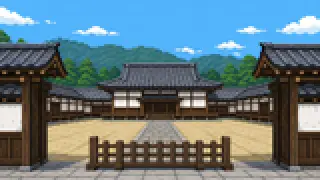
Sons of Aizu domain samurai entered the domain school Nisshinkan at age ten. Construction began in 1799 and finished in 1803, and the school was unusually well equipped for its era, with an observatory and even a swimming pool. After foundational reading instruction, the most capable students could go on to study in Edo or Nagasaki at the domain's expense.
The formation of the Byakkotai
In a March 1868 military reorganization, Aizu domain grouped its samurai by age into the Genbutai (age 50 and up), Seiryutai (36 to 49), Suzakutai (18 to 35), Byakkotai (originally 15 to 17, later raised to 16 to 17), and a junior reserve for 14 and 15-year-olds. The Suzakutai formed the main fighting force, and the Byakkotai was intended as a rear reserve.
How the tragedy at Iimoriyama unfolded
Defeated at Tonokuchihara, the boys saw black smoke over the castle town from Iimoriyama, believed it had fallen, and nineteen died.
The battle of Tonokuchihara and the retreat to Iimoriyama
On August 22, 1868, 37 members of the Byakkotai's second samurai-class squad were ordered into battle and fought government forces at Tonokuchihara, but were routed. The next day, about 20 of them, led by Shinoda Gisaburo, made their way through a side path over Takizawa pass and a tunnel at the Tonokuchi weir, reaching Iimoriyama, where they looked out toward Tsurugajo.
Source:Iimoriyama, Grave of the Nineteen Byakkotai Warriors, Aizuwakamatsu Tourism BureauThe Byakkotai, Aizuwakamatsu Tourism Bureau
The mistaken belief the castle had fallen, and the mass suicide
The black smoke the boys saw over the castle town actually came from fires in the town itself; Tsurugajo had not yet fallen. But believing the castle had already fallen, the boys chose to die rather than live on, telling themselves they would give their lives for their lord. Of the twenty, nineteen died; only Iinuma Sadakichi, who survived a self-inflicted wound to the throat, was found and revived.
Source:Iimoriyama, Grave of the Nineteen Byakkotai Warriors, Aizuwakamatsu Tourism Bureau
The survivor's later life, and monuments sent from abroad
Survivor Iinuma Sadakichi became a telecommunications engineer, and Iimoriyama later received monuments from Rome and Germany.
What became of Iinuma Sadakichi
The sole survivor, Iinuma Sadakichi, changed his name to Sadao after the Restoration, graduated from a telecommunications school in Shizuoka, and became an engineer for the Ministry of Communications. He strung telegraph lines in Korea during the First Sino-Japanese War and spent five years posted in Sapporo starting in 1905. He died in 1931 at age 76, having spent his life as a pioneer of Japan's telecommunications industry.
Monuments donated by Rome and Germany
In 1928, on the order of Mussolini, moved by the story of the Byakkotai, a monument built around an ancient Roman column was donated to Iimoriyama in the name of the citizens of Rome. In 1935, German embassy official von Etzdorf donated a separate monument in a personal capacity. Both inscriptions were chiseled away by Allied occupation forces after the war; the German monument's inscription is recorded as having been restored in 1953, and both monuments still stand on Iimoriyama today.
FAQ
How large was the Byakkotai overall, and were only some of them at Iimoriyama?
The full Byakkotai, combining its samurai-class, mixed-class, and foot-soldier squads, numbered about 343. Only a fraction of one squad, the 37-strong second samurai-class squad sent to Tonokuchihara, and of those only about 20, ended up at Iimoriyama.
Where is Tonokuchihara, the battlefield the Byakkotai fought at?
It is a plateau along the Nippashi River, which flows out of Lake Inawashiro, on the east side of the Juroku (Sixteen) Bridge. After breaking through Bonari Pass, government forces overcame Aizu's defense of that bridge and pushed on to Tonokuchihara.
Are there graves at Iimoriyama?
Yes. The Grave of the Nineteen Byakkotai Warriors includes nineteen headstones, among them soldiers who actually died elsewhere on Iimoriyama but were memorialized together with the group. A memorial service with a dedicated sword dance is held there twice a year, in spring and fall.
What was originally carved into the Rome monument?
The front bore text honoring the Byakkotai alongside a fascio, the symbol of Italy's fascist party at the time, while the back read "dedicated to the spirit of bushido." The front inscription was chiseled away by Allied occupation forces after the war.