Zushi–Hayama: Layers of history | LoreMania
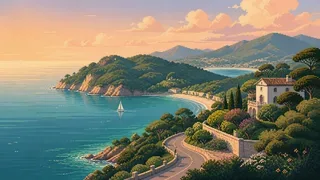
The history of Zushi and Hayama stacks several eras onto the same terrain, from burial mounds on the hills to temples and shrines tied to the Kamakura shogunate.
This page follows the historic sites of Zushi and Hayama from the oldest era onward.
Terms like "yagura" and "kiridoshi" can refer to different scopes depending on context, so each is checked against a source here.
Kofun-period to early-modern remains
The headline sites are the Nagae-Sakurayama Kofun Group, with two of Kanagawa's largest keyhole mounds, and the Ikego site group, preserved because it was requisitioned as military land.
Nagae-Sakurayama Kofun Group
Two keyhole-shaped kofun on a ridge straddling the border between Zushi's Sakurayama and Hayama's Nagae districts. Mound No. 1 is 91.3 meters long and Mound No. 2 about 88 meters, among the largest in Kanagawa Prefecture; both are estimated to date to the 4th century and form a designated national historic site.
Ikego Archaeological Site Group
A site that escaped development after being requisitioned by the Imperial Japanese Navy in 1937. Excavations ahead of US military housing construction from 1989 to 1994 uncovered more than 20,000 artifacts spanning the Paleolithic to modern eras.
Ikego Archaeological Site Museum
A free museum inside Ikego-no-Mori Nature Park. The dig site itself sits inside off-limits US military housing, but wooden artifacts and Yayoi-period farm tools recovered there are displayed here. It opened in 1999 as a gesture of Japan–US friendship.
Traces of the Kamakura shogunate and worship
Kamakura-era traces cluster here: the Nagoe Kiridoshi pass with the Mandarado yagura tombs, Wakaejima — Japan's oldest surviving harbor ruin — and the old temple Jinmuji with its cultural properties.
Nagoe Kiridoshi Pass
A mountain pass that once connected Kamakura to the Miura Peninsula, counted among the "Seven Entrances to Kamakura" in the Edo period. Designated a national historic site in 1966, its surroundings hold more than 150 rock-cut yagura tombs.
Source:City of Zushi, "Nagoe Kiridoshi, National Historic Site"
Mandarado Yagura Group
A medieval cluster of rock-cut tombs in a ravine along the Nagoe Kiridoshi pass, with more than 150 niches, one of the largest such groups in Japan. To protect it, the site isn't open year-round — only during limited spring/early-summer and autumn windows, on weekends, Mondays, and holidays.
Source:City of Zushi, "Mandarado Yagura Group, limited public opening"
Wakaejima Harbor Ruins
Japan's oldest surviving artificial harbor ruin. Tradition holds it was built in just one month in 1232 at the request of the monk Oamidabutsu, with the Kamakura shogunate's cooperation. Most of the site lies within Kamakura, but a portion falls within Zushi's Kotsubo district.
Source:City of Zushi, "Important Cultural Properties in Zushi"
Jinmuji
An old Tendai-sect temple said by tradition to have been founded in 724 by the monk Gyoki. It received the patronage of the Kamakura shogunate, including Minamoto no Yoritomo, and its grounds hold the Important Cultural Property Yakushido Hall along with several yagura tomb groups.
Source:City of Zushi, "Important Cultural Properties in Zushi"
Yakushido Hall
An Important Cultural Property hall at Jinmuji. Tradition dates its founding to 1593, but the structure standing today dates from a 1666 reconstruction, and a major 1992 restoration replaced its thatched roof with copper sheeting.
Source:City of Zushi, "Important Cultural Properties in Zushi"
Stone Gorinto
A Kamakura-period stone gorinto memorial tower at Toshoji temple. It originally stood at Keizoin temple in Hayama's Horiuchi district and was moved to its present location in 1976; its base bears an inscription dated 1303.
Source:City of Zushi, "Important Cultural Properties in Zushi"
FAQ
Are Nagoe Kiridoshi and the Mandarado Yagura Group the same place?
The Mandarado Yagura Group sits within a ravine that is part of the Nagoe Kiridoshi national historic site. The pass itself can be visited year-round, but the yagura group is shown to the public only during limited seasonal windows, to protect it.
Why did the Ikego site survive in such good condition?
The land was requisitioned by the Imperial Japanese Navy in 1937 and remained under development restrictions for decades afterward, which meant the site escaped the postwar development that reshaped much of the surrounding area.
Sources & references
- City of Zushi, "Nagae-Sakurayama Kofun Group"
- City of Zushi, "Ikego Archaeological Site Group"
- City of Zushi, "Ikego Archaeological Site Museum"
- City of Zushi, "Nagoe Kiridoshi, National Historic Site"
- City of Zushi, "Mandarado Yagura Group, limited public opening"
- City of Zushi, "Important Cultural Properties in Zushi"