Satsuma Kiriko: the Story of a Cut Glass Tradition That Vanished
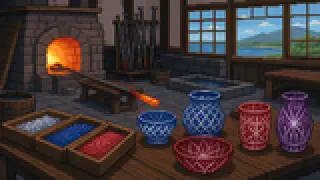
Satsuma kiriko is a style of cut glass produced by the Satsuma domain from the late Edo period into the early Meiji era. This article traces its birth, its disappearance, how it differs from Edo kiriko, and its modern revival, all with sources.
Satsuma kiriko belongs to the same broad category of cut glass as the better known Edo kiriko, but it is recognized by a distinctive technique called bokashi, which takes advantage of a thick layer of colored glass. Production lasted only a short time, and the technique itself disappeared entirely amid the turmoil of the late Edo period.
This article covers how the craft began, why it disappeared, how it differs from Edo kiriko, and the brand that revived it in the modern era.
How Satsuma kiriko began, and why it disappeared
Glassmaking begun under Shimazu Narioki was developed by Nariakira as part of the Shuseikan project, only to disappear by the early Meiji era.
The birth of Satsuma kiriko
Satsuma domain's glassmaking began under its tenth lord, Shimazu Narioki, who brought in glass artisans from Edo. The eleventh lord, Shimazu Nariakira, developed the craft further as part of the Shuseikan project, turning it into a fine art object intended for overseas trade. Nariakira himself was said to be fond of the glassware, and it is remembered as having been given as a gift to other domain lords and included among the trousseau Princess Atsu-hime brought with her to Edo.
The Satsuei War and the loss of the technique
After Nariakira's death, the Shuseikan project was scaled back, and British warships bombarding the Shuseikan facility during the Anglo-Satsuma War, known in Japanese as the Satsuei War, caused further damage. Amid the turmoil running from the late shogunate through the Meiji Restoration and into the Satsuma Rebellion, the technique behind Satsuma kiriko was lost entirely by the early Meiji era, and some of its artisans and know-how are said to have moved on to Tokyo, giving rise to Edo kiriko, and to Osaka, giving rise to Tenma kiriko. So few original pieces survive, an estimated 200 or so, that they now command high prices as antiques.
How it differs from Edo kiriko, and its modern revival
Satsuma kiriko is defined by bokashi, a color-gradient cut distinct from Edo kiriko, and has been revived since the 1980s as a Shimazu family brand.
Bokashi, the technique unique to Satsuma kiriko
Edo kiriko is cut into clear, colorless glass, while Satsuma kiriko is cut into glass overlaid with an unusually thick layer of color. Cutting boldly through that thick colored layer produces a visible gradient across the cut surface, the effect known as bokashi that defines Satsuma kiriko. The style is thought to have developed by drawing on European cut glass and Bohemian glass techniques.
Revival and the Shimazu Satsuma Kiriko brand
From the 1980s onward, glass workshops, artisans, and researchers across the region worked to reconstruct Satsuma kiriko, and in 1989 Satsuma Glass Crafts, operated directly by the Shimazu family's Shimazu Kogyo company, was certified as a Kagoshima Prefecture traditional craft. Pieces from this revival carry the Shimazu family crest, a circle with a cross inside, along with a Shimadzu stamp, distinguishing them from other Satsuma kiriko on the market. Exposure grew further after the glassware appeared in the opening sequence of the NHK historical drama Atsuhime.
FAQ
Where can Satsuma kiriko be bought today?
Satsuma Glass Crafts, run by the Shimazu family's Shimazu Kogyo, and Satsuma Vidro Craft are among the makers still producing it. A glassworks and shop stand next to Sengan-en itself, and pieces are also sold through online shops.
How valuable are surviving original pieces?
Roughly 200 authentic pieces are thought to survive. On a 2013 broadcast of the appraisal show Nandemo Kanteidan, a Satsuma kiriko bowl was authenticated and valued at 20 million yen.
Are all glassworks called Satsuma kiriko actually the same lineage?
No. Pieces produced around 1872 to 1877 by Kaibutsusha, a workshop run by Ichiki Shiro, are sometimes also called Satsuma kiriko, though some argue they should be labeled separately as Satsuma-lineage kiriko since they were not made under the domain itself. A 1980s revival line sold by an Osaka glassware wholesaler is likewise a separate lineage from the Shimazu family's own revival.
Why is Satsuma kiriko not a nationally designated traditional craft?
Because the technique was not passed down without interruption; it disappeared and had to be reconstructed later through research and revival work. National traditional-craft designation requires an unbroken line of transmission, so Satsuma kiriko instead holds Kagoshima Prefecture's own traditional-craft designation.