Kagoshima's Tram and Sakurajima Ferry: Built to Handle Volcanic Ash
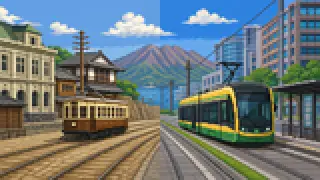
The Kagoshima City Tram runs farther south than any other tram network in Japan, and the Sakurajima Ferry connects downtown to the volcano across the bay, running from 4 a.m. to 11:30 p.m. every day. Both were shaped by one shared challenge: living with regular volcanic ash fall.
Getting around Kagoshima City means combining land transit, the tram and bus network, with sea transit, the Sakurajima Ferry. Both systems carry adaptations built specifically for a place where volcanic ash falls as a matter of course.
This article covers the tram's history and its ash-related adaptations, along with how the Sakurajima Ferry actually runs, all with sources.
The Kagoshima City Tram, Japan's southernmost
It opened as a private railway in 1912, became city-run in 1928, and today is Japan's southernmost tram, carrying about ten million riders a year.
The tram's history and its network today
The Kagoshima City Tram began operating in 1912 as a line run by a private company called Kagoshima Electric Railway, and the city took it over in 1928. Today the network spans two lines totaling 13.1 kilometers and is recognized as the southernmost tram system in Japan. It carries roughly ten million riders a year. The fare is a flat 170 yen regardless of distance, though it is set to rise to 200 yen on August 1, 2026, the first change in 12 years.
Source:Kagoshima City Transportation Bureau, "Tram Fares Are Changing" (市電の運賃が変わります)Wikipedia, the Kagoshima City Transportation Bureau (鹿児島市交通局)
Built to cope with volcanic ash
The tram fleet completed full air-conditioning in 1986, a change driven largely by the danger and discomfort of opening windows when ash was falling. Separately, the city began planting grass along stretches of track, piloting the idea in 2004 before rolling it out more broadly in 2006, and from May 27, 2010, it introduced a tram car equipped to mow that grass as it runs its normal route, a feature believed to be a world first.
Source:Wikipedia, the Kagoshima City Transportation Bureau (鹿児島市交通局)
The Sakurajima Ferry, the lifeline across the bay
Run by the Kagoshima City Shipping Bureau, this ferry connects Kagoshima Port and Sakurajima Port in about fifteen minutes, running every day of the year from 4 a.m. to 11:30 p.m.
How the Sakurajima Ferry actually runs
The Sakurajima Ferry is a scheduled route between Kagoshima Port and Sakurajima Port, operated by the Kagoshima City Shipping Bureau. Its operating hours were revised on October 1, 2025, and it now runs every day of the year, without exception, from 4 a.m. to 11:30 p.m. The crossing normally takes about fifteen minutes, occasionally stretching to around twenty depending on sea conditions. Departures come every fifteen to twenty minutes during the day, tighten to about every fifteen minutes during the busiest afternoon hours, and thin out to every thirty minutes to an hour in the early morning and evening.
FAQ
Is the Kagoshima City Tram network still expanding?
Not really. If anything, the network has been trimmed over time, including the closure of underused lines in 1985, and the current two-line, 13.1-kilometer system has stayed roughly the same size for a long stretch of years.
Why do the overhead wire poles sit in the middle of the road?
Between 1988 and 1992, the city relocated poles that once stood along the roadside to the center of the track, a project known as center-pole conversion, carried out to improve sightlines and road safety.
How is the grass on the grass-covered track maintained?
The grass itself is Victor, a damage-resistant, near-evergreen strain of Korai lawn grass (a zoysia variety). Upkeep is handled by a maintenance tram converted from a retired railcar, combining mowing and watering in a single unit.
Can cars ride the Sakurajima Ferry too?
Yes. It is a car ferry that carries passenger vehicles and buses as well as foot passengers, serving not only commuters and students living on the Sakurajima side but also tourism traffic and freight.