Kanazawa Castle: From Oyama Gobo to Ishikawa-mon Gate, With Sources
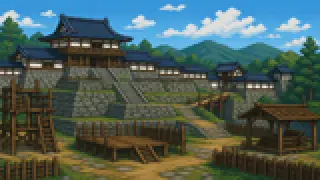
Kanazawa Castle began as Oyama Gobo, a fortified temple held by Ikko-ikki rebels, and became the Kaga Domain's seat of power once Maeda Toshiie moved in. Lightning destroyed its keep centuries ago and it was never rebuilt, but the castle's story survives today through Ishikawa-mon Gate and the reconstructed Hishi Yagura turret and Gojukken Nagaya storehouse.
Kanazawa Castle grew out of Oyama Gobo, a fortified temple that served as the stronghold of the Ikko-ikki uprising in Kaga. After Maeda Toshiie moved in in 1583, it remained the seat of the Kaga Domain's Maeda family until the Meiji Restoration. Its keep burned down in a lightning strike early in the Edo period and was never rebuilt.
This article traces the castle's transformation from Oyama Gobo, the repeated fires that struck it, its recent reconstructions, and the structure and history of the surviving Ishikawa-mon Gate, with sources.
From Oyama Gobo to Kanazawa Castle: Maeda Toshiie moves in
A fortified temple called Oyama Gobo was captured and renamed Kanazawa Castle before Maeda Toshiie moved in in 1583.
Oyama Gobo and the Ikko-ikki stronghold
Kanazawa Castle's predecessor was Oyama Gobo, also called Kanazawa Mido, a fortified temple built in 1546 as a stronghold of the Ikko-ikki uprising in Kaga province. Surrounded by moats and palisades, it served for decades as the movement's political center in the region. In 1580, Sakuma Morimasa, fighting for the Oda clan, captured it and renamed it Kanazawa Castle, making it his own base.
Maeda Toshiie's arrival and his castle-town-first approach
In 1583, following the Battle of Shizugatake, Maeda Toshiie received an expanded domain from Toyotomi Hideyoshi and moved into Kanazawa Castle. He reportedly left the castle's defenses largely untouched for around four years, holding that "battles are fought outside the castle walls," and prioritized building up the surrounding castle town and improving daily life for his subjects over fortification.
Source:Kanazawa's elegant history begins with Maeda Toshiie's arrival
Why doesn't Kanazawa Castle have a keep?
Lightning destroyed the keep in 1602, and it was never rebuilt; turrets like Hishi Yagura stand in its place today.
The 1602 lightning strike that destroyed the keep
Kanazawa Castle's keep burned down after a lightning strike in 1602. A three-story turret was built in its place, but that too was lost to fire in 1631. Tensions with the Tokugawa shogunate, wary of any structure that too visibly displayed a daimyo's power, are considered one reason the keep itself was never rebuilt afterward.
Three more fires and the rebuilding of Hishi Yagura, Gojukken Nagaya, and Kahoku-mon Gate
The castle's buildings were struck by major fires again in 1759, 1808, and 1881. Long left unrebuilt, the Hishi Yagura turret, the Gojukken Nagaya storehouse, and the turret at Hashizume-mon Gate were reconstructed using traditional techniques in 2001, and Kahoku-mon Gate, one of the castle's three main gates, followed in 2010, giving Kanazawa Castle Park much of its present-day appearance.
Source:Kanazawa Castle's Gojukken Nagaya, a symbol of "21st-century castle-building"
The design and history of the surviving Ishikawa-mon Gate
Named for facing the direction of old Ishikawa County, it was rebuilt in 1788 as a heavily defended masugata gate.
Where the name Ishikawa-mon comes from
Ishikawa-mon Gate served as the castle's rear gate, and its name is said to come from the fact that it faced the direction of old Ishikawa County, now the area around Hakusan and Nonoichi. Because a rear gate like this also doubled as an escape route in an emergency, it effectively functioned as the castle's back entrance.
The 1788 masugata gate and its defensive design
The Ishikawa-mon Gate standing today was rebuilt in 1788 after a major fire destroyed it completely in 1759. It follows a "masugata" design: an outer gate and an inner turret gate enclosed by a connecting turret and a two-story turret, forming a boxed-in space that let defenders strike at intruders from multiple sides at once.
FAQ
What stands in for the missing keep at Kanazawa Castle?
There is no keep, but the diamond-shaped Hishi Yagura turret and the Gojukken Nagaya, one of the largest storehouse buildings of any Japanese castle, serve as the site's signature structures today. Hishi Yagura's diamond floor plan is said to have been a deliberate choice, reducing blind spots so defenders could track an attacker's movements more easily.
Is Ishikawa-mon Gate the castle's main entrance?
No. Ishikawa-mon is the rear gate; the main gate is Kahoku-mon, which was lost for much of the modern era and only reconstructed from old plans in 2010.
How are Kanazawa Castle Park and Kenrokuen related?
They once sat inside the same castle grounds, with Kenrokuen built up over generations as the domain lords' garden. Today they're maintained as two separate parks split by a road, but where Kenrokuen preserves an actual Edo-period garden, most of the structures now standing in Kanazawa Castle Park — Hishi Yagura, Gojukken Nagaya, Kahoku-mon — are reconstructions completed from 2001 onward.
Are there other historic defensive sites near the castle?
Yes. During the long period of tension with the Tokugawa shogunate, the surrounding castle town gained temples like Myoryuji, popularly called the Ninja Temple, built with defensive tricks hidden behind an ordinary-looking exterior. Defensive thinking extended well beyond the castle walls into the town itself.
Sources & references
- The historical background of Kanazawa Castle
- Kanazawa's elegant history begins with Maeda Toshiie's arrival
- Questions about the buildings of Kanazawa Castle
- Kanazawa Castle's Gojukken Nagaya, a symbol of "21st-century castle-building"
- Kanazawa Castle's Ishikawa-mon Gate
- Ishikawa-mon Gate turret, Kanazawa Castle