Yokohama Chinatown: The Meaning of Its Gates and Temples
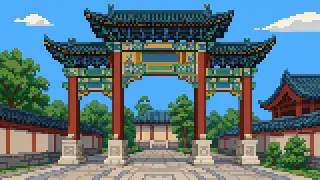
Yokohama Chinatown is one of Japan's largest Chinatowns, built by people who came to Japan after the port opened. While some 600 shops crowd its streets, gates and temples rooted in feng shui and faith are placed throughout the district. Once you know their meaning, an ordinary food crawl starts to look a little different.
Chinatown is more than just a lively place—it has a kind of blueprint: gates that guard the cardinal directions, and temples honoring the gods of commerce and seafaring.
Here we introduce the meaning of the iconic symbols you'll encounter as you walk, along with their origins.
The Gates That Adorn the Streets (Pailou)
Chinatown has ten pailou gates: the symbolic Zenrin-mon, plus four deity gates at the district's edges, each matched to a mythical beast, color, and direction.
Pailou (Gates)pairou
Chinatown has ten gates (pailou) of various sizes. Among them, the Zenrin-mon is the district's symbolic gate, its plaque bearing the wish "shin-jin zenrin"—that neighbors live in friendship with one another.
Source:横浜中華街 公式「牌楼(門)」
The Four Deity Gatesshishin-mon
Gates named after Chinese mythical beasts stand at the four edges of the district: the Choyo-mon to the east, the Suzaku-mon to the south, the Enpei-mon to the west, and the Genbu-mon to the north—each corresponding to a color and a direction.
Source:横浜中華街 公式「牌楼(門)」
Symbols of Faith
Faith centers on Kantei-byo, honoring the merchant god Guan Yu, and Maso-byo, honoring the sea goddess Mazu — fitting for a district born of the port's 1859 opening.
Yokohama Kantei-byoYokohama Kantei-byo
This temple honors Guan Yu, a hero of the Romance of the Three Kingdoms. Said to have been skilled in finance—legend even credits him with devising bookkeeping—Guan Yu is also revered as a god of commerce, and he has long drawn the deep devotion of Chinatown's people.
Source:横濱関帝廟 公式サイト
Yokohama Maso-byoYokohama Maso-byo
Opened in 2006, this temple honors Mazu, the goddess who watches over safe voyages and people's happiness. Fitting for a district built by those who crossed the sea, it is a place of prayer to the guardian deity of the sea.
Source:横濱媽祖廟 公式サイト
The Origins of Chinatown
Chinatown's history dates back to the opening of Yokohama Port in 1859. Merchants of Chinese origin settled in a corner of the foreign settlement, and as restaurants and general stores gathered, the bustle we know today took shape.
Source:横浜市観光情報「横浜中華街」
FAQ
What is the nearest station to Chinatown?
Motomachi-Chukagai Station on the Minatomirai Line is closest, with a gate visible right outside the exit. You can also walk there from JR Ishikawacho Station.
How can I see the gates and temples efficiently?
Enter through the prominent Zenrin-mon and walk while keeping the four deity gates in mind to get a sense of the district's layout. The two temples are a little apart, so dropping by between bites of a food crawl works well.
What is the difference between Kantei-byo and Maso-byo?
The deities they honor differ. One enshrines Guan Yu, the god of commerce; the other, Mazu, the goddess who protects voyages and households—so the prayers offered naturally differ too.
Can I worship at Kantei-byo and Maso-byo?
You can pray at both. It is common to offer incense as you worship, and visitors pray according to each temple's blessings—prosperous business, safe voyages, family safety and the like.