Nara City: Shrines and Memory
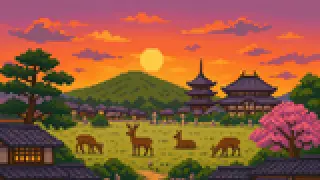
Todai-ji, where the Great Buddha was consecrated in 752; Kasuga Taisha, founded in 768; and the Heijo Palace Site, seat of the capital from 710 — Nara City holds a dense cluster of temples, shrines, and ruins that carry the memory of the eighth century. This guide sets out the specific dates and roles behind each one.
Nara City's temples and shrines are not simply old; each grew out of a distinct moment in history. Todai-ji was commissioned by Emperor Shomu, Kofuku-ji began as the clan temple of the Fujiwara family, and the Heijo Palace Site is the remains of the capital itself. Knowing how each one came to be changes how its name lands.
The entries below pair temples, shrines, and sites together and lay out their origins and dates in concrete terms.
Todai-ji Temple and Great Buddha Hall
Todai-ji is the Kegon school's head temple, commissioned by Emperor Shomu; the current Great Buddha Hall was rebuilt in 1709.
Todai-ji Temple
Todai-ji is the head temple of the Kegon school, built at the order of Emperor Shomu. The consecration ceremony for the Great Buddha took place in 752 and is said to have drawn monks from India and China, making it a strikingly international event for its time. As the central temple over Japan's network of provincial temples, it drew materials and labor from across the country.
Great Buddha Hall
The Great Buddha Hall standing today was rebuilt in 1709, making it the third version of the building after two earlier fires. Its frontage is now only about two-thirds the width of the original, yet it remains among the largest wooden structures in the world. One of its pillars has a hole cut through its base large enough for a person to crawl through, said to match the size of the Great Buddha's nostril.
Kasuga Taisha and Kofuku-ji Temple
Kasuga Taisha was founded in 768; Kofuku-ji began in 669 as the Fujiwara family's clan temple.
Kasuga Taisha
Kasuga Taisha was founded in 768 and enshrines the tutelary deity of the Fujiwara clan. Around 3,000 stone and hanging bronze lanterns line its approach and grounds, and all of them are lit twice a year — during the Setsubun festival in February and the Chugen Mantoro festival in August. The Kasugayama Primeval Forest rises directly behind the shrine, wrapping the buildings in dense woodland.
Kofuku-ji Temple
Kofuku-ji traces its origin to a temple built in 669 to pray for Fujiwara no Kamatari's recovery from illness, and it was relocated to its current site when the capital moved to Heijo-kyo in 710. As the Fujiwara clan's temple, it held enormous influence, and its treasures include the National Treasure Ashura statue among many others. The three-faced, six-armed Ashura figure is especially known for its quiet, contemplative expression.
Five-story Pagoda and Gango-ji Temple
The Five-story Pagoda was rebuilt in 1426; Gango-ji's roof still carries roof tiles dating to the Asuka period.
Five-story Pagoda
Kofuku-ji's Five-story Pagoda was first built in 730 but burned down repeatedly, and the current structure dates to a 1426 rebuilding. At 50.1 meters tall, it ranks as the second-tallest five-story pagoda in Japan, after the one at To-ji in Kyoto. The pagoda's reflection on the surface of Sarusawa Pond is considered one of Nara's defining views.
Gango-ji Temple
Gango-ji was established in 718 when Hoko-ji, Japan's oldest temple, was relocated from Asuka to its current site in Nara. Part of the roof over its main Gokuraku-bo hall and the adjoining meditation hall still uses roof tiles brought over during that move, dating back to the Asuka period; the mix of tile colors and shapes from different eras gives the roof a distinctly mottled appearance.
Heijo Palace Site and Suzakumon Plaza
The Heijo Palace Site was the seat of the capital from 710 to 784; Suzakumon Plaza is built around Suzakumon, a gate restored in 1998.
Heijo Palace Site
The Heijo Palace Site marks the center of Heijo-kyo, the capital of Japan from 710 to 784. It is a UNESCO World Heritage site, and its Daigokuden Hall, used for ceremonies and state affairs, was reconstructed in 2010. Much of the site consists of open ground where only foundation stones or the outlines of platforms remain, and ongoing excavation continues to reveal more of what once stood there.
Suzakumon Plaza
Suzakumon Plaza is a visitor facility built on the southern side of the Heijo Palace Site, centered on Suzakumon, the palace's main gate, with a guidance center and places to eat nearby. Suzakumon itself was reconstructed in 1998, and standing close to it, the thickness of its pillars and the detail of its coloring give a real sense of the palace's original scale.
FAQ
What is a useful route for this theme in Nara City?
Start at Todai-ji's Great Buddha Hall, move on to Kasuga Taisha, then continue through Kofuku-ji and its Five-story Pagoda to Gango-ji — a route that follows the eighth-century temples roughly in the order they arose.
Should these names be memorized in isolation?
Keep one founding or rebuilding date in mind for each site, and it becomes much easier to tell similarly named buildings apart.
Where should visitors verify the details?
Each entry points to a first-party source from a municipality, shrine, temple, transport operator, or tourism body. Check the official page again for dates and operating information before visiting.