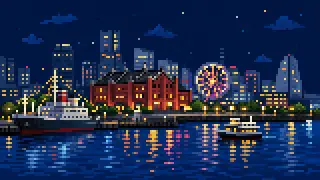
Yokohama Local Quiz Practice: Questions and Explanations
40QEasyIntermediateAdvanced
Review questions from the real quiz with answers, explanations and sources. Think it through first, then reveal the correct answer.
This is a selection from the question pool — the real quiz also draws questions you won’t find here.
Last updated: 2026-09-14
EasyTier 1 — 10 questions
Start with ten questions that make up Yokohama's calling card: the port's opening at the end of the Edo period, Japan's first railway, the original role of the Red Brick Warehouses. These are page-one topics from any guidebook, each asked with one extra step of precision. Get all ten and you could lead the stroll through Yamashita Park yourself. Open each answer to check the why, sources included.
Q1.What is the landmark skyscraper that towers over Yokohama's Minato Mirai district?
Tokyo Skytree
Yokohama Landmark Tower
Abeno Harukas
Yokohama Marine Tower
Reveal the correct answer
Correct answerYokohama Landmark Tower
Completed in 1993, the 70-story Yokohama Landmark Tower is beloved as a symbol of the city's skyline. The 69th-floor Sky Garden observatory looks out over the harbor, while the preserved stone dry dock at its base recalls the shipyard that once occupied the site.
Q2.Nationally famous as a Yokohama specialty, what is the star of Kiyoken's boxed lunch?
Eel
Crab
Beef tongue
Shumai (steamed dumplings)
Reveal the correct answer
Correct answerShumai (steamed dumplings)
Kiyoken opened as a shop inside Yokohama Station in 1908 and launched its signature shumai in 1928, adding dried scallop to the pork filling so the dumplings taste good even cold. The Shumai Bento boxed lunch, introduced in 1954, remains Yokohama's iconic ekiben.
Q3.Among Japan's three great Chinatowns, which is considered the largest?
Yokohama Chinatown
Kobe Nankinmachi
Nagasaki Shinchi Chinatown
Ikebukuro Chinatown
Reveal the correct answer
Correct answerYokohama Chinatown
Yokohama Chinatown grew from the Chinese community that settled after the port opened in 1859. With some 600 shops and restaurants, it is known as one of the largest Chinatowns in Japan, its streets framed by ornate gates and the Kanteibyo and Masobyo temples.
Q4.Nicknamed 'Yokohama's Ameyoko,' what is this bargain shopping street in Hodogaya Ward?
Motomachi Shopping Street
Kofukuji-Matsubara Shopping Street
Rokkakubashi Shopping Street
Bashamichi Shopping Street
Reveal the correct answer
Correct answerKofukuji-Matsubara Shopping Street
Kofukuji-Matsubara Shopping Street in Hodogaya Ward is lined with roughly 100 independent grocery and clothing shops across an area about 200 meters square. Nicknamed 'Yokohama's Ameyoko,' it is counted among the 'three great shopping streets of Yokohama' alongside Yokohamabashi-dori and Rokkakubashi. Its main street becomes a pedestrian-only zone every day from noon to 6 p.m., drawing crowds of shoppers.
Q5.What is the famous bridge spanning Yokohama Port that connects Honmoku and Daikoku Pier?
Akashi Kaikyo Bridge
Rainbow Bridge
Seto Ohashi Bridge
Yokohama Bay Bridge
Reveal the correct answer
Correct answerYokohama Bay Bridge
The Yokohama Bay Bridge, opened in 1989, is a cable-stayed bridge about 860 meters long linking Honmoku and the Daikoku Pier. Its white towers rise at the harbor entrance, and its nighttime illumination has become a fixture of Yokohama's port scenery.
Q6.Opened in 2019, which Sotetsu rail service lets you travel from Yokohama directly to JR Shinjuku without transferring?
Sotetsu-JR Through Service
Minatomirai Line
Yokohama Municipal Subway Green Line
Keikyu Airport Line
Reveal the correct answer
Correct answerSotetsu-JR Through Service
The Sotetsu-JR through service began on November 30, 2019, linking Nishiya and Hazawa-Yokohama-Kokudai stations with JR lines (the Yamanote Line, Shonan-Shinjuku Line, etc.) for direct, transfer-free travel between Yokohama and JR Shinjuku. Many residents now use it for daily commuting and schooling, and it symbolizes a major recent shift in the city's rail network.
Q7.Said to have originated in Yokohama, what is the style of ramen characterized by tonkotsu-shoyu (pork bone and soy sauce) broth and thick noodles?
Jiro style
Tsukemen (dipping noodles)
Tantanmen
Iekei ramen
Reveal the correct answer
Correct answerIekei ramen
Iekei ramen originated in Yokohama with Yoshimuraya, founded in 1974. It pairs a rich pork-bone and soy sauce broth with thick straight noodles, typically topped with spinach, roast pork, and nori. The name comes from the many shops whose names end in '-ya,' meaning house.
Q8.What is the mascot character of the 'Yokohama Port Opening Festival,' held around Port Opening Memorial Day on June 2 each year?
Hammer
Hama-taro
Yokopyon
Bay-kun
Reveal the correct answer
Correct answerHammer
The Yokohama Port Opening Festival is held around the port's opening memorial day (June 2), centered on Rinko Park in Minato Mirai, with fireworks among its highlights, heralding the arrival of summer in Yokohama. Its mascot is 'Hammer,' a sunglasses-wearing seagull introduced in 1995; a companion character named 'Yoko' joined in 2022.
Q9.Yokohama has the largest population of any municipality in Japan.
True
False
Reveal the correct answer
Correct answerTrue
Yokohama has the largest population of any municipality in Japan, spread across roughly 1.8 million households. Its daytime population is smaller than its nighttime one, a sign that the great port city is also a commuter city for Tokyo.
Q10.Yokohama Port was opened for foreign trade in 1859, at the end of the Edo period.
True
False
Reveal the correct answer
Correct answerTrue
Yokohama opened to foreign trade in 1859 under Japan's treaties with the Western powers. The shogunate, avoiding the Tokaido post town of Kanagawa, built the port and foreign settlement at the small fishing village of Yokohama, which grew rapidly into Japan's gateway for Western culture.
From here, fifteen questions that even lifelong hamakko hesitate over: the literary giant behind the city anthem, the nickname of the soy-sauce bottle in a Shumai Bento, the playing-card names given to harborside towers. Where history is involved, anchor yourself to the port's opening and count forward; for geography, spread a mental map around the harbor. If you have walked these streets, your feet already know several answers.
Q11.How many administrative wards does Yokohama have?
14 wards
16 wards
18 wards
23 wards
Reveal the correct answer
Correct answer18 wards
Yokohama comprises 18 wards, the second-most of any government-designated city in Japan after Osaka (24 wards). When the ward system began in 1927 there were only five; repeated subdivisions followed the city's growth, and the lineup was completed in 1994 with the creation of Aoba and Tsuzuki wards.
Q12.On what month and day is Yokohama's Port Opening Anniversary?
June 2
May 1
July 7
November 3
Reveal the correct answer
Correct answerJune 2
Yokohama's port opened in 1859 on a date that fell on the second day of the sixth month in the old lunar calendar, so June 2 is observed as Port Opening Anniversary Day, with festivities held around the harbor each year in early June.
Q13.Which Sotetsu line, fully opened in 2023, began through-service with Tokyu lines (the Toyoko and Meguro lines) via Shin-Yokohama?
Sotetsu Shin-Yokohama Line
Minatomirai Line
Yokohama Municipal Subway Green Line
Keikyu Main Line
Reveal the correct answer
Correct answerSotetsu Shin-Yokohama Line
The Sotetsu Shin-Yokohama Line first opened between Nishiya and Hazawa-Yokohama-Kokudai in 2019, then completed its full route to Shin-Yokohama on March 18, 2023. From Shin-Yokohama it now runs through-service with the Tokyu Toyoko and Meguro lines via the Tokyu Shin-Yokohama Line, giving western Yokohama a direct, transfer-free connection to Shibuya and Meguro.
Q14.Yamashita Park was built mainly by filling in rubble (debris) from which event?
The Great Yokohama Air Raid
Typhoon Vera (Ise Bay Typhoon)
The Great Kanto Earthquake
An eruption of Mt. Fuji
Reveal the correct answer
Correct answerThe Great Kanto Earthquake
Yamashita Park was created by filling the waterfront with rubble from the Great Kanto Earthquake of 1923 and opened in 1930. A symbol of the city's recovery, it is loved for its rose gardens and its sweeping views across Yokohama Harbor.
Q15.Said to be the birthplace of 'Napolitan' and 'doria,' what is this hotel in front of Yamashita Park?
Imperial Hotel
Hilltop Hotel
Hotel Okura
Hotel New Grand
Reveal the correct answer
Correct answerHotel New Grand
The Hotel New Grand opened opposite Yamashita Park in 1927 as part of Yokohama's recovery from the Great Kanto Earthquake. Its first head chef, the Swiss-born Saly Weil, created rice doria here, and the hotel is also credited as the birthplace of Napolitan spaghetti and pudding a la mode.
Q16.What is the rare animal, a relative of the giraffe, regarded as the symbol of Yokohama Zoo?
Koala
Red panda
Capybara
Okapi
Reveal the correct answer
Correct answerOkapi
The okapi, a forest-dwelling relative of the giraffe, is counted among the world's three rarest animals alongside the giant panda and the pygmy hippopotamus. The park introduced the okapi to Japan when it opened in 1999 and has kept and bred the species as its symbol ever since.
Q17.In Spanish and other languages, what does the 'Marinos' in Yokohama F. Marinos mean?
Port
Sea
Sailors
Waves
Reveal the correct answer
Correct answerSailors
'Marinos' is Spanish for sailors, a name that casts the club as seafarers setting out from the international port of Yokohama. Formerly the Nissan Motor company team, Yokohama F. Marinos is also one of the Original Ten clubs that launched the J.League in 1993.
Q18.What is the nickname of the gourd-shaped soy sauce container included in Kiyoken's Shumai Bento?
Sho-chan
Marin-chan
Shu-chan
Hyo-chan
Reveal the correct answer
Correct answerHyo-chan
The soy sauce container 'Hyo-chan' debuted in 1955, when cartoonist Ryuichi Yokoyama gave the little gourd-shaped bottle 48 different faces. The designs have changed with the times, and the bottles tucked into Shumai Bento boxes have become collectors' items in their own right.
Q19.Which cold dessert is said to have originated in Yokohama's Bashamichi (Carriage Road) district?
Shaved ice (kakigori)
Yokan (sweet bean jelly)
Ice cream
Pudding
Reveal the correct answer
Correct answerIce cream
In 1869, Machida Fusazo opened an ice shop on Bashamichi and began selling 'aisukurin,' regarded as Japan's first ice cream. A luxury at first, it gradually caught on as a taste of the age of Westernization, and Bashamichi is celebrated as the birthplace of ice cream in Japan.
Q20.Which of these is an occasion when the Yokohama City Song is still sung today?
The Port Opening Memorial Day (June 2) ceremony
Coming-of-Age Day
A shopping district's raffle event
New Year's shrine visits
Reveal the correct answer
Correct answerThe Port Opening Memorial Day (June 2) ceremony
The Yokohama City Song is still performed and sung today at the Port Opening Memorial Day (June 2) ceremony, as well as at graduation ceremonies and citywide events. It continues to be taught at public elementary schools alongside school songs -- a civic anthem sung across generations since its 1909 premiere.
Q21.What is the nickname of the rooftop plaza at Yokohama's Osanbashi passenger pier?
The Platypus (Kamonohashi)
Harbor Hill (Minato no Oka)
The Whale's Belly (Kujira no Onaka)
The Whale's Back (Kujira no Senaka)
Reveal the correct answer
Correct answerThe Whale's Back (Kujira no Senaka)
The rooftop plaza of the Osanbashi passenger terminal is nicknamed 'Kujira no Senaka,' the Whale's Back, for the gentle rise and fall of its wooden deck. From its boardwalk and lawns, the view sweeps from the Minato Mirai skyline all the way to the Bay Bridge.
Q22.Which park in the Minato Mirai 21 district serves as the main venue for the Yokohama Port Opening Festival?
Yamashita Park
Rinko Park
Harbor View Park
Zou-no-Hana Park
Reveal the correct answer
Correct answerRinko Park
The Yokohama Port Opening Festival is centered each year on Rinko Park in the Minato Mirai 21 district, with events spilling into the surrounding area. Held around Port Opening Memorial Day (June 2) and featuring fireworks, it is the event that heralds the arrival of summer in Yokohama.
Q23.Among Yokohama's Three Towers, what is the nickname given to the Kanagawa Prefectural Government Main Building?
Queen
King
Jack
Ace
Reveal the correct answer
Correct answerKing
The Kanagawa Prefectural Government Main Building, completed in 1928, is 'King' of Yokohama's Three Towers. The nickname is said to come from foreign sailors likening the towers to playing cards, and its central turret -- said to resemble a crown -- is why it became known as 'King.' Visiting all three towers is said to grant wishes.
Q24.What is the urban circulating ropeway that opened in front of Sakuragicho in 2021, the first of its kind in Japan?
Yokohama Seaside Line
Yume Mirai Line
YOKOHAMA AIR CABIN
Minato Ropeway
Reveal the correct answer
Correct answerYOKOHAMA AIR CABIN
YOKOHAMA AIR CABIN, opened in 2021, is Japan's first permanent urban circulating ropeway. Linking Sakuragicho Station with Unga Park in the Shinko district, roughly 630 meters in about five minutes, its gondolas offer an aerial stroll over Minato Mirai and the harbor.
Q25.Select all the underground shopping malls or basement shopping floors at Yokohama Station.
Yokohama PORTA (east exit)
Sotetsu Joinus underground mall (west exit)
Namba Walk (Osaka)
Yaesu Underground Mall (Tokyo)
Reveal the correct answer
Correct answerYokohama PORTA (east exit) / Sotetsu Joinus underground mall (west exit)
Yokohama PORTA at the station's east exit and the underground floors of Sotetsu Joinus (formerly the Diamond Underground Mall) at the west exit are both shopping areas directly connected to Yokohama Station. Namba Walk is in Osaka and the Yaesu Underground Mall is in Tokyo -- separate facilities unrelated to Yokohama Station.
Source:横浜新都市センター
AdvancedTier 3 — 15 questions
The final fifteen stand between you and any claim to Yokohama expertise: how Hara Sankei made his fortune, the Western houses on the Yamate bluff, the city's parade of Japan-firsts from beer to horse racing. Multiple-select and ordering questions are mixed in, so scattered facts must be reassembled along the timeline that begins at the port's opening. Clear this tier, and the top titles await in the real quiz.
Q26.Roughly in which decade were the Yokohama Red Brick Warehouses (No. 1 and No. 2) built?
1860s
1890s
1910s
1930s
Reveal the correct answer
Correct answer1910s
Warehouse No. 2 was completed in 1911 and No. 1 in 1913, built as bonded warehouses for the new Shinko Pier to designs by Finance Ministry architect Tsumaki Yorinaka. State-of-the-art fireproofing and earthquake resistance went into them, yet half of No. 1 was lost in the 1923 earthquake.
Q27.What was the main business of Hara Sankei, the industrialist who built Sankeien Garden, that made his fortune?
Sake brewing
Shipping
Raw silk trade
Railways
Reveal the correct answer
Correct answerRaw silk trade
Hara Sankei, born Tomitaro, was a Gifu native who married into the Hara merchant family of Yokohama and made his fortune in the raw-silk trade and silk reeling. He moved historic buildings to Honmoku to create Sankeien, opening its outer garden free to the public in 1906, and was a noted patron of young artists.
Q28.Among the Yamate Western-style houses, which is the largest of the prewar era and built in the Spanish style?
Ehrismann Residence
Diplomat's House
Bluff No. 18
Berrick Hall
Reveal the correct answer
Correct answerBerrick Hall
Berrick Hall was built in 1930 as the residence of British trader B. R. Berrick, designed in the Spanish style by architect J. H. Morgan. The largest surviving prewar foreign residence on the Yamate bluff, it is prized for details such as its quatrefoil windows.
Q29.On the Tokaido's fifty-three stations, which was the third post station counting from Nihonbashi?
Shinagawa-juku
Kanagawa-juku
Kawasaki-juku
Hodogaya-juku
Reveal the correct answer
Correct answerKanagawa-juku
Kanagawa-juku, in today's Kanagawa Ward, was the third post station from Nihonbashi, after Shinagawa and Kawasaki. A seaside station serving the port of Kanagawa, its temples housed foreign consulates when Yokohama opened, and the name lives on in the prefecture itself.
Q30.How do you read the Yokohama place name '弘明寺'?
Komyoji
Hiroakidera
Komeiji
Gumyoji
Reveal the correct answer
Correct answerGumyoji
The place name 弘明寺 is read 'Gumyoji.' The temple behind the name is held to be the oldest in Yokohama, and its wooden statue of the eleven-headed Kannon is an Important Cultural Property. The name also graces Keikyu and Blue Line stations and the lively shopping arcade at the temple gate.
Q31.Of Yokohama's 18 wards, which has the largest area?
Aoba Ward
Asahi Ward
Totsuka Ward
Kohoku Ward
Reveal the correct answer
Correct answerTotsuka Ward
Totsuka Ward is the largest of Yokohama's 18 wards at about 35.8 square kilometers, with Aoba Ward close behind; the smallest, Nishi Ward, covers only about 7. Totsuka is also the city's second most populous ward after Kohoku.
Q32.Which was the first full-scale Western-style racecourse in Japan, opened in 1866 at Negishi in Yokohama?
Totsuka Racecourse
Negishi Racecourse
Kawasaki Racecourse
Hodogaya Racecourse
Reveal the correct answer
Correct answerNegishi Racecourse
Negishi Racecourse, opened in 1866 on the Negishi bluff for the foreign community, was Japan's first permanent Western-style track. Its grounds are now Negishi Forest Park and the Equine Museum, where the imposing first-class grandstand of 1929, designed by J. H. Morgan, still stands.
Q33.Which brewery, opened in Yokohama's Yamate in 1870, became the origin of Kirin Beer?
Japan Brewery
Yebisu Beer
Sapporo Beer
Spring Valley Brewery
Reveal the correct answer
Correct answerSpring Valley Brewery
In 1870, the American William Copeland founded the Spring Valley Brewery at Yamate, drawn by its spring water. Regarded as Japan's first commercially successful brewery, its site was taken over in 1885 by the Japan Brewery Company, the direct forerunner of Kirin Beer.
Q34.In Yokohama's Yamashita Park, which statue of a girl was built in honor of a children's song?
Statue of the Girl with Red Shoes
Statue of a French Doll
Statue of a Maiden
Statue of the Goddess of Peace
Reveal the correct answer
Correct answerStatue of the Girl with Red Shoes
In a corner of Yamashita Park overlooking the sea sits the Statue of the Girl with Red Shoes, inspired by Ujo Noguchi's children's song 'Akai Kutsu' about a girl who sailed to a foreign land. It is one of the park's beloved landmarks, alongside the Hikawa Maru and the rose garden.
Q35.Which is longer in total length, the Yokohama Bay Bridge or the Tsurumi Tsubasa Bridge?
Yokohama Bay Bridge
They are the same length
Rainbow Bridge
Tsurumi Tsubasa Bridge
Reveal the correct answer
Correct answerTsurumi Tsubasa Bridge
The Tsurumi Tsubasa Bridge runs 1,020 meters, some 160 meters longer than the 860-meter Yokohama Bay Bridge. Both are cable-stayed bridges carrying the Shuto Expressway Bayshore Route across Yokohama's waters, standing as paired landmarks that are illuminated after dark.
Q36.Who was the second head chef of the Hotel New Grand, credited with inventing spaghetti Napolitan?
Shigetada Irie
Saly Weil
Tokuzo Akiyama
Nobuo Murakami
Reveal the correct answer
Correct answerShigetada Irie
Napolitan is credited to Shigetada Irie, the hotel's second head chef, who took his cue from the spaghetti eaten by occupation soldiers and refined it with a fresh-tomato sauce rather than ketchup, a recipe the hotel still keeps. The first head chef, Saly Weil, is remembered as the creator of doria.
Q37.Around when was 'Ota Nawanoren,' Yokohama's long-established gyunabe (beef hot pot) restaurant, founded?
Late Edo period
Early Meiji period
Taisho period
Showa period
Reveal the correct answer
Correct answerEarly Meiji period
Ota Nawanoren, said to date from around 1868, is Yokohama's venerable gyunabe house, famed for simmering chunky-cut beef in miso just as it did at its founding. Born in Yokohama's age of Westernization, gyunabe is regarded as a forerunner of today's sukiyaki.
Q38.Which temple in Kanazawa Ward, Yokohama, is associated with the Kanazawa Hojo clan and famous for its Pure Land-style garden?
Sojiji Temple
Kenchoji Temple
Gumyoji Temple
Shomyoji Temple
Reveal the correct answer
Correct answerShomyoji Temple
Shomyoji was founded in the Kamakura period by Hojo Sanetoki as the family temple of the Kanazawa Hojo clan. Its Pure Land-style garden around Aji-ga-ike Pond, crossed by a vermilion arched bridge, is a national Historic Site, and the adjoining Kanazawa Bunko preserves Sanetoki's celebrated library.
Q39.Select all of the following that Yokohama is said to be 'the first in Japan' for.
Daily newspaper
Gas lamps
Western-style park
Subway
Reveal the correct answer
Correct answerDaily newspaper / Gas lamps / Western-style park
Japan's first daily newspaper, the Yokohama Mainichi Shimbun, appeared in 1871; the first gas lamps were lit along Bashamichi in 1872; and Yamate Park, opened in 1870, was the first Western-style park. The first subway, however, was Tokyo's Ginza Line in 1927.
Q40.Arrange Yokohama's railways and new transit systems in order of opening, oldest first.
Yokohama Seaside Line
Yokohama Municipal Subway Blue Line
YOKOHAMA AIR CABIN
Minatomirai Line
Reveal the correct answer
Correct answerYokohama Municipal Subway Blue Line → Yokohama Seaside Line → Minatomirai Line → YOKOHAMA AIR CABIN
The Municipal Subway, today's Blue Line, opened its first section between Isezaki-Chojamachi and Kamiooka in 1972. The Seaside Line followed in 1989, the Minatomirai Line in 2004, and YOKOHAMA AIR CABIN in 2021, each marking a stage in the waterfront's development.