Osaka Castle & the City's History: From Ishiyama Honganji to the Siege of Osaka
Osaka Castle, the city's symbol, is not merely a beautiful fortress—it's a place where layer upon layer of local history has accumulated. From an ancient palace to a stronghold of the Ikko sect, the castle of a unifier of Japan, and the stage of the Siege of Osaka. Let's trace the city's journey with the castle as our axis.
Through every era, the grounds around Osaka Castle remained a center of politics, faith, and war.
Here we take up the turning points from the castle's prehistory through the Toyotomi era to the final showdown with the Tokugawa.
Osaka's History Traced Through Its Castle
From the ancient Naniwa Palace through Ishiyama Honganji, Hideyoshi's castle, and the Siege of Osaka, history is layered on this site; today's keep is a 1931 reconstruction, not the Toyotomi original.
Naniwa Palace (難波宮)Naniwa-no-miya
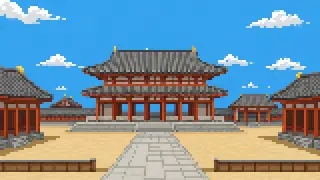
An ancient palace built at Naniwa. The Early Naniwa Palace of Emperor Kotoku and the Later Naniwa Palace of Emperor Shomu are well known. A historical park has been laid out south of Osaka Castle, where the foundation platform of the Daigokuden (Great Audience Hall) site has been restored.
Source:大阪市公式ホームページ
Ishiyama Honganji (石山本願寺)Ishiyama Honganji
On the site of Osaka Castle there once stood Ishiyama Honganji, a great stronghold of Jodo Shinshu (the Ikko sect). After waging the decade-long Ishiyama War against Oda Nobunaga, its forces withdrew from the site.
Source:大阪城天守閣 公式
The Building of Osaka Castle
On the former site of Ishiyama Honganji, Toyotomi Hideyoshi began building a magnificent castle from 1583. Gold-leaf roof tiles and towering stone walls displayed the prestige of a ruler of the realm—but that keep was lost in the Siege of Osaka.
Source:大阪城天守閣 公式
The Siege of Osaka
The campaigns in which Tokugawa Ieyasu attacked the Toyotomi clan. A truce in the Winter Campaign of 1614 led to the moats being filled in, and in the Summer Campaign the following year, 1615, Osaka Castle fell; Toyotomi Hideyori and Yodo-dono took their own lives, and the Toyotomi clan was destroyed.
Source:大阪城天守閣 公式
Sanadamaru (真田丸)Sanadamaru
An outer fort that Sanada Nobushige (Yukimura) built during the Winter Campaign of Osaka, on the southern side regarded as the castle's weak point. It inflicted heavy losses on the besieging Tokugawa forces and made Nobushige's name.
Source:大阪城天守閣 公式
The Present Castle Keep
The keep you see today was rebuilt in reinforced concrete in 1931, partly through donations from citizens, and inside it houses the history museum "Osaka Castle Museum." It is not the Toyotomi-era keep itself.
Source:大阪城天守閣 公式
FAQ
When was the present keep of Osaka Castle built?
It is a structure rebuilt in 1931 (Showa 6). The keeps of the eras of Toyotomi Hideyoshi and the Tokugawa have been lost, and the inside is now a museum.
Which is correct, "Osaka" written 大坂 or 大阪?
Until the Edo period the spelling 大坂 was common, and 大阪 took hold from the Meiji era onward. When recounting history, the period spelling 大坂 is sometimes used.
Is Osaka Castle a World Heritage Site?
It is not. What holds World Cultural Heritage status in Osaka Prefecture is the Mozu-Furuichi Kofun Group, the cluster of burial mounds spread across Sakai City and elsewhere.
What is there to see around the castle?
Beyond the keep, you can tour remains from different eras in one go—stone walls built with giant boulders, the moats, and the historical park of the Naniwa Palace site.