Aso Shrine and Kokuzo Shrine: a farming calendar of a volcano god
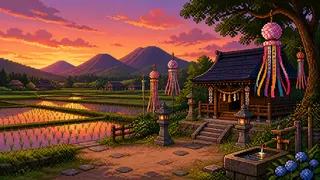
Aso Shrine, and Kokuzo Shrine, which can be read as enshrining its founding deity's son, together carry a story about a volcano god shaping the land. Tracing that story and the farming festivals that still follow from it shows how Aso's year is organized around a calendar rooted in myth. Akaushi cattle and local food culture extend that same calendar into daily life.
Aso Shrine is the Ichinomiya, or first-ranked shrine, of former Higo Province, enshrining twelve deities including Takeiwatatsu-no-Mikoto, and the founding myth of the land being carved open is echoed at Kokuzo Shrine too. This article separates the myth from the farming festivals that are still observed today.
The second half turns to Akaushi cattle, tied to grazing, and local foods like dago-jiru and Namino soba, tracing how the shrines' festivals connect to what ends up on the table.
The story of a volcano god, and the shrines that carry it
Aso Shrine enshrines Takeiwatatsu-no-Mikoto, the god said to have kicked open the caldera rim, while Kokuzo Shrine enshrines his son — together they carry Aso's farming festivals.
阿蘇神社Aso Shrine
Aso Shrine is the Ichinomiya of former Higo Province, enshrining Takeiwatatsu-no-Mikoto and eleven other deities. Its nationally designated Important Cultural Property gate collapsed entirely in the 2016 Kumamoto earthquakes; restoration work reused about 70% of the original parts and was completed in December 2023. The gate is counted among Japan's three great shrine gates.
Source:阿蘇神社について
健磐龍命Takeiwatatsu-no-Mikoto
Takeiwatatsu-no-Mikoto, the chief deity of Aso Shrine, is said to have kicked open the caldera's outer rim to drain a lake once held inside it, creating farmland in the process. His cry of 'tatenu' ('I cannot stand') after the kick is said to be the origin of the place name Tateno, and the water released is said to have become the Shirakawa River.
Source:阿蘇神社について
国造神社Kokuzo Shrine
Kokuzo Shrine enshrines Hayamikatama-no-Mikoto, son of Takeiwatatsu-no-Mikoto, and is said to have been founded some 2,000 years ago; it stands in the Ichinomiya district close to Miyagawa Valley. If Aso Shrine is the main shrine enshrining the parent, Kokuzo Shrine enshrines the son, and the two together have carried Aso's farming festivals forward.
Source:ご祭事
農耕祭事farming festivals
The farming festivals carried by Aso Shrine and Kokuzo Shrine form a nationally designated Important Intangible Folk Cultural Property with two pillars. The July 'Onda Festival' is a summer procession checking on the growing rice, while the 'Hitaki Shinji' fire ritual runs 59 straight days, from August 19 to October 16, keeping fire burning to ward off frost damage in autumn and winter.
Source:阿蘇の農耕祭事
Grazing and the local table
Akaushi cattle raised on open pasture, highland Namino soba, and dago-jiru dumpling soup all trace back to Aso's farming life rather than standing apart from it.
あか牛Akaushi
The Japanese Brown breed, known locally as Akaushi, suits Aso's grazing and is prized for lean red meat rather than the heavy marbling of Japanese Black cattle. It stars in local dishes such as Akaushi-don rice bowls, and grazing as a raising method also helps maintain the grassland landscape.
Source:世界遺産の登録を目指して
波野そばNamino soba
The Namino district in eastern Aso City, at 600 to 900 meters elevation, produces buckwheat suited to its cool highland climate, and the roadside station Michi-no-Eki Namino handles everything from harvest through drying, milling, and noodle-making on site. Namino was once an independent village, merged into Aso City in 2005 along with Aso and Ichinomiya towns.
Source:そばの花畑
だご汁dago-jiru
Dago-jiru, a Kumamoto comfort food, simmers hand-stretched wheat-flour dumplings with vegetables such as burdock root and taro in a miso or soy broth. In Aso, a stretch of National Route 57 lined with restaurants serving it is nicknamed 'Dago-jiru Kaido,' and the dish has long been eaten between spells of farm work.
Source:だご汁 熊本県
FAQ
Which shrine should I visit first, Aso Shrine or Kokuzo Shrine?
There's no fixed order, but visiting Aso Shrine, which enshrines the parent deity Takeiwatatsu-no-Mikoto, before Kokuzo Shrine, which enshrines his son Hayamikatama-no-Mikoto, lets you follow the founding myth's parent-child relationship as you go.
Can visitors watch both the Onda Festival and the Hitaki Shinji?
Both are generally open to the public, but exact dates are announced each year, so check with Aso Shrine or Aso City's official information before you plan a visit.
Where can I try Akaushi?
Restaurants throughout Aso City serve dishes such as Akaushi-don. Knowing that the cattle are raised through grazing may change how you taste it.
Are both dago-jiru and Namino soba considered Aso specialties?
Yes. Dago-jiru is a comfort food found across Kumamoto Prefecture that has taken root in Aso too. Namino soba, grown only in the Namino district's highland climate, is more distinctly local to that one area.