Matsumoto and Azumino: 280 Years of Lords, a Basin Shaped by Water
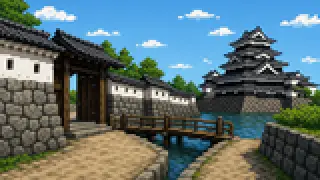
Fukashi Castle became known as Matsumoto Castle in 1582. After the Ishikawa father and son built its keep, six samurai families took turns as lords, while down in the basin the people of Azumino were channeling water from the alluvial fan through hand-dug canals.
Matsumoto Castle changed hands again and again from the Warring States period through the Edo period and into the Meiji era, and even survived a brush with demolition. Down in the basin, Azumino was a different kind of project: channeling the fan's scarce water through canals to turn dry land into paddies.
Matsumoto's political history and Azumino's reclamation look like separate stories, but they play out in the same basin. Here is the turnover of castle lords, the people who saved the keep, and the water and roads that stitched the basin together — all with sources.
How many times did Matsumoto Castle change hands?
From the Ishikawa father and son who built the keep to the Meiji Restoration, six samurai families held Matsumoto Castle in turn. The shortest tenure lasted about five years; the longest ran 145.
From Fukashi Castle to Matsumoto CastleFukashi-jo to Matsumoto-jo
During the Warring States period, this castle was called Fukashi, and the Takeda clan ruled it for 32 years. In 1582, after the Takeda clan's fall, Ogasawara Sadayoshi recovered his family's old territory amid the chaos and renamed the castle Matsumoto. The shift from the old name Fukashi to Matsumoto marked a major turning point.
Source:Matsumoto Castle official site, "History of Matsumoto Castle"
Ishikawa Kazumasa and Yasunaga: father, son, and the keepIshikawa Kazumasa and Yasunaga
Ishikawa Kazumasa and his son Yasunaga, who took the castle in 1590, began building the keep that still stands today. Across two generations of construction, the great keep, the smaller Inui keep, and the connecting turret between them — a trio built to wartime specifications — took shape in this period. The Ishikawa family was stripped of its domain in 1613 and left the castle without seeing their own project completed.
Source:Matsumoto Castle official site, "History of Matsumoto Castle"Matsumoto Castle official site, "The keep and its structure"
Six families, from five years to a hundred and forty-five
After the Ishikawa family, six samurai families in turn held Matsumoto Castle: Ogasawara, Toda, Matsudaira, Hotta, Mizuno, and Toda again. The shortest tenure belonged to Matsudaira Naomasa, about five years from 1633 to 1638. The longest was the Toda family's second term, 145 years from 1726 until the Meiji Restoration in 1871. The length of each lord's tenure alone hints at how stable, or unstable, each era was.
Source:Matsumoto Castle official site, "History of Matsumoto Castle"
What did the Meiji Restoration bring to the keep?
Stripped of its lord when Japan abolished its domains, Matsumoto Castle was put up for auction and came close to demolition, until local citizens bought it back, keeping it standing to this day.
Chikuma Prefecture: five years as a prefectural capitalChikuma-ken
After the 1871 abolition of the domains, Chikuma Prefecture was formed to govern four districts of central and southern Shinano plus the whole of Hida, with its office set up in the Ninomaru palace inside Matsumoto Castle. Chikuma Prefecture was absorbed into Nagano Prefecture in 1876, after only five years. Its name survives today in the Chikuma neighborhood of Matsumoto and in Higashi-Chikuma District.
Source:Matsumoto Castle official site, "History of Matsumoto Castle"Kotobank, "Chikuma Prefecture"
The keep, auctioned off for 235 ryo
Under the nationwide castle-abolition order, the buildings of Matsumoto Castle, including the keep, were put up for auction. The keep sold for 235 ryo, but a local deputy village head, Ichikawa Ryozo, and others campaigned to buy it back, raising funds partly by holding exhibitions inside the keep itself, and saved it from demolition. Had the auction simply run its course, the keep might not be standing today.
Source:Matsumoto Castle official site, "The castle citizens saved"
Kobayashi Unari, the preservation society, and the great Meiji repairKobayashi Unari
By the late Meiji era the keep's lean had become obvious, and in 1901 Kobayashi Unari, principal of the old Matsumoto Middle School, led the founding of a society to preserve it. Kobayashi had also served as principal of the school's predecessor from 1884. Funded by donations, the resulting "great Meiji repair" was completed in 1913 and straightened the leaning keep. This preservation movement paved the way for the castle's 1930 designation as a historic site and, after the war, as a National Treasure.
Source:Matsumoto Castle official site, "The castle citizens saved"Nagano Prefectural Matsumoto Fukashi High School, "School history"
A harsh campaign against Buddhism
Under Toda Mitsuhisa, the last lord of the Matsumoto domain, an 1870 campaign of haibutsu kishaku, the suppression of Buddhism, was proposed by the domain and carried out with a severity that stood out even nationally. Zenkyu-in, the Toda family's own funerary temple, and Zenzan-ji were among the temples abolished. It was one of the era's abrupt changes, reaching temples and shrines as well as the castle itself.
Source:Matsumoto Castle official site, "History of Matsumoto Castle"
What connected Matsumoto and Azumino?
Canals that channeled water across the alluvial fan, the Chikuni Kaido that carried salt, and boats that plied the Sai River all wove the whole basin together.
Five canals that reclaimed Azumino
A well-drained alluvial fan is not naturally suited to paddy fields, but throughout the Edo period the people of Azumino dug five canals in succession: the Yahara, Kanzaemon, Jikka, Goka, and Shinbori canals. The Jikka Canal, dug in 1816, was a major undertaking in which ten villages turned out together to cut a 15-kilometer channel. Two centuries of this engineering work turned dry land into a rice-growing basin.
Source:City of Azumino, "The canals that flow through Azumino"
The Chikuni Kaido, the road that carried saltChikuni Kaido
The Chikuni Kaido, linking Itoigawa on the Sea of Japan coast to Matsumoto, ran the length of Azumino and is said to be the longest of Japan's historic "salt roads," at about 120 kilometers. Pack horses and porters called bokka relayed the goods, and the road is said to have carried the Uesugi clan's legendary gift of salt to a rival domain, the origin of the saying "send salt to your enemy." For landlocked Shinano, this road was one of the few gateways for seafood.
Source:The Salt Industry Center of Japan, "The Salt Road: Chikuni Kaido (Nagano)"
Boats on the Sai RiverSai River
In 1832, a boat route opened on the Sai River between Matsumoto and Shinshu-Shinmachi, adding water transport to the basin's links with the outside world. Canals reclaimed farmland, highways carried goods overland, and river boats carried them by water: the Matsumoto-Azumino basin was tied to the wider world by several transport networks at once.
Source:Matsumoto Castle official site, "History of Matsumoto Castle"
FAQ
Did Matsumoto Castle really change hands six times?
Yes. Starting with the Ishikawa family, six families in turn held the castle: Ogasawara, Toda, Matsudaira, Hotta, Mizuno, and Toda again. Because the Toda family held it twice, the full sequence runs to seven terms.
Why did Chikuma Prefecture disappear so quickly?
Chikuma Prefecture was formed in 1871 by merging surrounding prefectures, then absorbed into Nagano Prefecture in the nationwide prefectural reorganization of 1876. Its office stood inside Matsumoto Castle for only about five years.
Was the keep really nearly destroyed?
Yes. Under the castle-abolition order it was auctioned in 1872 and sold for 235 ryo. Had local citizens not organized to buy it back, it might well have been torn down.
Are Azumino's canals still in use?
Yes. Many of the canals dug in the Edo period, including the Yahara and Jikka canals, still irrigate Azumino's rice fields today, after repeated repairs and improvements.
Sources & references
- Matsumoto Castle official site, "History of Matsumoto Castle"
- Matsumoto Castle official site, "The keep and its structure"
- Kotobank, "Chikuma Prefecture"
- Matsumoto Castle official site, "The castle citizens saved"
- Nagano Prefectural Matsumoto Fukashi High School, "School history"
- City of Azumino, "The canals that flow through Azumino"
- The Salt Industry Center of Japan, "The Salt Road: Chikuni Kaido (Nagano)"