Matsumoto's castle town: moats, waterways, and street plan
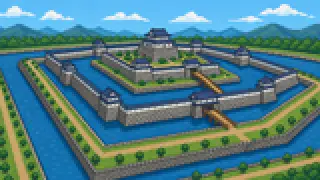
Matsumoto Castle cannot be understood from its keep alone. The moats, the street plan, and the springs are all part of the same design.
Matsumoto Castle brings its National Treasure keep to mind first, but the castle itself was only the center of a triple-moat system built to protect an entire castle town. Without looking at the moats' defensive design, the street plan beyond them, and the spring water network that supplied the town, the full picture of Matsumoto's castle town stays incomplete.
This article sets the keep's architectural details aside and instead checks primary sources on three angles: how the moats were built for defense, how the town beyond them was laid out, and how spring water tied the whole town together.
The triple moat that protected Matsumoto Castle
Matsumoto Castle had three moats, the inner, outer, and grand moat, guarding the main, second, and third enclosures in turn.
The inner, outer, and grand moatsuchibori, sotobori, sobori
Matsumoto Castle was surrounded by three water-filled moats, called from the inside out the inner moat, the outer moat, and the grand moat. The area inside the inner moat was the main enclosure (honmaru), the area inside the outer moat was the second enclosure (ninomaru), and the strip between the outer and grand moats was the third enclosure (sannomaru). The third enclosure housed the residences of senior and mid-ranking domain retainers, including the chief councillors. Records describe the earthen rampart along the grand moat as 17 meters wide at its base and 3.5 meters tall, topped with a further wall. Beyond the third enclosure's outer edge, rows of samurai residences continued, so that in an emergency the triple moats and their ramparts and walls formed a staged system meant to slow an attacker's advance step by step.
Source:History of Matsumoto Castle
The defensive distance to the inner moatabout 60 meters
The distance from the keep to the inner moat is about 60 meters, a figure said to reflect the effective range of the matchlock guns used at the time. The width of the moat itself was working as a defensive device, not merely marking a boundary. Each of the three moats had its own width and placement chosen with a military purpose in mind.
Source:The keep and its structure
The street plan spreading out from the third enclosure
The castle town was divided by trade: three core blocks, ten branch blocks, and a further merchant strip along the Zenkoji road.
Three core blocks and ten branch blocksoyamachi sancho, edamachi jucho
The castle town beyond the grand moat was made up of three core blocks, Honmachi, Nakamachi, and Higashimachi, along with ten branch blocks such as Bakuromachi, Isemachi, Koikemachi, and Yasuharamachi. Each block tended toward a different trade: wholesalers concentrated in Honmachi, kimono dealers and sake merchants in Nakamachi, and inns in Higashimachi. Even within a single castle town, each street carried its own trade identity.
Merchant houses along the Zenkoji roadthe Zenkoji road corridor
The castle town extended even beyond the grand moat, where the Zenkoji road ran north to south. Merchant houses lined the road on both sides, and a belt of temples and shrines was placed further out beyond them. This concentric arrangement of road, merchant houses, and temple land appears designed to satisfy three functions at once: defense, trade along the highway, and religious life.
The spring water that still feeds the castle town today
Groundwater is abundant around Matsumoto's castle town, and in 2008 the area was named one of Japan's 100 finest spring-water sites.
The Matsumoto castle town spring clusterMatsumoto Jokamachi Yusuigun
Groundwater gathering from the surrounding mountains is abundant around Matsumoto's castle town, which is why wells and springs are common throughout the area. In June 2008, the Ministry of the Environment named this cluster one of the "100 Finest Waters of the Heisei Era." Residents still draw water from these springs today, and the water is also used to water roadside trees and for the traditional practice of sprinkling water on the street to cool it. Even when a disaster cuts off the municipal water supply, hand pumps can keep drawing from these springs, which was part of why the cluster was recognized. The name refers not to a single spring but to the whole set of wells and spring points scattered across the castle town.
Genchi WellGenchi no Ido
Genchi Well is a spring that was used for drinking water even before Matsumoto's castle town was built. Its name is said to come from Kawabe Nuidonosuke Genchi, a retainer of Ogasawara Sadayoshi active in the Tensho era. The well produces roughly 200 liters of water per minute, and successive domain lords protected it throughout the Edo period by issuing notices forbidding pollution of the water. When Emperor Meiji made his 1880 tour of Matsumoto, water from this well was used to prepare his meals.
Source:Genchi Well
FAQ
How many moats did Matsumoto Castle have?
Three, called from the inside out the inner, outer, and grand moat. The inner moat enclosed the main enclosure, the outer moat the second enclosure, and the strip between the outer and grand moats formed the third enclosure.
How was the castle town divided?
Into three core blocks (Honmachi, Nakamachi, Higashimachi) and ten branch blocks, each associated with a different trade such as wholesaling, kimono dealing, or running inns.
Where does the name Genchi Well come from?
It is said to be named for Kawabe Nuidonosuke Genchi, a retainer of Ogasawara Sadayoshi in the Tensho era. The spring was already used for drinking water before the castle town was built.