How the Road to Karuizawa Kept Changing
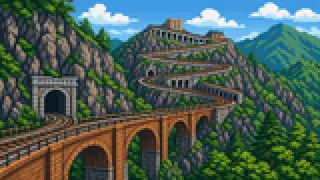
The way to reach Karuizawa has never stayed the same for long: on foot, by Abt-system rail, by electrified rail, and finally by bullet train.
The steep climb of Usui Pass was, for a long time, a technical wall for both travelers and trains heading to Karuizawa. Each time a new answer to crossing that pass appeared, the way people reached Karuizawa changed with it.
This article traces that story from the era of walking the Nakasendo through Abt-system rail, electrification, and the bullet train's opening, viewed through how each shift reshaped the post towns, the resort, and the people who settled here.
The Nakasendo and Usui Pass
Usui Pass was the Nakasendo's toughest climb, and Wakasare in Oiwake was where travelers chose their onward route.
Usui Pass, a formidable climb
For travelers heading toward Edo along the Nakasendo, Usui Pass was the toughest stretch of the whole route. At its summit, about 1,200 meters up, stands Kumano Kotai Shrine, known for straddling the border between Nagano and Gunma. Before any railway existed, this change in elevation could only be crossed on foot or on horseback.
Wakasare and the ichirizuka milestone
Wakasare, in Oiwake, is the fork where the Nakasendo and the Hokkoku Kaido diverge, and its signpost, stone lantern, and ichirizuka (one-ri milestone) still stand today. Records note that the Wakasare teahouse nearby was destroyed by falling volcanic rock during Mount Asama's 1803 eruption. Here, travelers chose whether to continue toward Kyoto on the Nakasendo or head for Echigo on the Hokkoku Kaido. The Oiwake History Walk guides visitors from Sendo-ji Temple's Toothache Jizo, past the Tsugaruya teahouse at a masugata bend, and on to Wakasare, with a Sherlock Holmes statue standing just beyond it.
Source:Japan Meteorological Agency: Mount Asama's recorded volcanic historyKaruizawa Town: Oiwake-juku Local History Museum informationShinano Oiwake Bunka Jiba Aburaya: Oiwake History Walk
How Rail Changed the Way People Arrived
Between 1888 and 1912, the way to reach Karuizawa shifted from walking to rail, and then to electrified rail.
Rail arrives from the Naoetsu side
The first railway to reach Karuizawa came not from the Tokyo side but from Naoetsu. The Naoetsu-Karuizawa line opened in 1888. At that time, no railway yet crossed Usui Pass, so travel to and from the Tokyo direction still relied on the mountain road.
The Abt system conquers Usui Pass
In 1893, the Abt-system Usui Line opened between Yokokawa and Karuizawa, finally making it possible to cross Usui Pass by rail. Climbing the steep grade by meshing a center rack rail with matching gears on the locomotive, the Abt system was the engineering answer to the pass's defining obstacle.
Japan's first railway electrification
In 1912, the Abt-system Usui Line between Yokokawa and Karuizawa was electrified while keeping its rack-rail mechanism, becoming Japan's first electrified railway section. Precisely because it was such a steep grade, the smoke problems and limited hauling power of steam locomotives became apparent early, which helped electrification arrive here first.
A new alignment and double-tracking
In 1963, the new Usui Line of the Shin'etsu Main Line was completed between Yokokawa and Karuizawa, replacing the Abt system with ordinary adhesion-based operation. That same year, the Karuizawa-Nagano section was also electrified, and in 1966 the Yokokawa-Karuizawa section was double-tracked. The pass's technical constraints were resolved step by step.
The Turning Point the Bullet Train Brought
The bullet train's 1997 opening brought two turning points: the retirement of the Abt-system section after more than a century, and a widening base of commuting and year-round settlement.
The old line retires as the bullet train opens
In 1997, the Hokuriku Shinkansen, the third-sector Shinano Railway, and a JR bus route between Yokokawa and Karuizawa all opened at once. The railway that first crossed Usui Pass in 1893, having already shed its Abt rack-rail system for ordinary adhesion operation back in 1963, closed out its 104-year run that same year. The history of rail crossing the pass reached a milestone precisely in exchange for the bullet train's arrival.
A parallel story of road-building
Roads were upgraded alongside the railway. The national highway between Sakamoto and Karuizawa was paved in 1933, the Usui toll bypass was completed in 1971, and that bypass became toll-free in 2001. Beyond rail's technical upgrades, reaching Karuizawa by car also became progressively easier.
Travel access and the growth of settlement
The East and West Nagakura villages established in 1889 together numbered only a few thousand residents, but by the time Karuizawa became a town in 1923, its population alone stood at 5,012, and by 2013 the whole town had reached a population of 20,000. As the means of reaching Karuizawa widened from walking to rail, and then to the bullet train and cars, the number of people settling here grew as well.
The old Karuizawa station building, kept as memory
When the bullet train opened, the old Karuizawa station building lost its original role, but rather than being torn down, it was preserved, opening in 2000 as the 'Old Karuizawa Station Building Memorial Hall.' Until it closed in 2017, it served as a facility conveying the shifting technology of crossing the pass.
FAQ
Why did the railway over Usui Pass use the Abt system?
Usui Pass was so steep that ordinary adhesion-based rail could not climb it. The Usui Line, which opened in 1893, adopted the Abt system, meshing a rack rail with matching gears, and in 1912 it also became Japan's first electrified railway section. The 1963 opening of a new line made the Abt system unnecessary.
I also want the people behind Karuizawa's resort history.
The missionaries and villa owners are covered in a separate article, 'Who Built Karuizawa's Summer Resort Culture?' This article focuses on the shifting transport technology itself and does not go into individual biographies.
Can I get detailed specifications for the rolling stock that was used?
This article traces the historical flow of route and technology changes; it does not catalog specifications for individual train models. Railway museums and specialist references cover that ground.
Does any trace of the old Abt-system line remain today?
The Abt-system section between Yokokawa and Karuizawa, retired in 1997, is no longer in operation, but facilities conveying that era, such as the Old Karuizawa Station Building Memorial Hall, have been maintained over the years. This article treats that preservation as part of the history too.