How Karuizawa Outgrew a Nakasendo Post Town
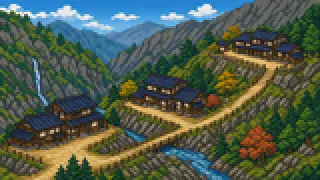
Karuizawa never reinvented itself just once. It is a town that has kept adding faces: post town, resort, transit hub.
Why did one Nakasendo post town, and no other nearby, turn into an international resort? Not by accident: three forces, the road, the railway, and villa culture, converged on the same small stretch of land.
This article follows that arc in order, from the three post towns of Karuizawa, Kutsukake, and Oiwake, through the resort's opening years, to the transit hub the town is today, with sources at each step.
The Post Town Era
Karuizawa began as three Nakasendo post towns: Karuizawa-juku, Kutsukake-juku, and Oiwake-juku.
The Three Post Towns Below Asama
Karuizawa-juku, Kutsukake-juku, and Oiwake-juku sat in a row along the Nakasendo at the southern foot of Mt. Asama, known together as the "three post towns below Asama." Today's Karuizawa Town covers roughly the ground these three settlements once occupied. Each grew as its own community, and together they shaped the skeleton of the town that came later.
Usui Pass, the Gateway
Just past Karuizawa-juku, on the way toward Edo, travelers faced Usui Pass. At its summit, roughly 1,200 meters up, sits Kumano Kotai Shrine, unusual nationwide for straddling the border between Nagano and Gunma. Travelers who cleared the pass then descended into what was once Kozuke Province.
Nitebashi, the Bridge of Two Ways
At the north end of the Kyu-Karuizawa Ginza shopping street, a bridge called Nitebashi crosses the Yagasaki River. Tradition holds that travelers and the inn's hostesses said their goodbyes here before parting, each heading a different way, which gave the bridge its name. Long after its post-town role ended, that name and story stayed with the resort town that grew up around it.
Source:Karuizawa Tourism Association: getting around Kyu-Karuizawa
The Turn Toward a Resort
Between the 1886 introduction of the resort and the first Japanese-owned villa in 1893, only seven years passed.
Launching a Resort
In 1886, the British missionary A. C. Shaw introduced Karuizawa as a summer resort to notable figures at home and abroad. The first villa went up in 1888, the same year a railway reached Karuizawa from Naoetsu. In 1893, Navy captain Yujiro Hatta built the first villa owned by a Japanese resident, adding local participation to what foreign residents had started.
Source:History of Karuizawa TownTown of Karuizawa: Hatta Villa
From Inn to Hotel
The inn called Kameya, on the Nakasendo in Karuizawa-juku, was remodeled in 1894 into a Western-style hotel exclusively for foreign guests. In 1896 it was renamed Mampei Hotel, spelled so foreign visitors could pronounce it easily. A post-town inn becoming the resort's signature hotel captures the whole turn in a single move.
Growing Into a Transit Hub
After incorporation in 1923, successive upgrades to the railway over the pass pushed the resort onto an international stage.
The Birth of Karuizawa Town
Higashi-Nagakura Village, established in 1889, was incorporated in 1923 and renamed Karuizawa Town, with a population of 5,012 across 890 households. In 1942 it merged with Nishi-Nagakura Village to form the town's present boundaries. The name of just one of the three post towns had, by then, become the name of the whole town.
Source:History of Karuizawa Town
Upgrading the Crossing
In 1893 the Abt rack railway opened between Yokokawa and Karuizawa, and in 1912 the line became Japan's first electrified railway. A new alignment replaced it in 1963, and when the Hokuriku Shinkansen opened in 1997, the old Abt-system section was abolished outright. Conquering the pass by rail took more than a century of step-by-step upgrades.
Source:History of Karuizawa Town
An International Stage
With transport in place, Karuizawa hosted the equestrian events of the 1964 Tokyo Olympics and the curling competition of the 1998 Nagano Olympics. G7 ministerial meetings followed in 2016 and 2023. A town that began as a summer retreat now regularly hosts international conferences and competitions.
Source:History of Karuizawa Town
FAQ
Where should I start with Karuizawa's history?
Start with the "three post towns below Asama." Once that frame is in place, both the resort era and the transit-hub era read as changes happening on the same ground, rather than separate stories. Learning that order, post town, resort, transit hub, works better than memorizing a timeline.
I want more detail on Karuizawa as a summer resort.
The missionaries, villas, and local commerce behind the resort get a full treatment in a separate article, Karuizawa's Summer Resort Culture, from the people-and-organizations side. This article keeps to the overall arc and doesn't dwell on individual backgrounds.
I can't tell Karuizawa, Kyu-Karuizawa, Oiwake, and Kutsukake apart.
This article covers the whole town's history. What each of those names refers to, and since when, is sorted out district by district in a separate article, Karuizawa, Kyu-Karuizawa, Oiwake, and Kutsukake, which maps the names against the history.
How did Mount Asama's eruptions figure into Karuizawa's history?
The 1783 Tenmei eruption, among others, affected the post towns and surrounding area. The mountain's own geology and how eruptions work belong to a separate article, Mount Asama and Karuizawa's Landscape, so this article only touches eruptions as one moment in the larger history.