How Churches, Hotels, and Villas Shaped Karuizawa's Landscape
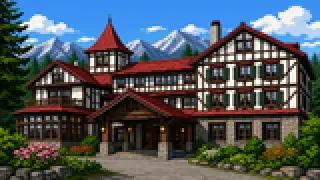
The buildings that remain in Karuizawa cannot be explained by style alone. Who used them, and how their roles kept changing, shaped this cultural landscape.
The Former Mikasa Hotel became a government office and then an occupation-forces facility; the former Konoe villa changed hands three times and was relocated twice. Many of Karuizawa's surviving buildings do not stand today in the form they were first built.
This article traces three building groups, hotels, churches, and villas, not as a catalog of styles but through how their use and their users kept shifting over time, with sources throughout.
Hotel Buildings as Traces of Modernization
The Alps Wing became a cultural property while remaining in active use as lodging, while the Former Mikasa Hotel passed through hotel, government, and occupation-forces roles before becoming a cultural property.
The Mampei Hotel's Alps Wing
The Alps Wing, the Mampei Hotel's surviving Western-style building, was completed in 1936, designed by architect Kume Gonkuro. It was registered as a Tangible Cultural Property in 2018. From 1976 to 1979, the Lennon family made Room 128 in this building their regular summer retreat. Even as it has continued operating as a place to stay, the building itself has accumulated historical value in its own right.
Source:Mampei Hotel official: About the Mampei HotelNippon Travel Magazine: The Mampei Hotel where John Lennon stayed
The Former Mikasa Hotel's shifting roles
Planned by businessman Yamamoto Naoyoshi and designed by architect Okada Tokitaro, the Former Mikasa Hotel was completed in 1905, with construction overseen by Sato Manpei of the Mampei Hotel. Meiji-ya Co. acquired it in 1925, operated by its subsidiary Chuotei, and the hotel suspended operations in 1944 because of the Pacific War. In 1945 it housed a Karuizawa office of the Ministry of Foreign Affairs, and in 1947, under occupation, it served as a rest hotel for officers of the US Eighth Army. After the occupation ended in 1952, it reopened as 'Mikasa House,' and in 1974 it was moved 50 meters north on rollers and repaired. It was designated a national Important Cultural Property in 1980, and structural renovation work including seismic reinforcement proceeded from 2020. One building kept changing roles, from hotel to government office to occupation facility and finally to cultural property.
Source:Karuizawa Town: Former Mikasa Hotel renewal materials (Important Cultural Property)National Cultural Properties Database: Former Mikasa Hotel
Buildings Raymond Left Behind
Antonin Raymond left Karuizawa buildings serving very different purposes: a church and his own villa-office.
St. Paul Catholic Church
St. Paul Catholic Church in Kyu-Karuizawa was founded by the English priest Father Ward, with its design handled by architect Antonin Raymond. Its exterior, marked by a steeply pitched triangular roof and exposed concrete, projects a presence distinct from the resort's villa architecture, one particular to religious buildings.
Source:Karuizawa Tourism Association: St. Paul Catholic Church
The Karuizawa Summer House
The Karuizawa Summer House was designed and built by Raymond in 1933 as his own villa and office. It is known for its distinctive butterfly roof, sloping down toward the center, in a wood-frame building partly two stories tall with a sheet-metal roof. Ramps and double-height openings create a sense of movement and openness inside, and it is regarded as a pioneering example of wood-frame modernist architecture using traditional Japanese techniques. It was relocated to its current site in 1986 and designated a national Important Cultural Property on September 25, 2023.
Source:Cultural Heritage Database: The Karuizawa Summer House
The People Behind Karuizawa's Villa Architecture
The former Konoe villa, Muro Saisei's villa, the Hatta Villa, and Meiji 44 Hall each survive today in a different form.
The Former Konoe Fumimaro Villa (Ichimura Memorial Hall)
Now known as the Ichimura Memorial Hall, the former Konoe Fumimaro villa was built by the construction firm Amerika-ya and first owned by Nozawa Genjiro. Konoe Fumimaro purchased the villa in Taisho 15 (1926), and in 1932 Ichimura Kesazo bought it and moved it to Minamihara the following year. In 1997 it was relocated again, to its current site at the eastern end of Amemiya-ike pond, and on May 24, 2016 it was designated a Karuizawa town cultural property. The hall now displays materials related to Konoe Fumimaro and Amemiya Keijiro.
Source:Karuizawa Town: Former Konoe Fumimaro Villa (Ichimura Memorial Hall) visitor information
The Muro Saisei Memorial Hall
The villa used by the writer Muro Saisei was built in Showa 6 (1931) and is now open to the public as the Muro Saisei Memorial Hall. Muro Saisei spent every summer here until 1961, the year before he died. It is an example of a single villa building shifting roles, from a private summer residence to a memorial hall for a writer.
Source:Karuizawa Town: Muro Saisei Memorial Hall visitor information
The Hatta Villa's architectural details
The Hatta Villa, known as the first villa built by a Japanese owner, is a wood-frame, two-story building whose facade became irregular because of the shape of its original lot. When it was first built, it had neither electricity nor running water: water came from a well on the grounds, and light came from oil lamps. The stone jizo statue in the garden is said to have washed down from upstream during the great flood of 1910. The building was donated to the town of Karuizawa in fiscal 2014.
Meiji 44 Hall, a story of preservation
Meiji 44 Hall, relocated and restored at Karuizawa Taliesin, was originally built as the Kyu-Karuizawa post office. It was constructed by railway carpenter Koda Ryokichi, who also worked on rebuilding Karuizawa Station, and was relocated and restored at Taliesin in 1996. Centered on Lake Shiozawa and gathering a garden, an art museum, and historic buildings, Taliesin has also become a place that gives retired buildings a new home.
Source:Retropost: The surviving early-Meiji second-class post office (Karuizawa Taliesin, Meiji 44 Hall)Karuizawa Tourism Association: Karuizawa Taliesin
FAQ
Why does Karuizawa have several buildings by Antonin Raymond?
Architect Antonin Raymond built the Karuizawa Summer House in 1933 as his own villa and office. Because an architect with such deep ties to the area also designed a church building, St. Paul Catholic Church, several works in different styles survive here together.
I want to know more about the Mampei Hotel's business history or the people behind resort culture.
The Mampei Hotel's shift from a wayside inn to a hotel is covered in a separate article, 'How Karuizawa Outgrew a Nakasendo Post Town,' and the organizations and commercial figures behind resort culture are covered in 'Who Built Karuizawa's Summer Resort Culture?' This article focuses specifically on the buildings themselves and their changing uses.
Can I get current admission fees or opening hours for these buildings?
This article covers architecture and changing use; it does not include pricing or opening-hours information for active facilities. Please check each facility's official information directly.
How did Mount Asama's eruptions affect these buildings?
The volcano's landforms and eruption mechanics are covered in a separate article, 'How Mount Asama Shaped Karuizawa's Water and Forests.' This article keeps its focus on architecture and changing use.
Sources & references
- Mampei Hotel official: About the Mampei Hotel
- Nippon Travel Magazine: The Mampei Hotel where John Lennon stayed
- Karuizawa Town: Former Mikasa Hotel renewal materials (Important Cultural Property)
- National Cultural Properties Database: Former Mikasa Hotel
- Karuizawa Tourism Association: St. Paul Catholic Church
- Cultural Heritage Database: The Karuizawa Summer House
- Karuizawa Town: Former Konoe Fumimaro Villa (Ichimura Memorial Hall) visitor information
- Karuizawa Town: Muro Saisei Memorial Hall visitor information
- Karuizawa Town: The Hatta Villa
- Retropost: The surviving early-Meiji second-class post office (Karuizawa Taliesin, Meiji 44 Hall)
- Karuizawa Tourism Association: Karuizawa Taliesin