Izumo: Clues from food and craft
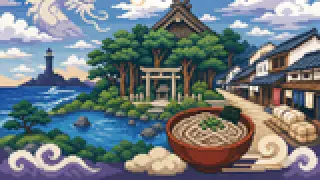
Buckwheat grain and lattice wood alike only become Izumo's own once someone mills or carves them; read far enough into this guide to clues from food and craft, and that line turns out to be the whole shape of the piece. It follows Izumo soba's milling method through to the latticework on Momen Kaido's townhouses, checking what material each specialty starts from and how it gets worked, rather than just listing local names.
Foods like Izumo soba and Zenzai and crafts like Izumo lattice and Momen Kaido's townhouses can look like separate categories at first. But both share the same trait: raw material worked by hand into something distinctly Izumo. This piece checks what that processing actually looks like.
Rather than repeating source text, it focuses on what's used, what the process is, and how each result is finished. Knowing the craft behind a specialty's name, not just the name itself, changes how you taste or look at it in Izumo.
Clues from food and craft: Izumo soba and Zenzai
Izumo soba is a noodle dish made from flour milled from whole buckwheat grains, while Zenzai is a sweet made from simmered azuki beans.
Izumo soba
Izumo soba uses flour milled by the hikigurumi method, which grinds the buckwheat grain husk and all, and it's sometimes counted among Japan's three great regional soba styles. It's commonly served as warigo soba, stacked in round lacquered bowls with the broth poured directly over each layer. Because whole-grain milling keeps more of the husk, the flour is darker and stronger in flavor than the pale, refined sarashina style, earthier and more assertive.
Zenzai
Zenzai is a sweet made from azuki beans simmered in a sweetened broth, usually served with mochi, and Izumo is counted among its possible places of origin. One account traces the name to jinzai, referring to the Kamiari festival held at Izumo Taisha in the tenth lunar month, with the pronunciation gradually shifting to zenzai. Unlike Izumo soba, which centers on milling buckwheat flour, Zenzai's process centers on simmering beans, a different ingredient and a different technique entirely.
Source:Zenzai — official reference
Clues from food and craft: Shimane Winery and Izumo Culture Heritage Hall
Shimane Winery makes and introduces wine from locally grown grapes, while Izumo Culture Heritage Hall preserves and opens to the public the buildings and garden of an old family home.
Shimane Winery
Shimane Winery is a wine-related facility near Izumo Taisha, where visitors can see how locally grown grapes are made into wine and taste the results. It's defined by processing an agricultural product, fermenting grapes into liquid wine, which sets it apart from Izumo Culture Heritage Hall, also grouped under food and craft here but concerned with preserving a building and garden rather than making anything.
Izumo Culture Heritage Hall
Izumo Culture Heritage Hall preserves and opens to the public the former Naito family residence, built in the Meiji era, notable for combining a Western-style building with a Japanese garden. Unlike a winery, it isn't a place where something is manufactured; its role is to show, through the building and garden themselves, how an old Izumo family once lived. Where Shimane Winery is a place that makes something, Izumo Culture Heritage Hall is a place that keeps something.
Clues from food and craft: Izumo lattice and Momen Kaido
Izumo lattice is the name for the latticework design itself, seen on Momen Kaido's townhouses, while Momen Kaido is the name of the whole street those townhouses line.
Izumo lattice
Izumo lattice is the latticework design, thin strips of wood set vertically and horizontally, seen on the fronts of the townhouses still standing along Momen Kaido. Used on windows and doorways facing the street, it's thought to have softened the view from outside while still letting light and air through. Against Momen Kaido, which names the whole street, Izumo lattice names one part of the buildings that line it, a whole-and-part relationship between the two.
Momen Kaido
Momen Kaido is the name of the street in Hirata Town that thrived as a cotton-trading market street from the Edo period into the early Showa era. Townhouses fitted with Izumo lattice line the street in a continuous run, making it the clearest place to actually see the design up close. Where Izumo lattice names a feature found on individual buildings, Momen Kaido names the whole street those buildings sit along.
Clues from food and craft: Hirata Town and Kamiari Festival
Hirata Town is the name of the district that prospered through water transport on Lake Shinji's west shore, while Kamiari Festival is the name of a rite held at Izumo Taisha in the tenth lunar month.
Hirata Town
Hirata Town sits on the west shore of Lake Shinji and grew through water transport and the cotton trade, becoming part of Izumo City in the 2005 merger. It's also where Momen Kaido and its Izumo-lattice townhouses still stand. Unlike Kamiari Festival, a rite held on a fixed schedule each year, Hirata Town is a place name: somewhere people actually live year-round, and somewhere you can walk its streets any day.
Kamiari Festival
Kamiari Festival is a sequence of rites held at Izumo Taisha during Kamiarizuki, the tenth lunar month, welcoming and later seeing off deities said to gather there from across Japan. It begins with a welcoming rite at Inasa Beach and continues with further ceremonies within the precinct. Unlike Hirata Town, which can be visited any day of the year, Kamiari Festival only happens during a specific window, so whether you catch it depends entirely on timing.
FAQ
What's a good route for this theme in Izumo?
Eat Izumo soba, then walk Momen Kaido to see the Izumo-lattice townhouses, and if there's time, stop by Shimane Winery or Izumo Culture Heritage Hall; enough to cover both food and craft in a single day.
Should these names be memorized as a list?
It helps to separate names for the food itself, like Izumo soba, from names for a building's design, like Izumo lattice; that distinction keeps similarly labeled Izumo names from blending together.
Where can I check the sources?
Each entry links to the Izumo Tourism Association, Izumo City's own site, or Izumo Taisha's own site. Hours and seasonal schedules can change, so confirm official details before visiting.