The Zenkoji Temple Town: Fundraising Tours, Shops, and Its Road
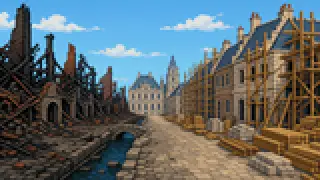
Say Zenkoji and picture only the main hall, and you are seeing half the story. The approach running from the Niomon gate to the Sanmon gate, lined with the shops of Nakamise, is what kept pilgrims arriving for centuries.
Even rebuilding the main hall once depended on a nationwide system of traveling fundraising tours. The Sanmon, Niomon, and Kyozo buildings along the approach each carry the craft and faith of a different era.
This article does not retell Nagano City's full history, or simply list gokaicho unveiling years. It looks instead at how the approach road and the systems built to receive pilgrims turned Zenkoji into a pilgrimage city.
The Degaicho System Behind the Main Hall's Rebuilding
Rebuilding Zenkoji's main hall depended on degaicho, a system of touring fundraising exhibitions held nationwide.
The 1700 Fire and Reconstruction
The last major fire tied to today's main hall struck in 1700. It destroyed even materials that had been set aside for other building work, forcing the temple to raise reconstruction funds from scratch. The present main hall was completed seven years later, in 1707.
Source:善光寺「紹介・歴史」
Degaicho and the Maedachi Honzon
Funds for rebuilding the main hall were raised over five years of degaicho tours. Since the principal image itself is an absolute hidden Buddha that cannot be moved, its stand-in, the Maedachi Honzon, was carried to towns across the country to collect donations. The amount raised is said to have topped 20,000 ryo.
Source:善光寺「紹介・歴史」
The Edo Degaicho and Ekoin Temple
Degaicho tours were not limited to the reconstruction years; they continued long after. During the first Edo degaicho, in 1692, the principal image is said to have been carried even into Edo Castle at the request of Keishoin, mother of the shogun Tokugawa Tsunayoshi. The stage for these tours was Ekoin Temple in Ryogoku, and for people in Edo, a pilgrimage to Zenkoji no longer required the journey all the way to Shinano.
Source:note「江戸東京散歩:両国」
Three Buildings Along the Approach
The approach is lined with three buildings, each raised in a different era and serving a different role.
The Sanmon Gate
Built in 1750, the Sanmon is a two-story gate with three bays across five sections, designated an Important Cultural Property. Its roof was restored to its original tochibuki construction of thick wooden shingles, making it the largest surviving roof of that type. Its hanging plaque is said to hide five doves, and the character for "zen" in "Zenkoji" is said to resemble a cow's face.
Source:善光寺「主要施設」
The Niomon Gate
Today's Niomon gate was built in 1918. Its two guardian statues were carved by Takamura Koun and Yonehara Unkai, and stand unsupported on their own legs. The gate's rear also enshrines Sanbo Kojin and the three-faced Daikokuten.
Source:善光寺「巡る」
The Kyozo Sutra Hall
Built in 1759, the Kyozo is a square, pyramid-roofed hall designated an Important Cultural Property in 1974. At its center stands an octagonal revolving bookcase, or rinzo, holding 6,771 volumes of the Tetsugen Obaku edition of the Buddhist canon. Turning it once is said to carry the same merit as reading every volume, and its design is traditionally credited to the Chinese monk Fu Daishi.
Source:善光寺「主要施設」
The People and Roads That Sustained the Temple Town
Zenkoji's governance and the town and road that welcomed pilgrims each played a distinct, complementary role.
Daikanjin and Daihongan
Zenkoji belongs to no single sect; it is administered jointly by two temples, Daikanjin and Daihongan. Daikanjin leads the Tendai sect and Daihongan the Jodo sect, and the head of each temple also serves concurrently as Zenkoji's own head priest. Daihongan's head, known as the Amiko Shonin, also leads the temple's morning service each day.
Source:善光寺「巡る」
Nakamise-dori
The roughly 400 meters between the Niomon and Sanmon gates make up Nakamise-dori. The main hall itself once stood here, and after repeated fires pushed it further back into the precinct, merchants are said to have gradually filled the vacated ground to form today's shopping street. Even Hachimanya Isogoro, the shop behind Zenkoji's well-known shichimi pepper, is said to have started as a street stall in front of the temple's public notice board. In 1873 this district was renamed Motozen-cho.
Source:信州善光寺仲見世通り「仲見世通りの歴史」
Omotesando
The opening of JR Nagano Station in 1888 reshaped pilgrimage itself. More visitors began arriving in organized groups from every prefecture, and inns, Western-clothing shops, and soba restaurants filled out Nakamise alongside its older trade. The roughly 1.5 kilometers between the station-front intersection and the Zenkoji intersection came to be called Zenkoji Omotesando, and in the 1920s, at the mayor's petition, it was widened to about 14.5 meters.
FAQ
What's the difference between degaicho and gokaicho?
Gokaicho is the unveiling of the Maedachi Honzon at Zenkoji itself, and pilgrims travel to Shinano to see it. Degaicho carries that same image to another location, such as Edo, and unveils it there instead, so the temple travels to its visitors rather than the other way around.
What's the difference between the Maedachi Honzon and the principal image?
The principal image is an absolute hidden Buddha that no one ever sees directly. The Maedachi Honzon is a stand-in image representing it, and it is this image, not the principal image itself, that is unveiled during gokaicho and degaicho.
Can visitors still climb the Sanmon gate?
Yes. Climbing the gate reopened in 2008, after the Heisei-era restoration, following roughly 40 years during which it had been closed to visitors.
Is Nakamise-dori still the name used today?
The formal address became Motozen-cho after the 1873 renaming, but the shopping street along the approach is still widely known by the name Nakamise-dori.