Kawanakajima and Matsushiro: A Battle's Memory, a Castle Town's Life
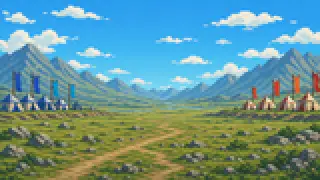
Say Kawanakajima, and most people picture the duel between Shingen and Kenshin. But what remains in southern Nagano City is more than a battle's memory. Matsushiro still carries the daily life of a castle town the Sanada family ruled for 250 years.
The Battles of Kawanakajima are an event passed down through a blend of legend and record. Matsushiro, meanwhile, still holds the traces of a domain school, a lord's residence, and a bell tower, the marks of administration, education, and daily life.
Nagano City's full history is left to its own article; here the battle's memory and Matsushiro's historic sites are kept apart, then traced back together. This is not a rundown of popular warlords either.
The "Memory" of the Kawanakajima Fighting
The Battles of Kawanakajima were not a single clash, but an event that took its present shape through generations of being remembered and retold.
The Standoffs, in Outline
At Kawanakajima, Takeda Shingen of Kai faced off repeatedly against Uesugi Kenshin of Echigo. The Nagano City Museum describes five standoffs and clashes over the twelve years from 1553 to 1564. This was not a single decisive battle but a long-running standoff punctuated by conflict.
Source:長野市立博物館「2階展示室」
The Fourth Battle and Hachimanbara
Of the five standoffs, the fiercest is said to have been the fourth battle, in 1561. Hachimanbara, where it was fought, still holds sites tied to the fighting, including a mound said to hold the heads of the fallen.
Source:長野市立博物館「2階展示室」
Where the Name "Battles of Kawanakajima" Came From
The name "Battles of Kawanakajima" was not used at the time of the fighting itself. The Nagano City Museum traces the name to later military chronicles such as the Koyo Gunkan. It should be understood not as a name given to a single contemporary battle, but as a collective term that took hold through later records.
Source:長野市立博物館「2階展示室」
Legends Kept at the Historic Site Park
The Kawanakajima Kosenjo Historic Site Park holds the Sakasa-Enju, a tree said to have grown from a branch Shingen planted upside down, and a statue depicting the one-on-one duel between Shingen and Kenshin. The statue is the work of the sculptor Tanaka Gekki, giving form to a duel that became fixed in later legend rather than a scene confirmed by historical record.
Source:長野市立博物館「川中島古戦場史跡公園案内」
From Kaizu Castle to Matsushiro Castle
Matsushiro Castle began as Kaizu Castle, a Kawanakajima-era stronghold, before becoming the center of a castle town under the Sanada family.
Kaizu Castle
In the time of the Kawanakajima fighting, Matsushiro Castle was known as Kaizu Castle. It used the Chikuma River as a natural outer moat, and is said to have been laid out by Yamamoto Kansuke on Takeda Shingen's orders. Its exact construction date is unclear, but records confirm it existed by 1560.
Source:真田宝物館「松代城跡」
The Sanada Family's Arrival and 250 Years of Rule
In 1622, Sanada Nobuyuki was transferred from Ueda to Matsushiro, granted 100,000 koku at Matsushiro along with 30,000 koku at Numata in Kozuke. From then on, the Sanada family ruled four districts of northern Shinano for about 250 years across ten generations.
Source:真田宝物館「真田家とは」
Restoring Matsushiro Castle
After the castle was abolished in the Meiji era, only its stone walls remained standing for a long time, until restoration work completed by 2004 rebuilt its turret gate, wooden bridge, stone walls, earthworks, and moat. The restoration, marking 444 years since the castle was first built, coincided with a citywide "Matsushiro Year" campaign and turned it into a destination drawing roughly 800,000 visitors a year.
Source:信州松代観光協会「松代について」
The Administrative, Educational, and Daily Heritage of the Castle Town
Matsushiro's castle town still holds heritage tied to administration, education, and daily life, apart from the story of the battles.
Bunbu Gakko
Bunbu Gakko, the Matsushiro domain school, opened in 1855 under a plan set by the 8th lord, Sanada Yukitsura. Alongside a hall for literary studies, it held practice halls for swordsmanship, jujutsu, archery, and spear fighting, and taught both Eastern and Western medicine as well as Western military science. Unlike most domain schools, it built no Confucius shrine, a point often cited as a sign of its forward-looking, modern character.
Source:真田宝物館「文武学校」
The Sanada Residence and Treasure Museum
The Sanada Residence was built in 1864 for Teishoin, stepmother of the 9th lord, Sanada Yukinori, after a relaxation of the sankin-kotai system allowed daimyo wives and children to return to their home domains. The neighboring Sanada Treasure Museum holds around 50,000 items handed down through the Sanada family, including the Aoe great sword.
Source:真田宝物館「真田邸」
The Old Yokota Residence, Wada Ei, and Rokko-sha
The Old Yokota Residence belonged to a mid-rank samurai family with a stipend of 150 koku, one that held posts such as district magistrate. Wada Ei, connected to this household, traveled to the Tomioka Silk Mill in Gunma during the Meiji era and recorded her experience in the "Tomioka Diary." Matsushiro itself was also home, in the Meiji era, to Rokko-sha, Japan's first privately run French-style mechanized silk-reeling mill, whose high-quality silk was exported abroad.
Sakuma Shozan and the Old Matsushiro Domain Bell Tower
Sakuma Shozan, a Matsushiro retainer, was honored alongside Yamadera Jozan and Kamahara Tozan as one of the "Three Mountains of Matsushiro," a trio of scholars. Employed by the 8th lord, Yukitsura, he worked on coastal defense and the study of Western military science. Shozan is said to have used wire of his own making to run a telegraph experiment from the old Matsushiro domain bell tower to the Oshishaya building, about 70 meters away.
FAQ
Were the Battles of Kawanakajima a single battle?
Popular retellings tend to compress a decade-plus rivalry into one dramatic afternoon, but the record resists that shorthand. Several separate standoffs, spread across a full generation, got flattened into a single legendary name only much later.
Was Matsushiro part of Nagano City from the Edo period onward?
No. Matsushiro-machi merged into Nagano City only in 1966, as part of a large-scale merger that also folded in Shinonoi City and Kawanakajima-machi, among others. Throughout the Edo period, it was an independent domain ruled by the Sanada family.
Did the Sanada family rule Matsushiro until the very end?
Yes. From taking the domain in 1622 until the abolition of the domains in 1871, the Sanada family ruled Matsushiro across ten generations. Succession sometimes passed through adopted heirs, but the position of Matsushiro's lord stayed with the Sanada family throughout.
Can visitors still see Matsushiro's historic sites today?
Yes. Sites including Bunbu Gakko, the Sanada Residence, and the Old Yokota Residence are open to the public, and since the 2004 restoration of Matsushiro Castle sparked the "Matsushiro Year" campaign, the area has drawn roughly 800,000 visitors a year as a well-known destination.