The Hida Takumi: Sanmachi's townhouses and Ichii-Ittobori carving
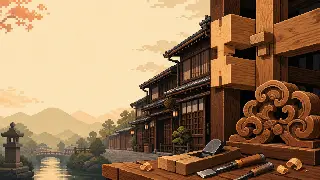
No account of Hida-Takayama's townscape or crafts is complete without the "Hida Takumi" — a woodworking tradition dating back to the ritsuryo era. That tradition lives on today in Sanmachi's townhouse architecture and in netsuke carving. We trace its history and living techniques, with sources.
Under the ritsuryo-era tax system, Hida Province was subject to a special provision that sent woodworking craftsmen, the "Hida Takumi," to the capital instead of paying standard taxes. That woodworking tradition is still spoken of today as the pride of the "Hida Takumi."
That skill lives on in the townhouse architecture preserved in Sanmachi and in traditional crafts such as Ichii-Ittobori carving. We look at how far the craftsmen's techniques spread, centered on townhouses designated National Important Cultural Properties.
Hida Takumi: a woodworking tradition since the ritsuryo era
Under the ritsuryo tax system, Hida Province sent woodworking craftsmen to the capital instead of paying standard taxes — a tradition still celebrated as the Hida Takumi.
Hida no Takumihida no takumi
Under the ritsuryo-era tax system, Hida Province received special treatment: instead of paying the standard taxes (so, yo, cho), it sent woodworking craftsmen to the capital. The craftsmen dispatched under this system were called the "Hida Takumi," and their skill and pride are still spoken of today as the pride of the "Hida no Takumi."
Sanmachi's surviving townhouses
The Meiji-era Kusakabe and Yoshijima Houses, large merchant townhouses famed for their beam structures, were both designated National Important Cultural Properties in 1966.
Kusakabe House (Kusakabe Folk Museum)kusakabe house
The main hall of Kusakabe House was built in 1879 (Meiji 12) by the renowned Hida craftsman Kawashiri Jisuke. A large townhouse of wood construction, partly two stories, measuring 17.4m by 17.3m, it's known for its orderly yet dynamic beam structure. Along with Yoshijima House, it was designated a National Important Cultural Property in 1966.
Source:Important Cultural Property: Kusakabe House (Main Hall, Storehouse, New Storehouse)
Yoshijima Houseyoshijima house
The neighboring Yoshijima House's main hall was built in 1907 (Meiji 40), about 30 years after Kusakabe House. Its impressive beams and roof framing around the open atrium show a refined townhouse craftsmanship. Both houses are merchant townhouses, not samurai residences.
Source:Yoshijima House (Oshin-machi, Takayama City, Gifu Prefecture) - Main Hall
Craftsmanship living on in the arts
The tradition lives on in Ichii-Ittobori — yew carvings finished with only a knife and left uncolored — and can be explored at the Hida Takayama Museum of History and Art.
Ichii-Ittobori carvingichii ittobori
Ichii-Ittobori is a traditional craft developed in the late Edo period by netsuke carvers from Takayama, including Hirata Ryocho and Matsuda Ryocho. It's carved from Japanese yew (ichii) wood using only a carving knife and left uncolored, giving it a simple charm that showcases the wood's natural grain and tone.
Hida Takayama Museum of History and Artmachi no hakubutsukan
The Hida Takayama Museum of History and Art's distinctive feature is that it uses the actual storehouses once used by a leading Takayama merchant house as its exhibition space. It introduces Takayama's history and culture broadly, from Enku Buddhist carvings and craft works like Ichii-Ittobori and Shunkei lacquerware to materials on the Kanamori clan, sake brewing, and the Takayama Festival.
FAQ
Who were the "Hida Takumi"?
In effect, people who paid their taxes with skilled labor rather than goods. Where farmers elsewhere sent harvests to the capital, Hida sent its craftsmen instead — an unusual arrangement said to be the root of the pride still attached to the name today.
What's the difference between Kusakabe House and Yoshijima House?
Both are leading examples of Takayama townhouse architecture, standing next to each other and both National Important Cultural Properties. They were built at different times: Kusakabe House in 1879, and Yoshijima House in 1907, about 30 years later.