Living and Preservation in Shirakawa-go: Keeping a Landscape Alive
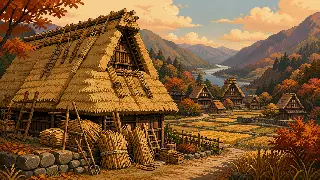
Shirakawa-go is not a town frozen for display. Residents continue to live there while maintaining roofs, houses, fields, and waterways. This article follows Ogimachi’s preservation movement through its local principles, mutual-help vocabulary, and two different ways of keeping houses alive.
In Ogimachi, residents formed a preservation organization in 1971 and shared three principles: do not sell, do not rent out, and do not demolish. World Heritage inscription came in 1995, but the foundations of preservation were built locally before the listing.
Maintaining gassho houses also requires large collective jobs, especially re-thatching. The mutual-help practice known as yui and the relocated houses displayed at Gassho Minkaen connect conservation with both community life and learning.
Three principles for continuing to live there
Ogimachi guards its landscape through three principles — do not sell, rent out, or demolish — upheld by a residents' organization founded in 1971 while people keep living there.
Do not sell, rent out, or demolish
The principles associated with Ogimachi’s preservation are not to sell, rent out, or demolish the gassho houses. The idea is to protect the landscape while residents continue living there, rather than replacing community life with a visitor-only display.
Ogimachi’s preservation organization
Shirakawa’s preservation history records the founding of a residents’ organization to protect Ogimachi’s natural environment in 1971. That local effort came before the 1976 preservation-district designation, the 1987 fund ordinance, and the 1995 World Heritage inscription.
The community work behind a roof
Re-thatching a gassho roof is too large for one household, so the mutual-help practice of yui and stores of bundled thatch sustain the roofs.
Yui
Re-thatching a gassho roof is too large a job for a household to complete alone. The practice called yui is a local system of mutual help in which people cooperate on such work. It shows that the skills and relationships supporting the buildings are part of the heritage too.
Preparing thatch
Long-term roof maintenance depends on materials as well as the day of the repair. Shirakawa’s preservation material uses the term nyu for bundled thatch kept for future use. Behind a preserved landscape is a cycle of growing, preparing, storing, and using material.
Two places that communicate preservation
Wada House, an Important Cultural Property still lived in today, and the open-air Gassho Minkaen museum embody two different ways of preserving gassho houses.
Wada House
Wada House is an Important Cultural Property of Japan, with about 300 years of history, and is still used as a residence. Because it remains connected to everyday life, it is a reminder not to treat cultural properties simply as old objects removed from the present.
Gassho Minkaen
Gassho Minkaen is an open-air museum that preserves and displays houses relocated from different places. Comparing it with Wada House, which remains a working residence, shows that there is more than one way to preserve a gassho building and its story.
FAQ
What attitude do the three preservation principles express?
They connect decisions about property with the community’s landscape and everyday life.
Who takes on a major gassho roof repair?
The work is shared through local cooperation rather than left to the household alone.