Nara City Local Quiz Practice: Questions and Explanations
15QEasyIntermediateAdvanced
Review questions from the real quiz with answers, explanations and sources. Think it through first, then reveal the correct answer.
This is a selection from the question pool — the real quiz also draws questions you won’t find here.
Last updated: 2026-09-14
EasyTier 1 — 5 questions
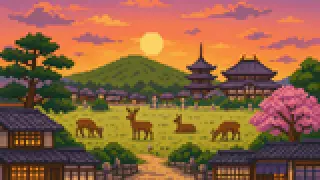
In Nara City, 奈良公園と鹿 begins with three local clues: the large eastern-city park where lawns and shrines and temples connect. deer living around the park and forming part of its cultural landscape. the head temple of the Kegon school enshrining the Great Buddha of Nara. Use those details to place each name, role, and season on a mental map. After choosing an answer, follow the cited source and turn a guess into a grounded picture of the area.
Q1.Opened in 1880 (Meiji 13), which roughly 660-hectare park holds Todai-ji, Kofuku-ji, Kasuga Taisha, and the Nara National Museum all within its grounds?
Nara Park
the Okina dance
The structure standing today dates from a 1426 reconstruction, and at 50.1 meters it ranks second among Japan's wooden pagodas after To-ji's
Heijo Palace Site
Reveal the correct answer
Correct answerNara Park
This park opened in 1880 and covers about 660 hectares, with Todai-ji, Kofuku-ji, Kasuga Taisha, and the Nara National Museum all sharing its grounds. For more than 140 years it has served as a green space right beside the city center.
Q2.Designated a national natural monument in 1957, what is the collective name for the deer living around Nara Park?
Rokuen Deer Park
Nara deer
Mt. Wakakusa
Tamukeyama Hachiman Shrine
Reveal the correct answer
Correct answerNara deer
The deer around Nara Park were designated a national natural monument, known as the 'Nara Shika,' in 1957. Tied to a legend that names them divine messengers, they are still carefully protected today. Stalls selling "shika senbei" deer crackers dot the park, drawing the familiar sight of visitors feeding the deer by hand.
Q3.Built in the 8th century at Emperor Shomu's request, which head temple of the Kegon school held the eye-opening ceremony for its Great Buddha in 752?
Shiga Naoya's Former Residence
Kofuku-ji Sanjunoto
Todai-ji
Gango-ji Temple
Reveal the correct answer
Correct answerTodai-ji
Built in the 8th century at Emperor Shomu's request, this temple serves as the head temple of the Kegon school. The eye-opening ceremony for its principal image, the Great Buddha (Vairocana), took place in 752, and it has stood since as one of Japan's defining works of Buddhist architecture.
Q4.Which terminus of the Kintetsu Nara Line has its entire station built underground?
Naramachi
Yamato-Saidaiji Station
Kyobate Station
Kintetsu Nara Station
Reveal the correct answer
Correct answerKintetsu Nara Station
This station is the terminus of the Kintetsu Nara Line, with the platforms, ticket gates, and every other part of the station built underground. Once above ground, both Nara Park and Naramachi are within easy walking distance. The station went underground in 1970, and its plaza above features a fountain statue of the monk Gyoki.
Q5.Wrapped and pressed with fish such as mackerel inside persimmon leaves, which Nara local sushi is this?
Kakinoha-zushi
Okina Mai
Miwa somen
Yamato tea
Reveal the correct answer
Correct answerKakinoha-zushi
In the Yoshino and Gojo areas, far from the coast, fish had to be kept fresh on the long trip inland. This pressed sushi, wrapped in persimmon leaves, is said to have grown out of that very need. The leaves' natural antibacterial properties helped preserve the fish, and the dish remains a beloved local specialty today.
In Nara City, 社寺と世界遺産 begins with three local clues: the hall at the temple that houses the Rushana Buddha. the ancient Nara shrine backed by the natural area. the temple known for its pagoda overlooking the pond. Use those details to place each name, role, and season on a mental map. After choosing an answer, follow the cited source and turn a guess into a grounded picture of the area.
Q6.Which building at Todai-ji, the main hall, houses the principal image of Rushana Buddha, known as the Great Buddha of Nara?
Shosoin Repository
Hannya-ji Temple
Great Buddha Hall
Todai-ji Nigatsu-do
Reveal the correct answer
Correct answerGreat Buddha Hall
The current Great Buddha Hall was rebuilt in 1709, the third version after the original and a Kamakura-era reconstruction. Its frontage is somewhat narrower than the original, but it remains one of the largest wooden buildings in the world.
Q7.Which of Todai-ji's gates, rebuilt in the Kamakura period by the priest Chogen using elements of Song-dynasty style, is the temple's grand entrance and one of Japan's largest surviving two-story gates?
Todai-ji Oyuya
Tegai-mon Gate
Todai-ji Kanjinjo
Nandaimon Gate
Reveal the correct answer
Correct answerNandaimon Gate
Nandaimon is Todai-ji's main gate. The original Nara-period gate blew down in the Heian period; the current gate was rebuilt in the Kamakura period by the priest Chogen, incorporating Song-style (daibutsuyo) construction. Its ridge was raised in 1199 and it was completed in 1203 together with the Kongo Rikishi guardian statues it houses.
Q8.Which temple was founded in 669 as the clan temple of the Fujiwara family?
Kofuku-ji Temple
Yakushi-ji Temple
Shin-Yakushi-ji Temple
Nara Park
Reveal the correct answer
Correct answerKofuku-ji Temple
Kofuku-ji Temple was founded in 669 as the Fujiwara clan temple and was relocated to its present site in 710 with the move of the capital to Heijo-kyo.
Q9.Which old town, developed around the former precinct of Gango-ji Temple, still has many Edo-period townhouses standing?
Former Daijo-in Garden
Naramachi
Yoshikien Garden
Naramachi Karakuri Toy Museum
Reveal the correct answer
Correct answerNaramachi
Naramachi is the old town that grew up around Gango-ji's former precinct, still lined with Edo-period merchant houses. Many of these lattice-fronted houses with mushiko windows have been converted into cafes and craft workshops popular with visitors.
In Nara City, ならまちの暮らし begins with three local clues: the pagoda in the temple precinct that shapes the Nara skyline. the heritage temple in the downtown district included in the Historic Monuments of Ancient Nara. a base on the south side of the palace site for learning about the ancient capital. Use those details to place each name, role, and season on a mental map. After choosing an answer, follow the cited source and turn a guess into a grounded picture of the area.
Q11.Which pagoda within Kofuku-ji is said to have been founded in 730 at the request of Empress Komyo?
Five-story Pagoda
Chukondo Hall
Nandaimon Gate
Tegai-mon Gate
Reveal the correct answer
Correct answerFive-story Pagoda
Kofuku-ji's five-story pagoda is said to have been founded in 730 at the request of Empress Komyo. Rebuilt several times after fires, the current pagoda dates from the Muromachi period and, at about 50 meters, is Japan's second-tallest wooden pagoda after Toji's.
Q12.Which temple is said to originate from the relocation of Asuka's Hoko-ji (Asuka-dera) to Heijo-kyo in 718?
JR Nara Station
Gango-ji
Hannya-ji
Naramachi old town
Reveal the correct answer
Correct answerGango-ji
Gango-ji traces its origin to Hoko-ji (Asuka-dera) in Asuka, moved to Heijo-kyo in 718. A small number of roof tiles on the Gokurakubo main hall are said to date from the temple's original Asuka-period construction, making them some of the oldest roof tiles in Japan.
Q13.Which temple lost most of its halls, including the Great Buddha Hall, to fire in 1180 when Taira no Shigehira's forces attacked, and was later rebuilt by the monk Chogen?
the seated statue of Ganjin
Kintetsu Nara Station
Todai-ji
Kongo Rikishi Statues
Reveal the correct answer
Correct answerTodai-ji
Todai-ji lost most of its halls, including the Great Buddha Hall, in the 1180 burning of the southern capital by Taira no Shigehira's forces, and was rebuilt in the Kamakura period by the monk Chogen. Chogen introduced construction techniques from Song-dynasty China known as the "Daibutsuyo" style, still visible in features like the Great South Gate.
Q14.Which 342-meter mountain, with three tiers of grassy slopes, is also known as Mount Mikasa?
Mt. Takamado
Shiga Naoya's Former Residence
Kongo Rikishi Statues
Mount Wakakusa
Reveal the correct answer
Correct answerMount Wakakusa
Mount Wakakusa stands 342 meters tall, its grassy slope rising in three terraced tiers, and is also called Mount Mikasa. Every January it hosts the "Yamayaki," a controlled burn of the dried grass whose flames light up the night sky as a winter tradition in Nara.
Q15.Which forest has remained untouched ever since hunting and logging were banned there in 841 as sacred grounds of Kasuga Taisha?
Kasugayama Primeval Forest
Kasuga Taisha Man'yo Botanical Garden
Mount Wakakusa
Mt. Takamado
Reveal the correct answer
Correct answerKasugayama Primeval Forest
Kasugayama Primeval Forest has kept its old-growth state since 841, when hunting and logging were banned as it became sacred ground for Kasuga Taisha. Untouched by human hands for over a thousand years, this broadleaf evergreen forest is also registered as a World Heritage site.