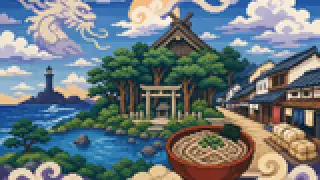
Izumo Local Quiz Practice: Questions and Explanations
15QEasyIntermediateAdvanced
Review questions from the real quiz with answers, explanations and sources. Think it through first, then reveal the correct answer.
This is a selection from the question pool — the real quiz also draws questions you won’t find here.
Last updated: 2026-09-14
EasyTier 1 — 5 questions
In Izumo, 出雲大社と神話 begins with three local clues: the Izumo shrine enshrining Okuninushi-no-Okami. the myth-linked beach west of the shrine. the varied coastal landscape at the western tip of the Shimane Peninsula. Use those details to place each name, role, and season on a mental map. After choosing an answer, follow the cited source and turn a guess into a grounded picture of the area.
Q1.Which shrine enshrines Okuninushi-no-Okami, god of nation-building and en-musubi, and is approached via Shinmon-dori street and the Ukabashi Grand Torii?
Izumo Taisha
Tatsumushi Shrine
Inochinushi Shrine
Gakuenji Temple
Reveal the correct answer
Correct answerIzumo Taisha
Okuninushi-no-Okami is the resident deity of Izumo Taisha, credited both with building the nation in myth and with tying the bonds — en-musubi — between people. Visitors reach the sanctuary by way of Shinmon-dori street and the towering Ukabashi Grand Torii. Izumo is also tied to the legend that every deity in Japan gathers here each tenth lunar month — the one month elsewhere called "godless," but in Izumo alone called "the month the gods are present."
Q2.According to the Kojiki, which beach was the stage for the kuni-yuzuri (land-transfer) negotiation between Okuninushi and Amaterasu's envoy?
Udo
Inasa Beach
Fumishima's black-tailed gulls
Inume Coast
Reveal the correct answer
Correct answerInasa Beach
Inasa Beach, just west of Izumo Taisha, is traditionally identified as the shore where Okuninushi met Amaterasu's messenger and agreed to cede the land — the kuni-yuzuri myth that anchors Izumo's whole mythological status.
Q3.Which headland forms the western tip of the Shimane Peninsula, its cliffs dropping straight into the Sea of Japan?
Fumishima's black-tailed gulls
Sagiura
Hinomisaki
Inume Coast
Reveal the correct answer
Correct answerHinomisaki
Hinomisaki sits at the far western edge of the Shimane Peninsula. Its rugged, wave-cut cliffs are what eventually made a lighthouse here a practical necessity, not just scenery.
Q4.Which Meiji-era lighthouse at Hinomisaki was completed in 1903?
Owashi Beach
Fumishima's black-tailed gulls
Sagiura
Izumo Hinomisaki Lighthouse
Reveal the correct answer
Correct answerIzumo Hinomisaki Lighthouse
Izumo Hinomisaki Lighthouse was completed in 1903, near the end of the Meiji era, as part of a wave of stone lighthouses built to mark Japan's coastline for modern shipping. At about 43.65 meters, it is the tallest stone lighthouse in Japan and is listed among the world's 100 great lighthouses, with a spiral staircase leading up to an observation deck.
Q5.Which shrine is built as two vermilion, Momoyama-style halls rather than a single sanctuary?
Hinomisaki Shrine
Amasaki-sha Shrine
the Ukabashi Grand Torii
Seidamari Plaza
Reveal the correct answer
Correct answerHinomisaki Shrine
Hinomisaki Shrine is unusual for having two separate vermilion halls in Momoyama style, built at different elevations, instead of one main sanctuary — a layout tied directly to the two deities it enshrines.
In Izumo, 海岸と灯台 begins with three local clues: the shrine building noted for its large shimenawa. the important gate surrounding the shrine’s honden. the sub-shrine at Izumo’s main shrine enshrining Susanoo. Use those details to place each name, role, and season on a mental map. After choosing an answer, follow the cited source and turn a guess into a grounded picture of the area.
Q6.Which gate in front of Izumo Taisha's Honden takes its name from the eight pillars supporting it?
Harae-no-Yashiro
the Bronze Torii
Yatsuashi-mon Gate
the Pine Approach
Reveal the correct answer
Correct answerYatsuashi-mon Gate
Yatsuashimon Gate takes its name from the eight pillars ("eight legs") that support its structure, and stands directly in front of the honden. It is a Registered Tangible Cultural Property, and ordinary worshippers can normally approach no further than this gate — a close view of the honden is reserved for limited special visits.
Q7.Which shrine, standing directly behind the Honden, enshrines Susanoo, held to be Okuninushi's father?
the Seidamari Torii
Harae-no-Yashiro
Yatsuashi-mon Gate
Sogano-yashiro
Reveal the correct answer
Correct answerSogano-yashiro
Sogano-yashiro sits directly behind the honden and enshrines Susanoo, regarded as the father of Okuninushi. The Yakumo hill rising behind the shrine is treated as sacred ground closed to entry, and visitors customarily touch the rock behind the building as part of their prayer.
Q8.Which Ichibata Railway station sits within walking distance of Momen Kaido?
Unshu-Hirata Station
Takahama Station
JR Izumoshi Station
Yokan Station
Reveal the correct answer
Correct answerUnshu-Hirata Station
Unshu-Hirata Station is an Ichibata Railway stop and the closest station to Momen Kaido. The street around it still lines up Edo- and Meiji-era merchant houses and white-walled storehouses from its days as a cotton-trading hub.
Q9.Which station serves as the terminus of Ichibata Railway's Kitamatsue Line?
Hamayama-koen-kitaguchi Station
Dentetsu-Izumoshi Station
Izumo-taishamae Station
Yokan Station
Reveal the correct answer
Correct answerDentetsu-Izumoshi Station
Dentetsu-Izumoshi Station is the terminus of the Ichibata Railway's Kitamatsue Line and sits next to the separately run JR Izumoshi Station. The Ichibata Railway links Izumo Taisha with the Matsue Shinjiko Onsen area and is affectionately known locally as "Bataden."
Q10.Which river, flowing to Lake Shinji, is traditionally identified as the site of Susanoo's slaying of the Yamata-no-Orochi?
the Kando River
Izumo Taisha-cho
the Hii River
Kamimukae-no-michi
Reveal the correct answer
Correct answerthe Hii River
The Hii River flows through the Izumo Plain to Lake Shinji and is traditionally identified as the river where Susanoo slew the Yamata-no-Orochi. Known historically as a flood-prone river, its bed is said to have risen over the centuries from sediment washed down by tatara ironworking upstream.
In Izumo, 平田の商い begins with three local clues: the shrine sub-shrine enshrining Amaterasu. a sub-shrine of a vermilion coastal shrine enshrining Susanoo. the pebble beach in the cove behind the coast Lighthouse. Use those details to place each name, role, and season on a mental map. After choosing an answer, follow the cited source and turn a guess into a grounded picture of the area.
Q11.Said to guard the direction where the sun sets and paired in legend with Ise Jingu, which lower shrine of Hinomisaki Shrine is this?
Hinoshizumi-no-miya
Izumo Taisha
Kami-no-miya
Haiden
Reveal the correct answer
Correct answerHinoshizumi-no-miya
Hinoshizumi-no-miya carries a legend that it guards the direction where the sun sets, forming a pair with Ise Jingu, which is said to guard the sun's own home. It is the lower shrine of Hinomisaki Shrine and enshrines Amaterasu Omikami. It sits lower on the grounds than the upper shrine, Kami-no-Miya, with the two structures facing one another.
Q12.Standing higher than the lower shrine Hinoshizumi-no-miya and enshrining Susanoo-no-Mikoto, which is the upper shrine of Hinomisaki Shrine?
Izumo Taisha
Kami-no-miya
Karakama Shrine
Tsukushi Shrine
Reveal the correct answer
Correct answerKami-no-miya
Kami-no-Miya is the upper shrine of Hinomisaki Shrine, set higher than the lower Hi-shizumi-no-Miya, and enshrines Susanoo. Hi-shizumi-no-Miya is said to watch over the night while Kami-no-Miya watches over the day, the two forming one shrine together.
Q13.Which small pebble beach sits in a cove behind the Izumo Hinomisaki Lighthouse?
Fumishima's black-tailed gulls
Hinomisaki
Owashi Beach
Benten-jima Island
Reveal the correct answer
Correct answerOwashi Beach
Owashi Beach is a small pebble cove tucked behind the Izumo Hinomisaki Lighthouse. Enclosed by the cliffs of Hinomisaki, this quiet inlet is also known as a photogenic spot for viewing the sunset together with the lighthouse.
Q14.Built in 1924 in Japanese style and registered as a National Important Cultural Property, which station building is this?
JR Izumoshi Station
Dentetsu-izumoshi Station
Izumo-taishamae Station
Former Taisha Station
Reveal the correct answer
Correct answerFormer Taisha Station
The former Taisha Station, built in 1924 in a Japanese architectural style, is registered as a National Important Cultural Property. Before it closed in 1990, it is said to have served dignitaries as a gateway to Izumo Taisha. The station building, platform, and a preserved steam locomotive remain on site much as they looked in operation.
Q15.Which town was once its own independent city before merging into Izumo City in 2005?
Hirata
Izumo Taisha-cho
Taki
Izumo Kizuki
Reveal the correct answer
Correct answerHirata
Hirata was formerly its own city, having prospered through river trade and the cotton business on the western shore of Lake Shinji, before merging into Izumo City in 2005.