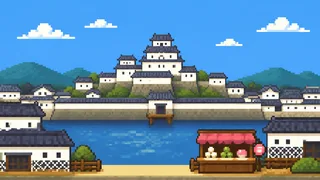
Himeji Local Quiz Practice: Questions and Explanations
40QEasyIntermediateAdvanced
Review questions from the real quiz with answers, explanations and sources. Think it through first, then reveal the correct answer.
This is a selection from the question pool — the real quiz also draws questions you won’t find here.
Last updated: 2026-09-14
EasyTier 1 — 10 questions
Ten questions open the file on Himeji, covering the story behind the White Egret nickname, the first grand gate on the walk toward the keep, and the year UNESCO recognized the castle as a World Heritage property. The set does not stop at the moat: it takes in the scattered islands offshore in the strait to the south, the ropeway climbing toward Mount Shosha, the shrine festival known for crashing portable shrines together, and two dishes born in local kitchens. Answer every one correctly and you are ready to walk a first-time visitor through the city yourself. Opening each answer reveals the sourced reasoning behind it.
Q1.What is Himeji Castle's well-known alternate name?
Black Egret Castle
White Egret Castle
Silver Egret Castle
Blue Egret Castle
Reveal the correct answer
Correct answerWhite Egret Castle
Himeji Castle earned the nickname White Egret Castle because its main keep and surrounding towers, finished in white plaster, were likened to a white heron spreading its wings in flight. That nickname has since become the shorthand the city itself is known by, well beyond castle enthusiasts.
Q2.In what year was Himeji Castle registered as a World Heritage Site?
1983
2013
2003
1993
Reveal the correct answer
Correct answer1993
Himeji Castle was inscribed as a UNESCO World Heritage Site in 1993, alongside Nara's Horyuji Temple, making the pair the first properties in Japan to receive that designation. The recognition reflects how rare it is for a wooden castle of this scale to survive largely unaltered into the present day.
Q3.Which well-known gate do visitors pass first at the entrance to Himeji Castle?
Water Gate
Ote Gate
Sakura Gate
Hishi-no-mon Gate
Reveal the correct answer
Correct answerHishi-no-mon Gate
Hishi-no-Mon is the imposing two-story gate that marks where the approach to the keep truly begins, just past the Sannomaru grounds; it ranks among the largest surviving gates anywhere in the castle. Diamond-shaped crests carved into its beams, from which it takes its name, still hint at the decorative taste of the Momoyama era.
Q4.Himeji Castle is one of Japan's "12 original castles," whose keeps have survived from before the Edo period. How many castles make up that group?
8
10
12
15
Reveal the correct answer
Correct answer12
Himeji Castle is counted among Japan's twelve original castles, a group whose keeps predate the Meiji era rather than being postwar reconstructions. Of those twelve, only five, Himeji included, carry the added distinction of National Treasure status, placing it in an especially select tier of surviving castle architecture.
Q5.What is the collective name for the more than 40 islands belonging to Himeji City in Harima Nada?
Ieshima Islands
Shodoshima
Awaji Islands
Naoshima
Reveal the correct answer
Correct answerIeshima Islands
The Ieshima Islands are an archipelago of more than forty islands and islets scattered in the sea south of Himeji, though only a handful of them are actually inhabited. Blessed with sheltered harbors, the group has thrived on fishing and shipping since the Edo period, giving Himeji its maritime, seafaring side.
Koko-en is a strolling Japanese garden built on the former West Residence grounds, right beside World Heritage Himeji Castle, where the domain's ruling family once lived. Its name is said to come from Kokodo, an Edo-period domain school that once stood near the garden's entrance, and its several distinctly styled garden spaces let visitors catch views of the keep as they wander through.
Q7.What kind of vehicle carries visitors up to the top of Mt. Shosha?
A ropeway
A cable car on rails
A chairlift
A monorail
Reveal the correct answer
Correct answerA ropeway
The Shoshazan Ropeway links a station at the foot of Mount Shosha with one near its summit, carrying visitors up to an ancient temple complex that spreads across the mountaintop. A hiking trail covers the same climb in nearly an hour on foot; the ropeway does it in a few scenic minutes.
Q8.What do participants do with the portable shrines at the "Nada Fighting Festival"?
Crash them into each other
Set them adrift at sea
Burn them
Just display them without carrying them
Reveal the correct answer
Correct answerCrash them into each other
The Nada Fighting Festival is the autumn grand festival of Matsubara Hachiman Shrine, famous for the dramatic clash of three portable shrines carried by rival groups. Seven former villages along the coast, including Shikama and Shirahama, each field a festival float, making it one of the most physical, high-energy festivals in the Banshu region.
Q9.Which kaiten-yaki (imagawayaki-style) sweet brand originated in Himeji?
Gozasoro
Naruto Kintoki
Ajarimochi
Sakadura Sohonpo
Reveal the correct answer
Correct answerGozasoro
Gozasoro is a Himeji-based confectionery chain specializing in kaiten-yaki, the round griddle-baked sweet also known as imagawayaki, sold with both white bean and red bean fillings as its signature options. It has grown from its Himeji roots into shops across the Kansai region and is a familiar gift item for locals.
Q10.What is the Himeji local dish that combines yaki-udon and yakisoba?
Chanpon-yaki
Himeji Oden
Ekisoba
Hine-pon
Reveal the correct answer
Correct answerChanpon-yaki
Chanpon-yaki is a Himeji specialty that combines yaki-udon and yakisoba on the same griddle, letting diners taste the contrasting textures of two different noodles in a single dish. It has remained a long-standing favorite at local teppan restaurants around the city, distinct from the champon noodle soup found elsewhere in Japan.
The next fifteen move past postcard facts into territory where daily familiarity with Himeji stops being enough: the year the castle first earned National Treasure status, the egret worked into the city's official emblem, the gate marking the Sannomaru entrance, and the precise way Himeji Oden gets served at the counter. Municipal history threads through as well, from why the zoo and the centennial garden were each built to mark a civic milestone, to the decades-long friendship with Phoenix, Arizona, and the reasoning behind an armor-making family's pivot to making wind chimes. Read carefully, since several of these hinge on distinguishing a plausible-sounding neighbor from the real answer.
Q11.In what year was Himeji Castle designated a National Treasure?
1961
1945
1951
1931
Reveal the correct answer
Correct answer1931
Himeji Castle was first designated a National Treasure in 1931 under the old preservation law, and received that status again in 1951 once Japan's postwar Cultural Properties Protection Law took effect. The re-designation reflected renewed recognition of how significant its main keep and surrounding buildings are as heritage architecture.
The Sanyo Shinkansen stops only at Himeji Station within the city, which functions as the gateway connecting to local trains and buses heading toward Himeji Castle. Nishi-Akashi and Aioi also have Shinkansen platforms, which can be confusing, but both of those stations actually sit outside Himeji's city limits.
Q13.Which annual Himeji summer festival is known for yukata?
Himeji Castle Festival
Himeji Yukata Festival
Nada Fighting Festival
Mount Shosha Festival
Reveal the correct answer
Correct answerHimeji Yukata Festival
The Himeji Yukata Festival is the city's summer festival known for the sea of yukata-clad visitors who fill its streets, with food stalls and dance performances that invite heavy community participation. It has become a fixture of the Himeji summer, when residents in yukata are a common sight around town.
Himeji's city emblem features a white egret, drawing on the long-standing tradition of comparing the castle's graceful, white-plastered silhouette to the bird in flight. By overlapping the image of the castle with that of the egret, the emblem ties the city's civic identity directly to its castle-town history.
Q15.Which gate is at the entrance to Himeji Castle's Sannomaru?
Sakura Gate
Hishi-no-Mon Gate
Ote Gate
Water Gate
Reveal the correct answer
Correct answerSakura Gate
Sakura Gate stands at the entrance to Himeji Castle's Sannomaru bailey, the first gate visitors pass through when approaching from Otemae-dori. Beyond it lies the open Sannomaru grounds, followed by the inner gates, including Hishi-no-Mon, that lead progressively closer to the keep complex itself.
Q16.What is characteristic of how Himeji oden is eaten?
Served with ginger soy sauce
Coated with miso
Eaten with only yuzu pepper
Topped with kuromitsu syrup
Reveal the correct answer
Correct answerServed with ginger soy sauce
Himeji Oden is defined less by its ingredients than by how it's eaten: the simmered fish cakes and vegetables are dipped in, or topped with, ginger-infused soy sauce. Any oden served this way came to be collectively called Himeji Oden, a style now familiar in both home kitchens and local restaurants.
Himeji's official city butterfly is the Chinese windmill, a large swallowtail whose Japanese name, jakou-ageha, refers to the musk-like scent given off by the adult males. Conservation efforts within the city aim to protect its habitat, and the butterfly has become a well-loved symbol of Himeji alongside the egret.
Q18.In what year did Koko-en open next to Himeji Castle?
1985
1992
2001
2010
Reveal the correct answer
Correct answer1992
Koko-en opened in 1992 as a commemorative project marking the 100th anniversary of Himeji's incorporation as a city, built right beside the castle as a strolling Japanese garden. It was laid out over excavated remains of Edo-period samurai residences, giving a newer attraction a genuine sense of the castle town's history.
Q19.What was Himeji Municipal Zoo's opening meant to commemorate?
The signing of the Japan-US peace treaty
Himeji Castle's World Heritage listing
Himeji's 100th anniversary as a city
Hosting the National Sports Festival
Reveal the correct answer
Correct answerThe signing of the Japan-US peace treaty
The decision to build Himeji Municipal Zoo was made by the city council in September 1951 to commemorate the signing of the Treaty of San Francisco, the peace treaty that formally ended the Allied occupation of Japan. The zoo opened that December, becoming one of the symbols of Himeji's postwar recovery.
Q20.Which island is NOT one of the four inhabited islands of the Ieshima Islands?
Ieshima
Ogashima
Shodoshima
Nishijima
Reveal the correct answer
Correct answerShodoshima
The Ieshima Islands' four inhabited islands are Ieshima, Ogashima, Bouzejima, and Nishijima; Shodoshima, though it sits in the same Seto Inland Sea and belongs to Hyogo Prefecture, is not one of them. The geographic proximity of these islands to Shodoshima makes this a classic point of confusion in quizzes about the area.
Q21.In what year did Himeji City sign its sister-city agreement with Phoenix, Arizona?
1964
1976
1985
1993
Reveal the correct answer
Correct answer1976
Himeji signed a sister-city agreement with Phoenix, Arizona, in 1976, one of the earliest such partnerships the city established overseas. In the decades since, the relationship has grown to include student exchange programs and cultural exchange centered on Japanese gardens, sustaining an active friendship between the two cities.
Q22.On which dates is the Nada Fighting Festival held every year?
October 14-15
August 14-15
November 3
Coming-of-Age Day in January
Reveal the correct answer
Correct answerOctober 14-15
The Nada Fighting Festival, the autumn grand festival of Matsubara Hachiman Shrine, is held every year on October 14 and 15. Across those two days, the seven former villages parade their festival floats, culminating on the final day in the dramatic clash of portable shrines that gives the festival its name.
Q23.Why did the Myochin family shift from Edo-era armor making to making firetong wind chimes?
To open a new field using their armor-making skills
To sell souvenirs at Himeji Castle
To make musical instruments
To make ceremonial items for temples
Reveal the correct answer
Correct answerTo open a new field using their armor-making skills
The Myochin family had served as official armor makers for the Himeji domain, but when the Meiji-era abolition of the domains ended demand for armor, they redirected their metalworking skills toward a new craft: making firetongs. Later generations went on to develop further new products, letting their forging techniques survive into the present day.
Q24.Which clan ruled Himeji Domain from 1749 until the end of the Edo period?
The Ikeda clan
The Honda clan
The Matsudaira clan
The Sakai clan
Reveal the correct answer
Correct answerThe Sakai clan
The Sakai clan took over Himeji Domain in 1749, moving in from Maebashi Domain in Kozuke Province, and went on to rule Himeji continuously until the Meiji Restoration. That long tenure stands in contrast to the earlier decades, when the Ikeda, Honda, and other clans changed hands in quick succession.
Q25.Which top-grade sake rice is widely used in sake brewing in the Himeji area?
Yamada Nishiki
Koshihikari
Akitakomachi
Hitomebore
Reveal the correct answer
Correct answerYamada Nishiki
Sake brewing across the Himeji and wider Banshu region relies heavily on Yamada Nishiki, widely regarded as the finest sake rice available. Bred originally in Hyogo Prefecture, its large grains and well-formed starchy core make it easier to brew into clean, refined sake with relatively little off-flavor.
The final fifteen sit closest to the keep's own construction records: the nine years Ikeda Terumasa spent rebuilding the tower we see today, the mismatch between its five visible tiers and its actual floor count, the roughly one thousand loopholes still built into its walls, and the mountaintop temple complex reached by way of the ropeway introduced earlier. Ordering questions and multi-select formats show up here too, asking you to line up milestones for the zoo, the ropeway, and a trio of local mountains by elevation. Work through this set and the deeper register of Himeji's history starts to come into focus.
Q26.In what year was Himeji Castle's main keep completed?
1580
1600
1639
1609
Reveal the correct answer
Correct answer1609
Today's main keep at Himeji Castle was built by Ikeda Terumasa, who was awarded the castle for his role at the Battle of Sekigahara and spent nine years, from 1601 to 1609, rebuilding it on a far grander scale. He expanded on the three-story keep Toyotomi Hideyoshi had raised there decades earlier.
Q27.How many floors does Himeji Castle's main keep have including the basement?
6 floors
7 floors
8 floors
9 floors
Reveal the correct answer
Correct answer7 floors
Seen from the outside, Himeji Castle's main keep appears to have five tiers, but internally it is built with six floors above ground plus one basement level, seven floors in total. This mismatch between the exterior's tier count and the interior's actual floor count is a common feature of Japanese castle keeps.
Q28.What are the openings set into the walls as defensive facilities at Himeji Castle?
A storehouse
A stone wall
Loopholes
A well
Reveal the correct answer
Correct answerLoopholes
Sama are small openings cut into the walls of the keep and surrounding ramparts, used to shoot arrows or matchlock guns at attackers from inside. Roughly a thousand of these openings survive within Himeji Castle's inner bailey today, with elongated rectangular ones built for arrows and round, triangular, or square ones sized for firearms.
Q29.Which bailey spreads to the west of Himeji Castle?
Higashi-no-Maru Bailey
Minami-no-Maru Bailey
Kita-no-Maru Bailey
Nishi-no-Maru Bailey
Reveal the correct answer
Correct answerNishi-no-Maru Bailey
Nishi-no-Maru is the bailey spreading across the western side of Himeji Castle, known for buildings still standing there associated with Princess Sen, who came to live at the castle after the Siege of Osaka. It is also a popular spot for viewing the keep as a single, unified silhouette from the west.
Q30.Which temple is on Mount Shosha in Himeji City?
Engyoji Temple
Kiyomizudera Temple
Chusonji Temple
Eiheiji Temple
Reveal the correct answer
Correct answerEngyoji Temple
Engyoji is an ancient Tendai-sect temple whose halls spread across the summit of Mount Shosha in western Himeji, said to have been founded in 966 by the monk Shoku. Sometimes called the 'Mount Hiei of the West,' the mountaintop temple complex includes buildings that jut dramatically out over the cliffside terrain.
Source:Official Himeji City and Himeji Tourism Convention Bureau information
Q31.How many animal species were kept at Himeji Municipal Zoo when it opened in December 1951?
6 species
16 species
26 species
36 species
Reveal the correct answer
Correct answer16 species
When Himeji Municipal Zoo opened in December 1951, its collection amounted to just 16 species and 56 animals in total, a modest start shaped by the material shortages of the postwar reconstruction years. That small opening-day roster stands in sharp contrast to the far larger, more diverse collection the zoo maintains today.
Q32.In what Showa year were the Ieshima Islands incorporated into Setonaikai National Park?
Showa 12
Showa 22
Showa 32
Showa 42
Reveal the correct answer
Correct answerShowa 22
The Ieshima Islands were incorporated into Setonaikai National Park in 1947, more than a decade after the park itself was first designated. Setonaikai National Park, established in 1934, was among the very first national parks created in Japan, and the Ieshima Islands are protected today as part of its scattered, multi-island seascape.
Q33.What is the nearest station to Matsubara Hachiman Shrine, venue of the Nada Fighting Festival?
Sanyo Electric Railway's Shirahamanomiya Station
JR Agaho Station
Sanyo Electric Railway's Shikama Station
JR Himeji Station
Reveal the correct answer
Correct answerSanyo Electric Railway's Shirahamanomiya Station
Matsubara Hachiman Shrine, the venue for the Nada Fighting Festival, is about a five-minute walk from Shirahamanomiya Station on the Sanyo Electric Railway's main line. On festival days the area gets crowded enough to warrant extra trains and traffic controls, making that rail line the main way most visitors arrive.
Q34.In which era did Himeji's white-tanned leather become widely known for use in warriors' armor and horse tack?
Kamakura period
Muromachi period
Azuchi-Momoyama period
Meiji period
Reveal the correct answer
Correct answerAzuchi-Momoyama period
Himeji's white-tanned leather became widely known during the Azuchi-Momoyama period, when it was used for warriors' armor and horse tack and was even presented as a gift to figures such as Toyotomi Hideyoshi. Its flexibility and durability come from a distinctive tanning process that relies on nothing more than rapeseed oil and salt.
Q35.According to Toyo Keizai's "Urban Data Pack," where does Himeji rank among Japan's 62 core cities for number of department stores and general supermarkets?
1st
5th
15th
30th
Reveal the correct answer
Correct answer1st
According to the 2021 Economic Census, Himeji has eight department stores and general supermarkets combined, ranking first among Japan's 62 core cities for that count. The figure is often cited as evidence of a level of retail density that outstrips what the city's population size alone would suggest is possible.
Q36.The Sakai clan took over Himeji Domain in 1749 and ruled until the end of the Edo period. What senior shogunate post did its lord hold?
Roju (senior councilor)
Tairo (great elder)
Wakadoshiyori (junior councilor)
Kyoto Shoshidai (Kyoto deputy)
Reveal the correct answer
Correct answerRoju (senior councilor)
Sakai Tadazumi, who moved to Himeji from Maebashi Domain in 1749, held the powerful shogunate post of roju, a senior councilor overseeing national affairs on behalf of the shogun. Placing a daimyo of that rank in charge of Himeji reflects how strategically important the city was as a watch post over western Japan.
Q37.Put the following Shoshazan Ropeway milestones in chronological order.
The gondola cars were enlarged
The Shoshazan Ropeway opened
The summit observation deck was completed
New cars were introduced
Hint: It opened first, then its equipment was upgraded in stages.
Reveal the correct answer
Correct answerThe Shoshazan Ropeway opened → The gondola cars were enlarged → New cars were introduced → The summit observation deck was completed
The Shoshazan Ropeway opened in 1958 and has since become one of Himeji's signature pieces of tourist transport, linking the mountaintop with the valley below. Its gondola cars were enlarged in 1992, new cars were introduced for its 60th anniversary in 2018, and a summit observation deck was completed in 2022, each upgrade arriving in stages.
Q38.Put the following events at Himeji Municipal Zoo in chronological order.
Cumulative visitors passed 25 million
A red panda arrived for the first time
It opened as a zoo
A taxidermied giant panda, "Ran Ran," was exhibited
Hint: It opened around the same time as the Treaty of San Francisco.
Reveal the correct answer
Correct answerIt opened as a zoo → A red panda arrived for the first time → A taxidermied giant panda, "Ran Ran," was exhibited → Cumulative visitors passed 25 million
Himeji Municipal Zoo opened in 1951, followed by the first arrival of a red panda in 1973, the exhibition of a taxidermied giant panda named Ran Ran in 1982, and the milestone of 25 million cumulative visitors in 2005, marking out the zoo's growth across more than half a century.
Q39.Put the following hills and mountains in Himeji from lowest to highest elevation.
Mt. Sepiko
Mt. Tegara
Mt. Masui
Hint: The lowest is the hill inside a park near the city center.
Reveal the correct answer
Correct answerMt. Tegara → Mt. Masui → Mt. Sepiko
Comparing peaks around Himeji by elevation, Mt. Tegara, close to the city center, is the lowest at about 50 meters, followed by Mt. Masui at roughly 259 meters. Mt. Sepiko, part of a prefectural park, rises past 800 meters, tall enough to count as a genuine hiking destination within the city limits.
Q40.Select all of the following that are true about Japan's 12 original castles.
Himeji Castle is one of them
All 12 are designated National Treasures
Hikone Castle and Matsumoto Castle are also among them
Their keeps, built before the Edo period, still survive today
Reveal the correct answer
Correct answerHimeji Castle is one of them / Hikone Castle and Matsumoto Castle are also among them / Their keeps, built before the Edo period, still survive today
Of Japan's twelve original castles, only five, Matsumoto, Inuyama, Hikone, Himeji, and Matsue, hold National Treasure status; the remaining seven are ranked as Important Cultural Properties instead. Simply having a keep that predates the Edo period isn't enough on its own to earn the higher National Treasure designation.