Himeji Castle's Defenses, Gates, and Connected Buildings
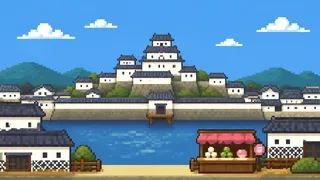
Himeji Castle is full of details that disappear when it is viewed only from a distance. Follow the rise of Himeyama Hill, the gates that interrupt the route, the openings in the walls, and the long spaces of Nishi-no-Maru to see how defense and daily life share one castle.
On a castle visit, a gate name becomes more useful when it is tied to the area it serves. Sakura Gate, Hishi-no-mon Gate, I-no-Mon Gate, and Nishi-no-Maru each belong to a different moment in the approach toward the keep.
This article reads the castle through three layers: the terrain and confusing approach route, the defensive openings and gates, and the keep complex and long rooms of the west bailey.
An approach route shaped by Himeyama Hill
Himeyama Hill and a complex, sharply turning approach route make a direct advance toward the keep difficult.
Himeji Castle on Himeyama Hill
Himeji Castle stands on Himeyama Hill. Thinking about the climb as part of the castle, rather than as a simple height statistic, makes the approach route easier to read: movement up the hill and movement through the grounds are both part of the defensive setting.
Source:How to enjoy Himeji Castle | Himeji Castle official site
The complex approach route
The grounds use a complex approach route with sharp turns intended to confuse an enemy. A visitor cannot simply draw a straight line to the keep; gates and baileys break the movement into stages and make distance and direction harder to judge.
Source:How to enjoy Himeji Castle | Himeji Castle official site
Gates and openings built for defense
Sakura Gate, Hishi-no-mon Gate, and I-no-Mon Gate mark the route, while loopholes and stone-drop openings address attackers near the walls.
Sakura Gate and Hishi-no-mon Gate
Sakura Gate stands at the entrance to Sannomaru, while Hishi-no-mon Gate is the well-known first gate visitors pass at the castle entrance. Remembering the two as landmarks in different explanations is more reliable than treating every gate name as an interchangeable label.
Source:Himeji City official tourism guideScale of Himeji Castle | Himeji Castle official site
Loopholes and stone-drop openings
Loopholes were used for attacking with bows and guns, while stone-drop openings were meant for attacking enemies approaching the walls. Both are easy to miss in a broad view, yet each small opening records a particular defensive action.
Source:Chapter I: Official World Heritage Himeji Castle guide
The keep complex and the west bailey
The connected keep complex joins the main keep and three subsidiary keeps, while Nishi-no-Maru contains Hyakken Corridor and Kesho-yagura.
The connected keep complex
Himeji Castle's keep complex consists of the main keep and three subsidiary keeps, joined as a connected keep complex. The main keep is therefore not an isolated tower: the connected arrangement of keeps and watari-yagura is central to the castle's architectural identity.
Hyakken Corridor and Kesho-yagura
Nishi-no-Maru is the west bailey, where Hyakken Corridor is known as the long row of rooms. Kesho-yagura, also in the west bailey, is associated with Princess Sen. Together they add long interior movement and personal history to a castle often described only through its defenses.
Source:How to enjoy Himeji Castle | Himeji Castle official siteSpecial exhibitions at Himeji Castle | Himeji Castle official site
FAQ
Why is the approach route at Himeji Castle so complex?
It was designed to confuse attackers and prevent a straight advance toward the keep. Sharp turns, multiple gates, and separated baileys make direction and distance difficult to read.
What were loopholes and stone-drop openings for?
Loopholes allowed defenders to attack with bows and guns, while stone-drop openings targeted enemies close to the walls. The two facilities represent different defensive actions.
What can be found in Nishi-no-Maru?
Nishi-no-Maru contains Hyakken Corridor, known as a long row of rooms, and Kesho-yagura, which is associated with Princess Sen. It adds residential and personal history to the defensive route.
How many keeps make up the keep complex?
The complex has one main keep and three subsidiary keeps, four keep buildings in all. They are joined in a connected arrangement rather than standing as one isolated tower.