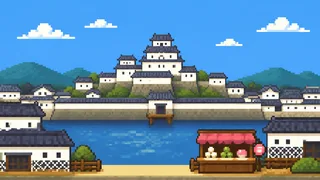
Clear the Himeji Local Quiz and earn the Himeji Local title. Want to know Himeji even better, or already confident? The tougher courses are next.
How well do you really know the White Heron? This quiz covers Himeji Castle from its defensive design — the maze of gates, the openings cut into its walls, the long corridor of the Nishinomaru — to the white plaster finish and World Heritage standing of the main keep. Then it steps outside the walls: Engyoji temple on Mount Shosha, the Ichikawa river crossing the city, the summer Yukata Festival, and Himeji oden eaten with ginger soy sauce. The ranks climb from common knowledge to questions that reward a slow walk through the castle grounds. The daily challenge question shows you how the quiz is angled before you commit.
Q1.What is Himeji Castle's well-known alternate name?
Black Egret Castle
White Egret Castle
Silver Egret Castle
Blue Egret Castle
Reveal the correct answer
Correct answerWhite Egret Castle
Himeji Castle earned the nickname White Egret Castle because its main keep and surrounding towers, finished in white plaster, were likened to a white heron spreading its wings in flight. That nickname has since become the shorthand the city itself is known by, well beyond castle enthusiasts.
Q2.In what year was Himeji Castle registered as a World Heritage Site?
1983
2013
2003
1993
Reveal the correct answer
Correct answer1993
Himeji Castle was inscribed as a UNESCO World Heritage Site in 1993, alongside Nara's Horyuji Temple, making the pair the first properties in Japan to receive that designation. The recognition reflects how rare it is for a wooden castle of this scale to survive largely unaltered into the present day.
Q3.Which well-known gate do visitors pass first at the entrance to Himeji Castle?
Water Gate
Ote Gate
Sakura Gate
Hishi-no-mon Gate
Reveal the correct answer
Correct answerHishi-no-mon Gate
Hishi-no-Mon is the imposing two-story gate that marks where the approach to the keep truly begins, just past the Sannomaru grounds; it ranks among the largest surviving gates anywhere in the castle. Diamond-shaped crests carved into its beams, from which it takes its name, still hint at the decorative taste of the Momoyama era.
Q4.In what year was Himeji Castle designated a National Treasure?
1961
1945
1951
1931
Reveal the correct answer
Correct answer1931
Himeji Castle was first designated a National Treasure in 1931 under the old preservation law, and received that status again in 1951 once Japan's postwar Cultural Properties Protection Law took effect. The re-designation reflected renewed recognition of how significant its main keep and surrounding buildings are as heritage architecture.
Q5.In what year was Himeji Castle's main keep completed?
1580
1600
1639
1609
Reveal the correct answer
Correct answer1609
Today's main keep at Himeji Castle was built by Ikeda Terumasa, who was awarded the castle for his role at the Battle of Sekigahara and spent nine years, from 1601 to 1609, rebuilding it on a far grander scale. He expanded on the three-story keep Toyotomi Hideyoshi had raised there decades earlier.