Amakusa's Sea and Its Dolphins
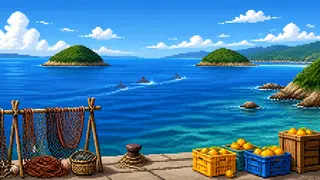
Amakusa's sea has two faces: a tourist sea where wild dolphins gather off Tsuji-shima, and a working sea where the people of Ushibuka have earned their living by fishing. This article introduces how dolphin watching began and what manners support it, alongside the working face of the fishing town of Ushibuka.
Amakusa's sea is a tourist destination and a fishing ground at once. The waters where wild dolphins settle and the waters that hold one of Japan's leading fishing ports are, in fact, the same sea.
This article introduces, with sources, how the Indo-Pacific bottlenose dolphin population and dolphin watching began, alongside the fishing industry of Ushibuka port.
Glossary terms covered here: Indo-Pacific bottlenose dolphin, dolphin watching, Tsuji-shima, Ushibuka, Ushibuka Port, Goshoura Dinosaur Island Museum
A Sea Shared With Wild Dolphins
Wild Indo-Pacific bottlenose dolphins live year-round off Itsuwa, and Amakusa's dolphin watching, run as tourism since the early 1990s, observes this resident pod at a respectful distance.
Indo-Pacific bottlenose dolphinMinami-handou Iruka
A population of wild Indo-Pacific bottlenose dolphins lives year-round in the waters off Itsuwa, Amakusa City. A pod settling in the same waters throughout the year is considered unusual in Japan, and Amakusa's dolphin watching observes exactly this pod. Despite its similar-sounding name to the plain bottlenose dolphin, it is formally recognized as a distinct species.
Source:イルカウォッチング
Dolphin WatchingIruka Watching
Dolphin watching in Amakusa began as a tourism business in the early 1990s. Today several inns and boat operators run observation cruises, and Amakusa City, under the goal of "a sea kind to both people and dolphins," works on rules such as boat speed and approach distance to maintain space from wild animals. The premise throughout is that visitors are observing wildlife, not touring a managed attraction.
Source:人にもイルカにも優しい海の実現
Tsuji-shimaTsuji-shima
Off the northern point of Shimo-shima, reached by the Tsuji Bridge, sits the small island of Tsuji-shima. The waters just offshore hold a dolphin pod that stays through the year, which is why the island counts among the region's dolphin-watching hubs. Many observation boats, however, actually depart from other ports on Shimo-shima such as Futae, so it is worth noting that Tsuji-shima itself is not always the boarding point.
Source:通詞島
The Working Sea of Ushibuka
Ushibuka, a natural harbor at the southern tip of Shimo-shima, is a working fishing town whose port also ranks among Japan's leading producers of zabushi fish flakes.
UshibukaUshibuka
At the southern tip of Shimo-shima, facing the East China Sea, sits the port town of Ushibuka. Its ria coastline, sheltered on three sides by the sea, formed a natural harbor, and the town grew around deep-sea and offshore fishing. It is described as offering a wide range of seafood, including red sea bream, silver-stripe round herring, and sea urchin, along with active aquaculture of sea bream and yellowtail.
Source:天草牛深に来んね!
Ushibuka PortUshibuka Kou
Ushibuka Port is one of Kumamoto Prefecture's largest fishing ports, shipping fresh seafood nationwide, and it also ranks among Japan's leading producers of zabushi, smoked-and-dried fish flakes other than bonito, such as mackerel and sardine flakes. Apart from the dolphin watching it is known for as a tourist spot, it shows that Amakusa's sea is also a working sea.
Source:天草牛深に来んね!
An Island Where an Ancient Sea Left Its Fossils
The Goshoura Dinosaur Island Museum, reopened in March 2024, holds roughly 2,000 fossils of dinosaurs and marine creatures unearthed from Cretaceous strata.
Goshoura Dinosaur Island MuseumGoshoura Kyoryu no Shima Hakubutsukan
Set against today's sea, where wild dolphins swim, is the record of an ancient sea preserved at Goshoura. The Goshoura Dinosaur Island Museum reopened in March 2024 as a full renewal of the former Goshoura Cretaceous Museum, displaying roughly 2,000 fossils of dinosaurs and marine creatures, including ammonite fossils, unearthed from Cretaceous strata. The same Amakusa sea links two stories separated by some 100 million years.
Source:御所浦恐竜の島博物館
FAQ
Can anyone join a dolphin-watching tour?
Yes. Several inns and boat operators run tours, and some accept same-day bookings. Check each operator's information for departure ports and tour length.
Are the Indo-Pacific bottlenose dolphin and the common bottlenose dolphin the same species?
No, they are different species. Their similar names cause frequent confusion, but the pod resident in Amakusa's waters is formally the Indo-Pacific bottlenose dolphin.
Is Ushibuka a tourist port or a fishing port?
Both. Ushibuka Port has a leading domestic track record as a fishing base, while the town is also known for tourism as the birthplace of Ushibuka Haiya-bushi.