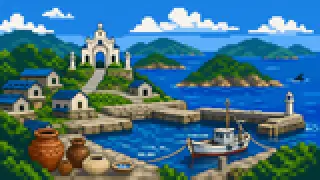
Amakusa Local Quiz Practice: Questions and Explanations
40QEasyIntermediateAdvanced
Review questions from the real quiz with answers, explanations and sources. Think it through first, then reveal the correct answer.
This is a selection from the question pool — the real quiz also draws questions you won’t find here.
Last updated: 2026-09-21
EasyTier 1 — 10 questions
Cross the bridges first, and start by meeting the islands through ten questions: the five bridges of Amakusa Gokyo linking Amakusa-Kamishima and Amakusa-Shimoshima, the waters where kuruma prawn aquaculture began, Amakusa Champon among Japan's three great champon dishes, the wild dolphins settled off Tsuji-shima, and the Sakitsu settlement's World Heritage status. These are the fixtures of any travel guide, asked with one extra step of precision. Answer all ten correctly and you could guide a visitor around the islands yourself. Open each answer to see the reasoning and sources behind it.
Q1.What are the two large islands at the core of the Amakusa archipelago that make up Amakusa City?
Tanegashima and Yakushima
Etajima and Miyajima
Shodoshima and Naoshima
Amakusa-Kamishima and Amakusa-Shimoshima
Reveal the correct answer
Correct answerAmakusa-Kamishima and Amakusa-Shimoshima
Amakusa City is centered on the two large islands of Amakusa-Kamishima and Amakusa-Shimoshima, but the wider archipelago counts well over 120 islands in total. The two main islands are linked to each other and to the Kyushu mainland by the five bridges of Amakusa Gokyo, and Amakusa-Shimoshima is also home to Amakusa Airport.
Q2.What is the collective name for the five bridges linking Amakusa to the Kyushu mainland?
Shimanami Kaido
Amakusa Gokyo (Five Bridges)
Amakusa Ohashi
Seto Ohashi
Reveal the correct answer
Correct answerAmakusa Gokyo (Five Bridges)
Amakusa Gokyo is the collective name for five bridges, Tenmon, Oyano, Naka-no-hashi, Maejima, and Matsushima, that link Misumi on the Kyushu mainland to Amakusa-Kamishima. The bridges opened in 1966 and are also nicknamed the Amakusa Pearl Line, after the pearl farming once thriving in the waters below.
Q3.What is the nickname of the aircraft operated by Amakusa Airlines?
Tsubasa-go
Hayabusa-go
Mizoka-go
Kamome-go
Reveal the correct answer
Correct answerMizoka-go
Amakusa Airlines' single aircraft is nicknamed Mizoka-go, meaning cute in the Amakusa dialect. The airline began flying between Amakusa and Fukuoka on March 23, 2000, and later upgraded to an ATR42-600, relaunched as the new Mizoka-go.
Q4.Alongside Nagasaki and Obama champon, which Amakusa specialty is counted among Japan's "three great champon"?
Amakusa Soba
Amakusa Champon
Amakusa Udon
Amakusa Ramen
Reveal the correct answer
Correct answerAmakusa Champon
Amakusa Champon ranks alongside Nagasaki Champon and Obama Champon as one of Japan's three great champon noodle dishes. Its broth is made from the bones of Amakusa Daio, a branded local chicken, and it remains a soul-food dish beloved as home cooking across the region.
Q5.Also known as Kawachi bankan, which citrus fruit represents Amakusa in summer?
Amakusa kumquat
Amakusa mikan
Amakusa bankan
Amakusa yuzu
Reveal the correct answer
Correct answerAmakusa bankan
Amakusa bankan, also called Kawachi bankan, is the citrus fruit that defines Amakusa's summer. It originated as a chance natural hybrid of pomelo found in Kawachi, Kumamoto City, in 1935, and is grown across several regions under different local names, thriving in Amakusa's mild climate.
Source:田尻農園
Q6.What is the arcade shopping street in the center of Hondo, Amakusa City, called?
Motomachi Shopping Street
Chuo Market
Gintengai
Honmachi-dori
Reveal the correct answer
Correct answerGintengai
The Hondo Central Shopping Street, known as Gintengai, is the only all-weather covered arcade shopping street on the islands of Amakusa. Its arcade roof was completed in the 1970s, and it has long anchored commerce and foot traffic in Hondo, Amakusa City's central district.
Q7.Which festival, centered on Ushibuka Port in Amakusa City, is held every April?
Ushibuka Haiya Festival
Amakusa Shiro Festival
Amakusa Great Pottery Market
Sakitsu Lantern Festival
Reveal the correct answer
Correct answerUshibuka Haiya Festival
The Ushibuka Haiya Festival is held every April around Ushibuka Port and traces its roots to the Haiya-bushi song, once sung at banquets entertaining visiting sailors. It has a long history spanning many decades, and the song itself is considered the root of Haiya and okesa lineage folk songs found across Japan.
Q8.About how high is the year-round dolphin sighting rate on Amakusa's dolphin watching tours?
Over 90%
About 30%
About 50%
Under 10%
Reveal the correct answer
Correct answerOver 90%
Amakusa's dolphin watching tours run year-round with a sighting rate of over 90 percent. About 200 wild Indo-Pacific bottlenose dolphins live permanently in the waters off Tsuji-shima, making it one of the few places where boats can reliably approach dolphins in the wild.
Q9.The Sakitsu settlement in Amakusa City is a component asset of which World Heritage site?
Sites of Japan's Meiji Industrial Revolution
Sacred Sites and Pilgrimage Routes in the Kii Mountain Range
Historic Monuments of Ancient Kyoto
Hidden Christian Sites in the Nagasaki Region
Reveal the correct answer
Correct answerHidden Christian Sites in the Nagasaki Region
The Sakitsu settlement is registered as a World Heritage component asset of Hidden Christian Sites in the Nagasaki Region. The settlement's landscape is valued for preserving the memory of a fishing community's life and faith during the era of Christian prohibition, and the church inside it remains in active use for worship today.
Q10.What does "mizoka" mean in the Amakusa dialect?
Lonely
Delicious
Noisy
Cute
Reveal the correct answer
Correct answerCute
Mizoka in the Amakusa dialect means cute. The Amakusa dialect varies its sentence endings by district and is said to include more than 50,000 words in total.
The next fifteen move into territory where even people born and raised on these islands hesitate: the name of Amakusa Gokyo's first bridge, the exact date Amakusa Airlines began flying, the story behind Sakitsu's specialty confection Sugi Yokan. This is the gap between recognizing a name and knowing what sits behind it. Where history or geography is involved, the prompts carry a date or place name as a handhold; when unsure, try redrawing how the islands, bridges, ports, and flight routes connect on a map.
Q11.How does Amakusa City rank in land area among municipalities in Kumamoto Prefecture?
5th largest
2nd largest
Outside the top 10
Largest in the prefecture
Reveal the correct answer
Correct answerLargest in the prefecture
Amakusa City covers about 683 square kilometers, making it the largest municipality in Kumamoto Prefecture. It was formed in 2006 through the merger of two cities and eight towns, inheriting the combined footprint of all ten former municipalities.
Amakusa City was formed on March 27, 2006, through the merger of Hondo City, Ushibuka City, and other municipalities, ten in total, two cities and eight towns. The merger made it Kumamoto Prefecture's largest municipality by area and its third most populous.
Q13.What is the name of Amakusa Gokyo's Bridge No. 1?
Maejima Bridge
Tenmon Bridge
Naka-no-hashi Bridge
Oyano Bridge
Reveal the correct answer
Correct answerTenmon Bridge
Bridge No. 1 of the Amakusa Gokyo is named Tenmon Bridge. It is the first bridge crossed from the Misumi side of the Kyushu mainland, has served as Amakusa's gateway since the crossing opened in 1966, and marks the starting point of the pearl-farming-themed Amakusa Pearl Line.
Q14.Why is Amakusa Gokyo nicknamed the "Amakusa Pearl Line"?
The bridges shine white
The sea appears pearl-colored there
Pearl farming once thrived in the area
Construction costs were extremely high
Reveal the correct answer
Correct answerPearl farming once thrived in the area
Amakusa Gokyo is nicknamed the Amakusa Pearl Line because pearl farming once flourished in the archipelago's ria coastline, dating back to the Meiji era. Fewer farms operate today, but the bridges' nickname still preserves that history along the waters they cross.
Q15.Which Nagasaki Prefecture port does the Shimatetsu Ferry connect to from Onike Port in Itsuwa, Amakusa City?
Mogi Port
Kuchinotsu Port
Ioujima Port
Nagasaki Port
Reveal the correct answer
Correct answerKuchinotsu Port
The Shimatetsu Ferry connects Onike Port in Itsuwa, Amakusa City, with Kuchinotsu Port in Minamishimabara, Nagasaki Prefecture, in about 30 minutes. The route offers a much shorter crossing between Amakusa and the Shimabara Peninsula than driving, serving both tourists and daily commuters.
Q16.Who reportedly taught the recipe for Sakitsu's specialty "Sugi Yokan"?
An envoy delegation from the Ryukyu Kingdom
A monk who came from Tang China
Dutch merchants
Portuguese missionaries
Reveal the correct answer
Correct answerAn envoy delegation from the Ryukyu Kingdom
Sakitsu's specialty Sugi Yokan is said to originate from an envoy delegation of the Ryukyu Kingdom, shipwrecked at Sakitsu, who taught the recipe to local residents in gratitude for being rescued. The sweet takes its name from the cedar boards traditionally used to set it.
Q17.Around when did the Amakusa Daio chicken breed reportedly go extinct?
Early Meiji era
Early Showa era
Early Heisei era
Late Taisho era
Reveal the correct answer
Correct answerEarly Showa era
Amakusa Daio, a local Amakusa chicken breed, is said to have gone extinct in the early Showa era, before Kumamoto Prefecture began restoring it in 1992. It is an unusually large breed for a local chicken, prized for its long raising period and strong flavor.
Q18.What combination of facilities does Amakusa City's complex "Kokorasu" integrate?
A library, a health center, and a community center
A bank, a post office, and a city hall
A school, a gym, and a pool
A hospital, a police station, and a fire station
Reveal the correct answer
Correct answerA library, a health center, and a community center
Amakusa City's complex Kokorasu integrates the functions of a library, a health center, and a community center under a wooden roof built with locally grown Amakusa timber. The Central Library occupies its second floor, and the whole complex spans about 5,452 square meters.
Q19.What kind of setting was the Haiya-bushi song originally sung in?
Temple memorial services
School sports days
Banquets entertaining sailors calling at Ushibuka Port
Ceremonies inside a castle
Reveal the correct answer
Correct answerBanquets entertaining sailors calling at Ushibuka Port
Haiya-bushi originated as a song performed at banquets held to entertain sailors whose ships called at Ushibuka Port. Said to have originated in Ushibuka, it spread nationwide during the Edo period and is considered the root of regional Haiya-lineage folk songs, including okesa and jinku.
Source:牛深ハイヤ祭り保存会
Q20.How many times a year is the original Amakusa Shiro battle standard flag put on public display at the Amakusa Christian Museum?
On permanent display
12 times a year
4 times a year
Once a year
Reveal the correct answer
Correct answer4 times a year
The Amakusa Shiro battle standard flag, designated a national Important Cultural Property in 1964, is shown as an original only four times a year, the first week of March, May, August, and November, at the Amakusa Christian Museum.
The Amakusa dialect carries influences from Nagasaki and Nanban European culture, blending in a variety of borrowed words, alongside vocabulary that traces back to classical Japanese and the Kyoto dialect. Its sentence endings vary by district, and its vocabulary reportedly exceeds 50,000 words.
Q22.What are popular hometown tax gifts from Amakusa City?
Japanese black beef and Akoya pearls
Hokkaido cheese
Aomori apples
Shinshu soba noodles
Reveal the correct answer
Correct answerJapanese black beef and Akoya pearls
Popular hometown tax gifts from Amakusa City include Amakusa Kurogyu black beef, Akoya pearls, and the local chicken breed Amakusa Daio. All three are specialty products of Amakusa's sea and land, and the program also helps support the region's primary industries.
Q23.About how tall is the rock face on Goshoura Island known as the "Cretaceous Wall"?
About 200m
About 2m
About 2000m
About 20m
Reveal the correct answer
Correct answerAbout 200m
The Cretaceous Wall on Goshoura Island is a rock face about 200 meters tall, where Cretaceous-period strata are exposed in the open. Dinosaur fossils have also been found on the island, making it a popular site for observing strata and joining fossil-collecting experiences.
Q24.In what year was the Sakitsu settlement registered as a World Heritage site?
2000
2006
2018
2022
Reveal the correct answer
Correct answer2018
The Sakitsu settlement was registered as a World Heritage site in 2018, as a component asset of Hidden Christian Sites in the Nagasaki Region. The evaluation included Sakitsu Church within the settlement, preserving the memory of a fishing village's life and faith during the era of Christian prohibition.
Q25.What is distinctive about the interior of Sakitsu Church?
It is floored with tatami mats
It is floored with wooden boards
It has a dirt floor
It is carpeted
Reveal the correct answer
Correct answerIt is floored with tatami mats
Sakitsu Church is unusual in Japan for having a tatami-mat floor inside. It creates a distinctive worship space where visitors kneel on tatami before the altar, echoing the fishing village's everyday life.
The final fifteen form the gate before any claim to Amakusa expertise: what magistrate Suzuki Shigenari actually did to rebuild the islands after the Shimabara-Amakusa Rebellion, how Amakusa became the quarry behind Arita ware, what the Cretaceous strata beneath Goshoura Island reveal. Ordering and multiple-select questions are mixed in here, so scattered facts have to be reassembled along a timeline and a map. Clear this tier, and the top titles in the real quiz sit within reach.
Q26.In what year was Suzuki Shigenari appointed magistrate of Amakusa?
1700
1641
1637
1600
Reveal the correct answer
Correct answer1641
Suzuki Shigenari was appointed magistrate of Amakusa in 1641, after the Shimabara-Amakusa Rebellion was suppressed. He investigated actual production levels, lowered the assessed rice yield to match reality, and requested settlers from western daimyo to rebuild the war-ravaged region.
Q27.What share of Arita ware's raw material comes from Amakusa pottery stone?
About 30%
Under 10%
About 50%
Over 90%
Reveal the correct answer
Correct answerOver 90%
Over 90 percent of the raw material used in Arita ware comes from Amakusa pottery stone. Low in iron and prized for its whiteness, the stone has long supplied kilns in Arita, Hasami, and beyond, and it remains highly valued and still actively mined today.
Sakitsu Church was designed by Tetsukawa Yosuke, celebrated for his church architecture. A carpenter turned architect from Nagasaki Prefecture, he is credited with about 30 church buildings over his career, shaping the landscape of Christian heritage sites across the Amakusa and Nagasaki region.
Q29.In what year was Amakusa Airlines' aircraft updated to the ATR42-600 model?
2020
2016
2000
2010
Reveal the correct answer
Correct answer2016
In 2016, Amakusa Airlines upgraded its aircraft from the original Mizoka-go to an ATR42-600, relaunched as the new Mizoka-go. The plane's two engines even carry their own nicknames, Haru-chan and Kai-kun, adding to the affection locals hold for the aircraft.
Q30.Which is an actual vessel name of the Shimatetsu Ferry fleet?
Pearl Express
Amakusa Marine-go
Amakusa Maru
Ferry Amakusa II
Reveal the correct answer
Correct answerFerry Amakusa II
The Shimatetsu Ferry operates two vessels, Ferry Kuchinotsu and Ferry Amakusa II, connecting Onike Port and Kuchinotsu Port in about 30 minutes. The route serves as a lifeline between Amakusa and the Shimabara Peninsula for both tourists and local residents.
Q31.What is the maximum weight a male Amakusa Daio can reach?
About 1kg
About 12kg
About 3kg
About 7kg
Reveal the correct answer
Correct answerAbout 7kg
A male Amakusa Daio can reach up to 90cm in height and about 7kg in weight, making it an unusually large local chicken breed. It reaches an average of about 4kg after roughly 100 days of raising, and carries a history of extinction in the early Showa era followed by restoration since 1992.
Q32.What is distinctive about Amakusa Champon's noodles?
Thin noodles like pasta
Fried noodles like instant ramen
100% buckwheat noodles like soba
Thick, chewy noodles influenced by the local dish dago-jiru
Reveal the correct answer
Correct answerThick, chewy noodles influenced by the local dish dago-jiru
Amakusa Champon uses thick, chewy noodles influenced by the local dish dago-jiru, distinct from the noodles of its Nagasaki relatives. Its broth is made from Amakusa Daio chicken bones, and it is counted among Japan's three great champon dishes alongside Nagasaki and Obama champon.
Q33.About how old are the fossils found at Goshoura's Trigonia sandstone fossil collection site?
About 500 million years old
About 98 million years old
About 10,000 years old
About 1 million years old
Reveal the correct answer
Correct answerAbout 98 million years old
The Trigonia sandstone fossil collection site on Goshoura yields fossils from strata roughly 98 million years old, dating to the mid-Cretaceous. The island also has a 200-meter rock face called the Cretaceous Wall, and is known as a fossil island where dinosaur remains have also been found.
Q34.In which area of Amakusa City is the Amakusa Takarajima International Exchange Hall "Porto" located?
Goshoura
Ushibuka
Chuo-shincho (Hondo)
Sakitsu
Reveal the correct answer
Correct answerChuo-shincho (Hondo)
The Amakusa Takarajima International Exchange Hall Porto is located in Chuo-shincho, in the Hondo district, and houses a multipurpose hall, seminar rooms, and an exchange hall. Sitting in Amakusa's central urban area, it serves as a hub for international exchange and local events.
Q35.Besides the base amount, what extra is offered in Amakusa City's settlement incentive grant?
There are no bonuses
Child-rearing and telework bonuses
A retiree bonus only
A student-only bonus
Reveal the correct answer
Correct answerChild-rearing and telework bonuses
Amakusa City's settlement incentive grant, paid out as Amakusa Takarajima gift vouchers, comes with several add-on bonuses beyond its base amount, including child-rearing and telework bonuses, plus a regional bonus for those moving outside the Hondo urban planning area.
Q36.What edition number was the Ushibuka Haiya Festival held in 2025?
100th
10th
53rd
30th
Reveal the correct answer
Correct answer53rd
The 2025 edition of the Ushibuka Haiya Festival was its 53rd. Rooted in Haiya-bushi, a song once sung at banquets for visiting sailors, the festival traces back to a tune that spread nationwide during the Edo period and is considered the ancestor of regional Haiya-lineage folk songs like okesa.
Q37."Mizoka" is said to be a slurred form of what original word?
Kairashika
Yokanise
Megurashika
Mizorashika
Reveal the correct answer
Correct answerMizorashika
Mizoka, the Amakusa dialect word for cute, is said to be a slurred form of the older word mizorashika. It has become a symbol of the region, even lending its name to Amakusa Airlines' aircraft, and remains a widely loved piece of local dialect.
Q38.Which is NOT a requirement for beef to be called Amakusa Kurogyu?
Being born and raised in Amakusa
Having a meat quality grade of 3 or higher
Being raised solely on Hokkaido-grown feed
Feed being mainly Amakusa-grown
Reveal the correct answer
Correct answerBeing raised solely on Hokkaido-grown feed
To be labeled Amakusa Kurogyu, cattle must be born and raised in Amakusa, fed mainly on Amakusa-grown feed, and reach a meat quality grade of 3 or higher. The brand is managed by the Amakusa Livestock Agricultural Cooperative. There is no requirement that the cattle be raised solely on Hokkaido-grown feed, despite Hokkaido's reputation as a major dairy and beef-producing region.
Q39.Select what is actually part of the World Heritage component asset "Sakitsu settlement."
The Sakitsu settlement
Sakitsu Church (a building within the settlement)
Oe Church
Hara Castle ruins
Reveal the correct answer
Correct answerThe Sakitsu settlement / Sakitsu Church (a building within the settlement)
The World Heritage component asset is the Sakitsu settlement itself, and Sakitsu Church, standing within the settlement, is included as part of it. Oe Church, by contrast, is not a component asset, and the ruins of Hara Castle belong to a different prefecture, Nagasaki.
Among the main islands of the Amakusa archipelago, Amakusa-Shimoshima ranks largest by area, followed by Amakusa-Kamishima, Oyano-jima, and Goshourajima. Alongside the two islands that form Amakusa City, Goshourajima, known for its dinosaur fossils, is also counted among the archipelago's key islands.