Suwa Taisha's Four Shrines and the Onbashira Festival
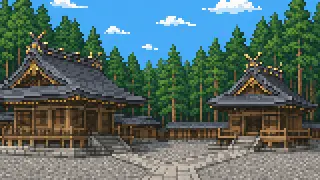
Suwa Taisha isn't one building; it's four shrines scattered across the basin.
Suwa Taisha consists of four shrines: Kamisha's Honmiya and Maemiya, and Shimosha's Harumiya and Akimiya. This article sets aside a general history of the Suwa area and focuses instead on how these four shrines relate to one another in space, and how the Onbashira Festival, held once every seven years by the old count, makes that relationship visible.
The Onbashira Festival tends to get reduced to its roughest moments. But at its core it's something else: over a thousand parishioners pulling great logs together, by hand, the region's own social fabric made visible, not just a scene of danger.
Four Shrines as One System: Kamisha and Shimosha, Two Paired Shrines
Kamisha pairs Honmiya and Maemiya; Shimosha pairs Harumiya and Akimiya. None of the four has a honden; each venerates nature itself.
Kamisha's Honmiya and Maemiya
Kamisha comprises two shrines: Honmiya, in Suwa City, and Maemiya, in Chino City. Maemiya is said to be the birthplace of Suwa's faith, an older sacred site, while Honmiya serves as Kamisha's center with a larger complex of halls. The two sit about 2 kilometers apart, meaning the single label 'Kamisha' actually holds two different faces from two different eras: an origin site, and the center built up around it later.
Shimosha's Harumiya and Akimiya
Shimosha comprises Harumiya and Akimiya, both within Shimosuwa Town. Harumiya venerates a cedar as its sacred tree, while neighboring Akimiya venerates a yew, different objects of worship even though the two sit close together under the single name 'Shimosha,' each keeping its own distinct form of faith.
Source:About Suwa Taisha
A Faith With No Honden
Honmiya, Harumiya, and Akimiya all lack a honden, the building that would normally house a shrine's deity; instead, each venerates nature itself, a mountain, or a sacred tree. The four shrines aren't the same architecture repeated in four places. What they share is that each keeps alive, in its own location, a faith centered on the mountain or tree already standing there.
Source:About Suwa Taisha
The Onbashira Festival's Route: From the Mountain to the Village
Every seventh year by the old count, in the Year of the Tiger or Monkey, Kamisha hauls its pillars some 25 kilometers and Shimosha about 20, entirely by hand.
Every Seventh Year, in the Tiger and Monkey Years
Formally called the Shikinen Zoei Onbashira Taisai, this is Suwa Taisha's largest rite, held every seventh year by the old count, in the Years of the Tiger and Monkey. Records trace organized, prefecture-wide service back to the reign of Emperor Kanmu in 804, and today roughly 200,000 parishioners across the Suwa area take part. Rebuilding the four shrines' halls and hauling great fir logs called onbashira up to the four corners of each shrine are the festival's two pillars, so to speak.
Source:The Grand Onbashira Festival
Yamadashi: Hauling Out of the Forest
Kamisha's eight pillars come from shrine-owned forest on Mount Oyakoya, about 25 kilometers away at the foot of Yatsugatake; Shimosha's eight come from national forest in Higashimata, continuing on from the Kirigamine highlands, about 20 kilometers away. The largest pillars run nearly 17 meters long and weigh about 13 tons, yet no vehicles or rollers are used; each pillar takes 1,000 to 2,000 people pulling together. Sliding down steep slopes and hauling across rivers look dangerous, but that's simply what pulling by human power and harmony looks like.
Source:The Grand Onbashira Festival
Satobiki and Raising the Pillars
In May's satobiki procession, the pillars advance toward their shrines alongside a colorful parade of mounted archers, decorated chests, and umbrella dances. Once hauled to a shrine's four corners, each pillar's tip is cut into a triangular point in a rite called kanmuri-otoshi; then, in the tateonbashira rite, it's raised upright by human power alone, parishioners still riding it as it rises. It's the moment a pillar carried for weeks from mountain to village finally becomes part of the shrine itself.
Source:The Grand Onbashira Festival
What the Festival Reveals About the Region's Structure
The sixteen pillars are assigned by parishioner district, and the treasure hall is rebuilt at Kamisha and Shimosha in alternating turns.
The Parishioner Organization Behind Sixteen Pillars
Sixteen pillars in all are raised, four at each of the four shrines. Since 1890, Kamisha has held a lottery on February 15 of the festival year to decide which district handles which pillar, and parishioners pray at Honmiya every morning from New Year's until the day before that lottery. Shimosha holds no such lottery, because its district assignments are fixed in advance. That difference shows two distinct ways of organizing parishioners coexisting within what looks like a single festival.
Source:The Grand Onbashira Festival
The Treasure-Hall Relocation Rite: Halls Reborn in Alternating Turns
The treasure hall that holds the sacred token of Suwa's deity is rebuilt at Kamisha and Shimosha in alternating turns with each Onbashira Festival. The rite marking the token's move to its new hall is called the treasure-hall relocation rite; Kamisha holds it on June 15, the month after satobiki, while Shimosha holds it the night before satobiki. Behind the festival's bustle over hauling pillars, the halls themselves are quietly being reborn as well.
Source:The Grand Onbashira Festival
FAQ
Isn't Suwa Taisha just one shrine?
No, it's four: Kamisha's Honmiya and Maemiya, and Shimosha's Harumiya and Akimiya, together called Suwa Taisha. Visiting all four in sequence, known as the Four Shrine Pilgrimage, is a well-known way to experience it.
How often is the Onbashira Festival held?
By the traditional count it's every seventh year; in practical terms that's once every six years, always in a Year of the Tiger or Monkey. Working from that count will tell you roughly when the last and next festivals fall.
The festival gets described as dangerous. What's it really about?
Dramatic moments like the yamadashi slope descent are real, but the festival's core is 1,000 to 2,000 parishioners pulling together by hand, with no vehicles or rollers, cooperative labor built on human power and harmony. Focusing only on the danger hides that cooperative structure.
Do Kamisha and Shimosha run the festival the same way?
No. Kamisha decides pillar assignments by lottery; Shimosha's are fixed in advance. Even the treasure-hall relocation rite falls on a different day at each, the month after satobiki at Kamisha, the night before satobiki at Shimosha.